Reviewed: 23 August 2026 · Written by Jay Jung
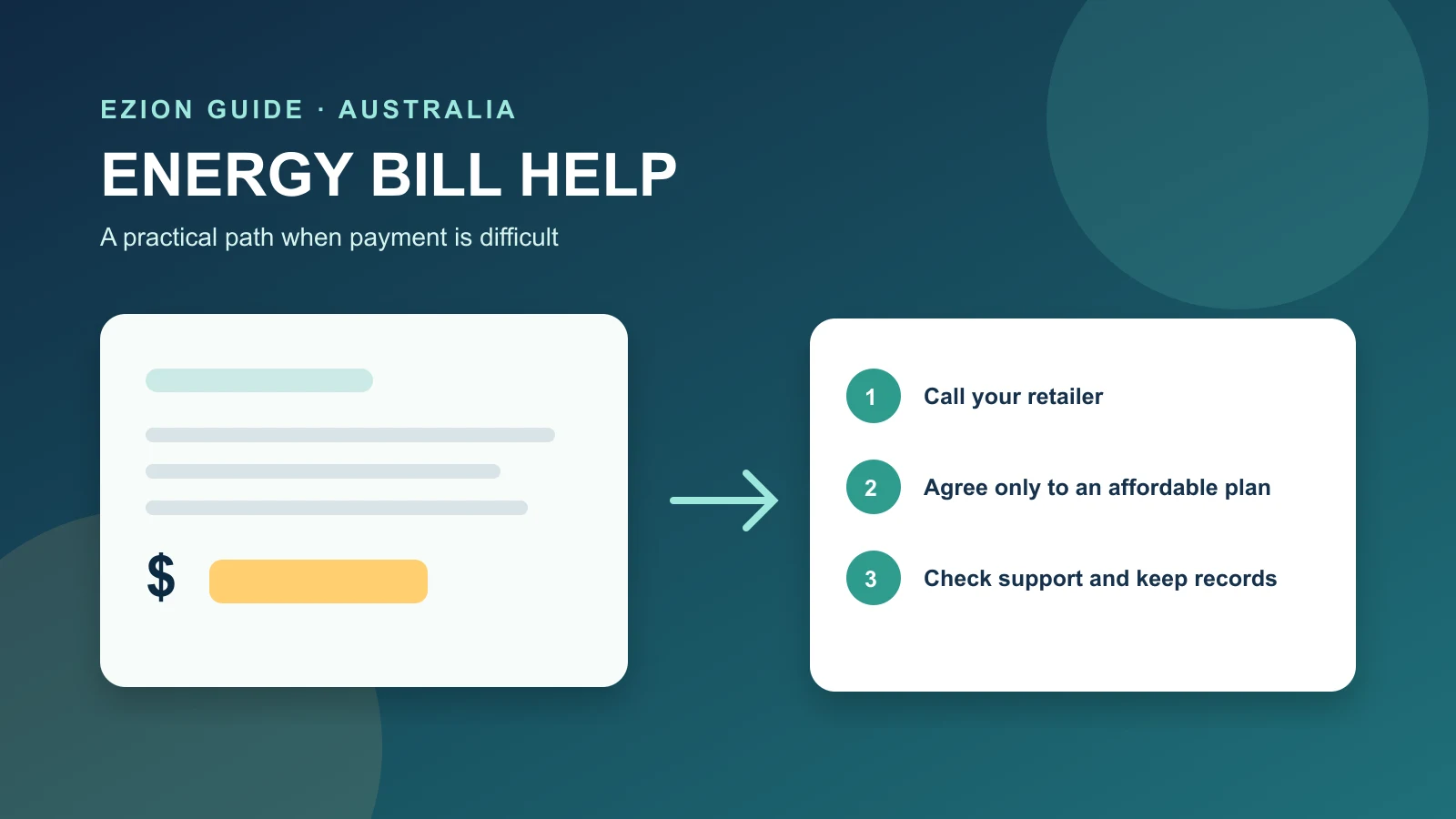
If an electricity or gas bill is more than you can pay, the useful first step is not to ignore it or rush into a new loan. Contact the retailer named on the bill, say plainly that you are having payment difficulty, and ask for an arrangement based on what you can actually afford.
If a payment or disconnection deadline is close
Call the number on the bill now. Tell the retailer if you have received a reminder or disconnection warning. Ask for its payment-assistance or hardship team, explain what amount you can manage, and request the next step in writing. Note the date, the representative’s name or reference number, and what was agreed.
You can use this script: “I am having difficulty paying this bill. Please explain my payment-assistance options and hardship program. I need an arrangement based on what I can afford while also covering ongoing energy use.” If speaking for yourself is difficult, ask whether an authorised support person can contact the retailer with you or on your behalf.
Do not assume that submitting an application elsewhere automatically pauses collection or disconnection activity. Keep the retailer informed. If electricity is needed for registered life-support equipment, tell the retailer and distributor immediately and follow the separate registration process that applies.
First check which consumer framework applies
Retail energy rules are not identical across Australia. The National Energy Customer Framework (NECF) applies in the Australian Capital Territory, New South Wales, Queensland, South Australia and Tasmania. Victoria has its own payment-difficulty framework. Western Australia and the Northern Territory use separate local arrangements.
The practical sequence in this guide—contact the retailer, request affordable help, check government assistance, keep records and use an ombudsman when needed—works as a starting point nationally. However, a specific legal protection described for NECF customers should not be assumed to apply unchanged in Victoria, WA or the NT. Check the regulator or ombudsman for your state or territory when the exact rule matters.
Step 1: tell the retailer before the problem grows
Energy Made Easy says retailers covered by the National Energy Retail Law must assist customers who are having payment difficulties. A retailer’s hardship program is intended for longer-term or recurring difficulty, while a payment extension or ordinary payment plan may suit a shorter interruption. You do not have to diagnose yourself with the perfect label before calling—describe the problem and ask the retailer to explain the available paths.
Give enough information to build a workable arrangement: the amount owing, when income is expected, what regular amount is realistic, and whether the difficulty is temporary or continuing. You do not need to promise money that is not available. A plan that looks tidy on paper but fails at the first instalment does not solve the problem.
Ask the retailer to check whether it can provide more time, smaller regular payments, entry to its hardship program, information about concessions, a review of whether a cheaper current offer is available, or referral to free financial counselling. Some options are required in particular frameworks; others depend on the retailer and circumstances, so ask rather than assuming every item is guaranteed.
Step 2: agree only to a payment plan you can sustain
A payment plan normally needs to address both the existing debt and the energy that the household will continue using. Energy Made Easy says the retailer should consider how much is owed, likely bills over the next 12 months and what the customer can afford. Before agreeing, write down the instalment, frequency, first payment date, expected ongoing charges and what happens if circumstances change.
Do not accept an amount merely because it avoids an uncomfortable conversation. Say what is affordable after essential housing, food, medicine and transport costs. If the proposed amount is not sustainable, explain why and ask for it to be reconsidered. If an agreed plan later becomes unaffordable, contact the retailer before missing the payment where possible.
In NECF jurisdictions, a residential customer who keeps to an agreed payment plan has protections from disconnection for non-payment. That is not a universal promise that one phone call prevents disconnection. The agreement must be clear, the payments must be maintained, and jurisdiction-specific rules still matter.
Step 3: check concessions and current government assistance
Concessions, rebates and emergency assistance vary by state, territory, account type and personal eligibility. Use the live energy.gov.au rebates and assistance index, then follow the listing to the agency that actually administers the program. Energy.gov.au is an information index; it does not approve or pay every listed benefit.
Do not rely on an old social-media post or previous bill credit. The federal Energy Bill Relief Fund ended on 31 December 2025, while state and territory programs continue to change. Ask the retailer whether a concession is already recorded correctly on the account, especially after moving home, changing retailer or receiving a new eligible card.
Step 4: NSW households can check EAPA
The NSW Energy Accounts Payment Assistance scheme, known as EAPA, is an assessed program for a current residential electricity or natural-gas bill when short-term financial hardship, crisis or emergency makes payment difficult. It is a NSW example, not a national rebate, and assistance is not automatic.
Service NSW says an applicant generally needs an unpaid bill for the current home, an open account, and authority to act for the account holder. Final bills, closed accounts, previous homes, business accounts and some forms of supply are outside the usual path. Some approved embedded-network customers may qualify, but provider participation can change; use the current official eligibility page rather than a copied list.
If you book an EAPA assessment, tell the retailer. The NSW guidance specifically says to contact the retailer so it knows that you are seeking help. Applying without communication should not be treated as a guarantee against disconnection. If assessed as eligible, assistance is applied to the energy account; this guide does not promise approval or a particular amount.
Step 5: respond to a disconnection warning immediately
Do not put a warning aside because the full balance is unavailable. Contact the retailer, identify the notice, ask what must happen to keep the account engaged in its assistance process, and request written confirmation. Keep copies of the bill, notice, emails, chat transcripts, payment receipts and complaint reference numbers.
Australian regulators describe disconnection for non-payment as a last resort, but rules and exceptions are detailed. Avoid broad claims such as “the retailer cannot disconnect you.” Instead, establish which framework applies, whether an agreed plan or hardship arrangement is active, and whether every required step has been followed. If the retailer will not explain the process or you believe a disconnection is wrongful, escalate urgently to the relevant energy ombudsman.
Step 6: make a complaint and use the ombudsman
Start with the retailer’s complaint process. State the outcome you need, attach the relevant notice or account record, and ask for a complaint reference. A short timeline is useful: when the bill arrived, when you requested help, what the retailer offered, why it was unaffordable or disputed, and any approaching deadline.
If the issue is not resolved, contact the energy ombudsman for your state or territory. Ombudsmen provide independent dispute resolution, but they do not guarantee that a debt will be cancelled or that every complaint will have the same outcome. The Energy Made Easy useful contacts page lists the relevant bodies.
The Australian Competition and Consumer Commission enforces competition and consumer law, but it does not resolve individual billing disputes. Its guidance directs customers to the retailer and then the local energy ombudsman.
Step 7: use free financial counselling if the pressure is wider
If rent, credit, tax, fines or other debts are competing with the energy bill, a free financial counsellor can help prioritise the situation and communicate with creditors. The National Debt Helpline is a free, independent and confidential service on 1800 007 007. It is not a lender and does not sell a debt-consolidation product.
A counsellor can help you prepare an affordable budget, understand options and organise evidence for a hardship request or complaint. This is different from paid debt-management advertising. If the situation involves immediate danger, family violence, homelessness or a medical emergency, use the relevant emergency or specialist service as well.
After the immediate problem is stable
Only then move to optimisation. Check the bill-reading guide if charges, meter readings or an estimate look wrong. Use the electricity-plan comparison guide before switching; moving retailer does not erase an existing debt. For longer-term household changes, the home energy guide covers efficiency without pretending that essential heating, cooling or medical use can simply be switched off.
Keep this checklist
- Bill, account number and current balance
- The regular amount you can genuinely afford
- Retailer call and complaint reference numbers
- Written payment or hardship arrangement
- Current concession and rebate checks
- Ombudsman details for your jurisdiction
- National Debt Helpline: 1800 007 007
Official sources
- energy.gov.au — If you are having trouble paying your electricity and gas bills
- energy.gov.au — Rebates and assistance
- Energy Made Easy — Having trouble paying your bill?
- ACCC — Problems with your energy company
- AER — Review of payment difficulty protections
- NSW Government — Get help with your energy bills
- Service NSW — EAPA common questions
Disclosure
This guide has no affiliate relationship and provides general information only. It does not guarantee assistance, eligibility, a particular dispute outcome, continued connection or savings. Programs and legal protections vary by jurisdiction and circumstances; confirm current details with your retailer, government agency, regulator, ombudsman or a qualified financial counsellor.