By Jay Jung · Reviewed 2 September 2026
A heat-pump clothes dryer can suit an Australian home that needs reliable indoor drying without the high electricity use typical of a conventional vented dryer. It recirculates warm air and recovers heat rather than continually heating replacement air. The trade-off is usually a higher purchase price, longer programs and more components to maintain. The right choice depends on load size, available space, drainage, cycle time and how often the household will actually use it.
This guide covers heat-pump, vented and conventional condenser dryers; capacity and installation; the Energy Rating Label; everyday operation; and maintenance. Use our appliance running-cost guide to turn labelled energy into an estimate at your tariff, our Energy Rating Label guide to compare like with like, and our rooftop-solar self-consumption guide before moving cycles into solar hours.
No universal saving: purchase prices, tariffs, load moisture, programs, climate and usage differ. This article has no affiliate links and does not recommend a brand. It does not guarantee a bill saving, fixed percentage reduction or payback period. Check the exact model documents, current government program rules and your own electricity plan.
How the three common dryer types differ
A vented dryer heats air, passes it through the load and expels warm moist air. It is mechanically simple and often cheaper to buy, but the room needs suitable ventilation and some installations need a duct to outdoors. Never discharge moisture into a closed cupboard or ignore the manufacturer’s clearance and venting instructions.
A conventional condenser dryer condenses moisture into a tank or drain instead of exhausting it outdoors. It can be easier to place than a vented model, but it still commonly uses electric resistance heat and releases some heat into the room. “Condenser” does not automatically mean “heat pump”; confirm the technology in the specification and registration record.
A heat-pump dryer is also a condensing dryer, but it transfers and reuses heat in a closed refrigeration loop. It generally does not need an outdoor exhaust duct. It still needs the clearances, ambient conditions and airflow stated by the manufacturer, and it produces condensate that must reach a tank or approved drain connection. A no-vent claim is not permission to seal the machine into an unsuitable cabinet.
Heat-pump drying usually operates at a gentler temperature and can take longer. That can suit many fabrics, but care labels remain the authority: do not tumble-dry an item that says not to, and use the specified low-temperature or delicate program where required. If rapid turnaround is essential, compare the actual Program Time and suitable load size rather than assuming every heat-pump model is equally slow or fast.
Choose capacity from real loads, not household labels
Dryer capacity is the maximum dry weight of laundry for the stated program, not the volume of wet washing that can be pushed into the drum. Start with the washing machine capacity and the loads you dry. A dryer that is much smaller may split one washed load into two cycles; one that is unnecessarily large may cost more and occupy more space without improving daily use.
- Count weekly loads. Record towels, sheets, uniforms and ordinary clothing separately for a normal fortnight.
- Notice the largest repeated load. Bedding and towels often set the practical requirement, but check whether the model permits that item and quantity.
- Leave tumbling room. Stuffing the drum can prevent air from moving through fabric, extend the cycle and produce uneven drying.
- Check program-specific limits. A machine advertised at 9 kg may allow less on mixed, delicate, wool or quick programs.
Do not size solely from broad labels such as “couple” or “large family”. A household that line-dries most clothes and uses a machine only for towels has a different requirement from one drying every load indoors. Compare candidates within the capacity band that covers your repeated loads, then compare labelled energy, time, noise, warranty and service access.
Measure the whole installation before buying
Measure width, height and depth at the actual location, including door swing, hoses, plug, skirting boards and required clearances. Measure every doorway, stair turn and lift used for delivery. If stacking, use only a compatible stacking kit and arrangement approved for both appliances; do not improvise a shelf or place a dryer where stability, controls or service access are compromised.
Confirm the power-point location and follow the manual. Do not use a damaged outlet, overloaded power board or extension lead as a permanent solution. If a new outlet or fixed electrical work is needed, use a licensed electrician. The floor must support the machine and allow it to remain level.
Choose between the condensate tank and direct drainage before installation. A tank makes placement flexible but must be emptied when indicated; a full tank may interrupt a cycle. A drain hose can remove that task, but it must follow the specified height, routing and connection method. A kinked, loose or incorrectly shared drain can cause faults or water damage. Check whether the supplied hose reaches and whether a plumber or approved fitting is required.
Heat-pump models generally do not require an outdoor exhaust vent, which can help apartments and internal laundries. They are not installation-free. Check permitted room temperature, ventilation around the cabinet, moisture management, noise, door access and any strata, rental or building requirements. Ask the manufacturer about enclosed-cupboard installation rather than relying on a retailer photo.
Read the Energy Rating Label carefully
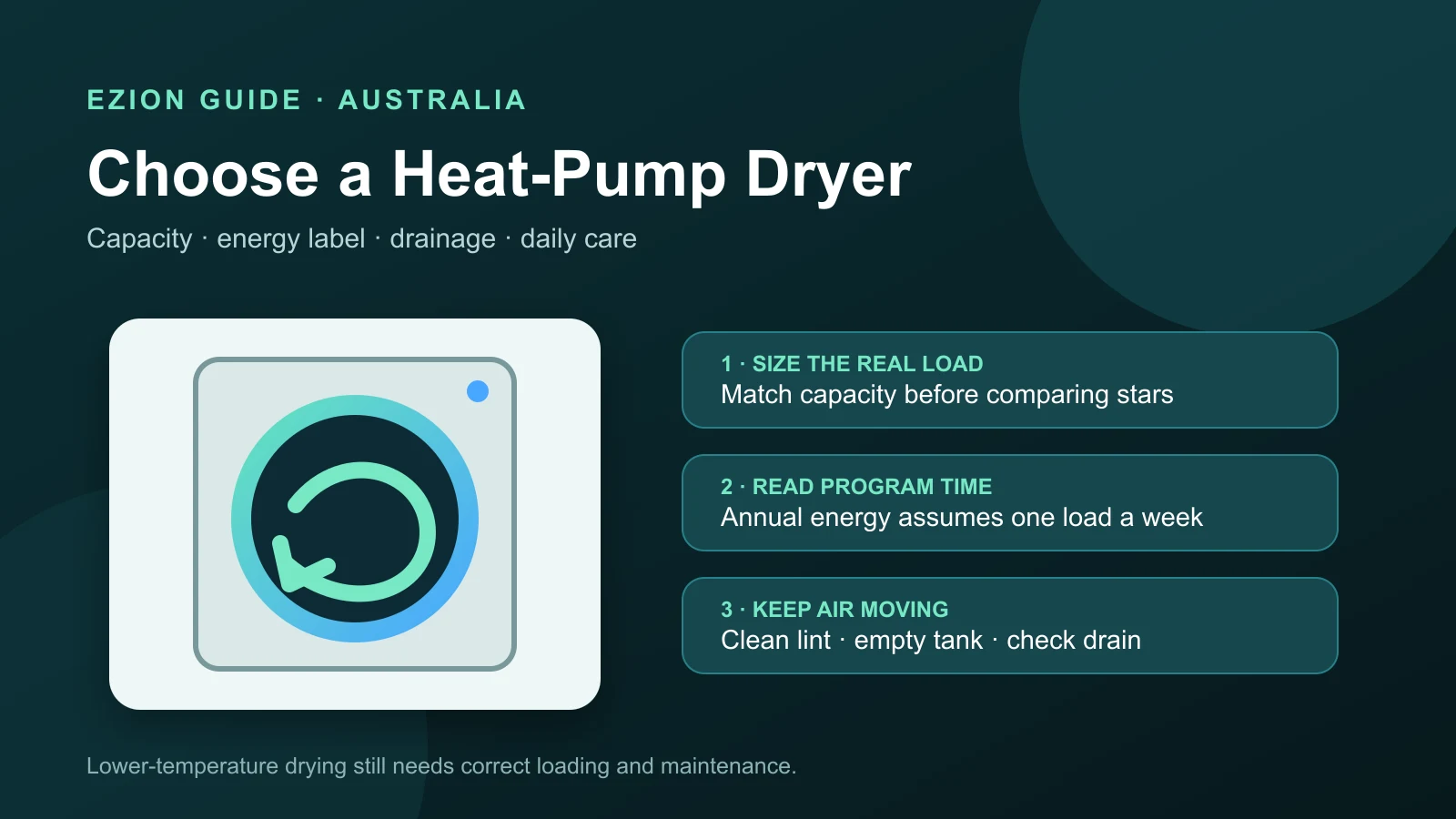
Compare exact model numbers. The star rating helps compare efficiency among comparable dryers, while the energy-consumption figure supports a cost estimate. Capacity matters: a larger efficient model can still use more energy than a smaller model, and a smaller machine that forces two cycles may not be the better household choice.
For clothes dryers, the label’s annual energy figure is based on an assumed use of one load per week under the regulated test. It is not a prediction of every household’s annual bill. If you normally run four loads per week, the label is still useful for ranking similar machines, but your consumption will not be represented by the once-weekly assumption. Program choice, starting moisture, load size, ambient conditions and maintenance all affect real use.
Check the label’s Program Time as well as stars and energy. It indicates how long the labelled program took under the test conditions. A long program may be acceptable overnight or during a workday but unsuitable between consecutive sports loads. Compare time only across genuinely comparable capacity and test conditions, then inspect manuals for the programs you expect to use.
The government Energy Rating Calculator can compare registered models, annual energy, indicative running costs and total cost inputs. Replace its default electricity price and usage assumptions where the tool allows, and treat the result as an estimate. A simple household estimate is labelled annual kWh multiplied by your usage rate, adjusted cautiously for how your weekly loads differ from the label assumption. Do not invent a payback from a single showroom sticker.
Reduce drying work before the cycle starts
The dryer must remove water left by the washer. Use the highest washing-machine spin speed that the fabric and machine instructions safely allow. A stronger final spin can leave less moisture for the dryer, though delicate fabrics may need a lower setting. Untangle items before loading, fasten covers as directed and separate heavy towels from light synthetics when mixed loads produce uneven results.
Use outdoor line drying or an indoor rack with safe ventilation when practical. Finish partly air-dried items in the dryer if needed rather than treating every load as all-or-nothing. Never place dripping-wet items, solvent-contaminated material, rubber-backed products or anything prohibited by the manual into the machine.
Load enough to use the drum effectively without packing it tight. Very small loads can be convenient but may use more energy per item; oversized loads can run longer and remain damp. Match the program to fabric and dryness required. “Cupboard dry” may be unnecessary for clothes that will be ironed, while under-drying items that will be stored can create odour or moisture problems.
Use auto-sensing, schedules and solar with limits
Moisture-sensing programs can stop when the target dryness is reached instead of running a fixed timer after the load is dry. Keep sensor surfaces clean as the manual directs, and do not assume the most aggressive dryness setting is best. If loads repeatedly stop damp, first check sorting, loading, spin speed, filters, sensor cleaning and program selection before adding time.
A built-in delay start can move a cycle to a convenient tariff or solar period, but only use delayed or unattended operation if the manufacturer permits it and the household’s fire-safety plan allows it. Do not use an unapproved external timer to switch a dryer. Avoid running a dryer while everyone is asleep or away if official fire-safety advice or the manual says it should be supervised.
Homes with rooftop solar can consider daytime drying when generation is available. Check the monitoring app because cloud, season and other appliances change the surplus. Stagger the dryer, dishwasher, electric hot water and EV charging instead of starting everything at noon. Self-consuming solar may avoid an import but also forgo an export credit, so the bill value depends on the plan; it is not “free” electricity in every financial comparison.
Lint, condensate and heat-exchanger care
Fire and Rescue NSW says to clean the clothes-dryer lint filter each and every time it is used. Follow that minimum and the model’s instructions. Switch the machine off as directed before maintenance, remove lint without damaging the mesh and refit the filter correctly. Never operate it with a missing or damaged filter.
Empty the water tank at the frequency stated by the manufacturer, often after each cycle or when indicated. Clean and inspect the drain arrangement if connected. Stagnant condensate, a blocked hose or a loose fitting can create odour, stoppages or leaks.
Heat-pump dryers may have additional filters, a condenser or heat-exchanger area that needs scheduled cleaning. Designs differ: some allow careful user access; others use a self-cleaning system or require service. Do not poke fins, remove panels or wash components unless the manual explicitly permits it. Reduced airflow can lengthen drying and strain the appliance. Vacuum around the machine, keep air openings clear and arrange authorised service for persistent faults, unusual noise, burning smells, repeated overheating warnings or damaged wiring.
Keep the laundry area’s smoke alarms and escape plan current. Stop using the dryer if it behaves abnormally. Do not try to trade fire safety for lower tariffs or solar timing.
Check current assistance, not old advertisements
Government support changes. As reviewed on 2 September 2026, the NSW Government washing-machines-and-dryers page stated that there was no current NSW Government incentive or rebate and no Australian Government incentive or rebate for these appliances. It also directed households to its Energy Savings Finder. Check the live page again before purchase because eligibility and program status can change.
Victoria publishes a Victorian Energy Upgrades clothes-dryer discounts page. A listing does not mean every buyer, property, retailer or model qualifies, or that an offer remains available. Check the current product requirements, approved-provider process, consumer rights, quote inclusions and disposal obligations before agreeing. Do not allow a discount to replace capacity, safety, warranty and total-cost checks.
A practical shortlist
- Record normal weekly loads and the largest load you repeatedly machine-dry.
- Measure the location, delivery path, clearances, door swing, power and drain.
- Shortlist comparable heat-pump models at the required capacity.
- Compare annual kWh, stars and Program Time using exact model numbers.
- Check tank and drain options, noise, filters, service access and warranty terms.
- Estimate cost with your tariff and realistic loads; include purchase, delivery and installation.
- Read the manual’s installation, prohibited-item, supervision and maintenance rules before paying.
- Recheck any government assistance on the day you accept a quote.
A heat-pump dryer is a strong candidate when indoor drying is frequent, space suits a condensing appliance and the household accepts longer cycles and regular care. It is not automatically the cheapest option for a home that rarely uses a dryer. Choose from the real load and site constraints, compare the regulated figures, then run the selected machine in a way that keeps airflow, lint control and fabric safety ahead of promised savings.
Official sources
- Energy Rating: Clothes dryers
- Your Home: Appliances
- Energy Rating Calculator: Clothes dryers
- NSW Climate and Energy Action: Energy-efficient washing machines and dryers
- energy.gov.au: Energy ratings
- energy.gov.au: Get the most from your solar system
- Fire and Rescue NSW: Home fire-safety checklist
- Victorian Energy Upgrades: Clothes-dryer discounts