Reviewed: 26 August 2026 | Author: Jay Jung
Home charging is less about buying the fastest box and more about building a routine that safely replaces the energy you actually drive away. Around 80% of reported EV charging in Australia occurs at home, while the average Australian drives about 33 km a day. Those figures explain why both a standard power point and a dedicated wallbox can be sensible—but for different homes, cars and parking arrangements.
This guide takes you through the decision in order: driving need, charging option, electricity supply, tariff and solar timing, permissions, installation, then a one-week check. It does not replace an electrical assessment or the instructions supplied with your vehicle and charging equipment.
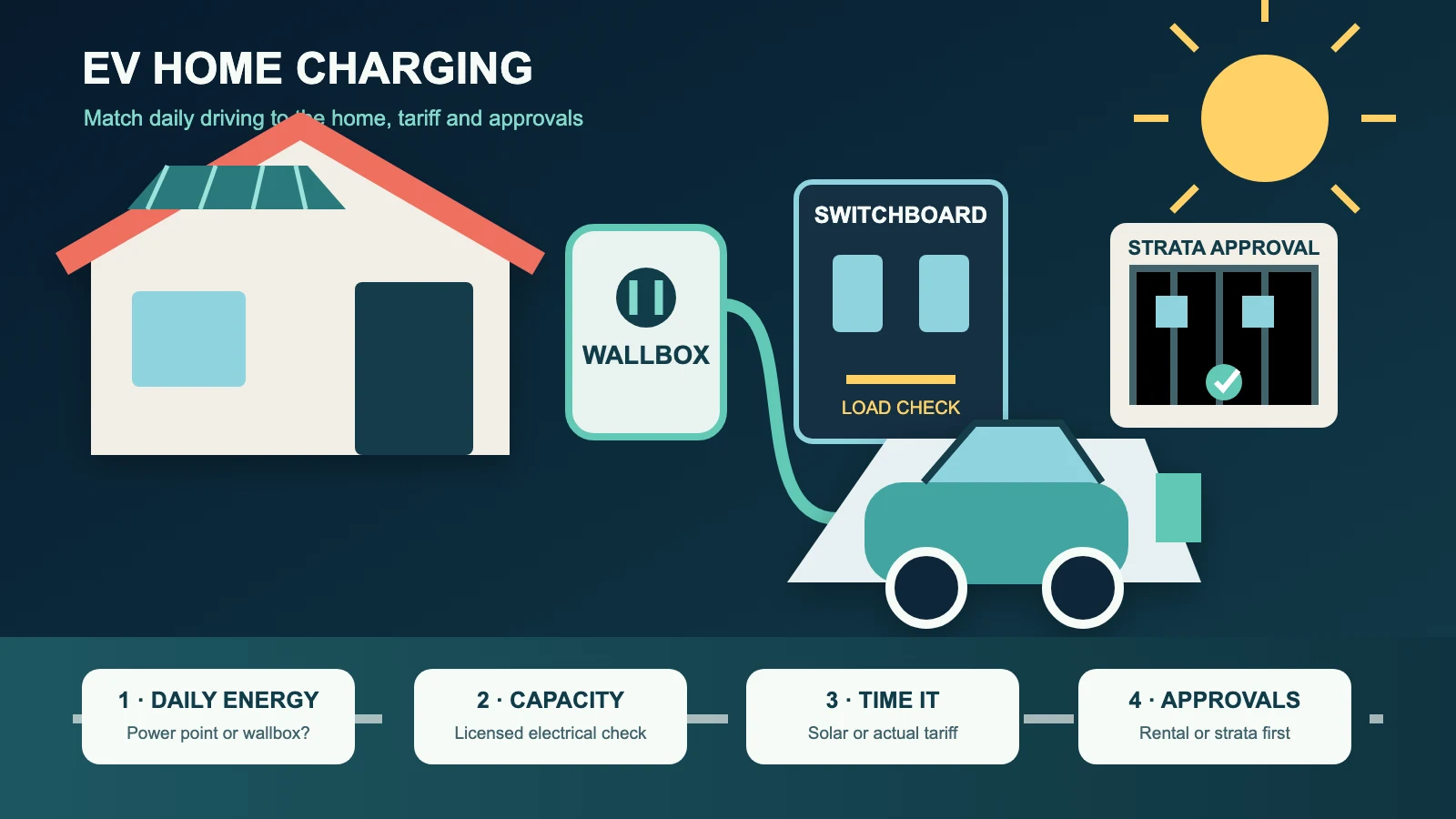
The decision sequence: start with the trip, not the charger
- Measure your routine. Note a typical day, the longest recurring day and how many hours the car is parked at home. Do not size the system around a rare road trip that can be handled by public charging.
- Check the vehicle. Record its battery capacity, recommended charge limits, AC connector and maximum AC acceptance rate. Australian home AC charging commonly uses Type 2, but the vehicle may accept less power than the wallbox can supply.
- Test whether Level 1 meets the routine. A compliant, suitable power point may be enough when daily travel is modest and the vehicle has a long overnight dwell time.
- Request an electrical assessment before choosing Level 2 power. A licensed electrician should assess the charging location, cable route, switchboard, available supply and protective requirements.
- Map charging to your real bill. Identify supply and usage charges and whether the usage tariff is single-rate, time-of-use or demand-based. “Off-peak” is not automatically the cheapest plan overall.
- Resolve ownership and permissions. Renters should get written landlord approval before fixed work. In strata, establish the owners corporation process before paying for detailed installation work.
- Commission and observe. Confirm settings, metering and safe operation over seven days rather than assuming the default configuration is right.
Level 1 power point or Level 2 wallbox?
Level 1: slower, simple and sometimes sufficient
Level 1 uses a standard 240 V power point and an appropriate EV charging cable. The federal guidance states a maximum of 2.4 kW and says a full charge can take up to 24 hours. That full-battery figure is not the daily question for most households: if you replace only the energy used that day, a slower connection may still finish before the next departure.
Choose this path only when the outlet and charging arrangement are suitable. Plug the charging cable directly into the wall outlet—never through an extension lead or power board. Have a licensed electrician advise whether the outlet, circuit and installation are appropriate for sustained EV charging, and follow the vehicle and cable manufacturer’s instructions.
Level 2: dedicated capacity and more control
Level 2 uses a dedicated AC charger, typically rated from 7 to 22 kW. It can provide faster charging and may support scheduling, solar matching or load management. The badge rating is not a promise of the rate your car will receive: charging is limited by the charger, the vehicle’s maximum acceptance rate, battery state of charge and battery temperature. A 22 kW unit paired with a vehicle that accepts less will charge at the lower available rate.
A wallbox must be installed by a licensed electrician, and the home may need switchboard or electricity-supply work. Faster is useful when the car returns late, leaves early, travels farther or must share limited charging hours. Otherwise, paying for unused power adds no practical value.
Battery charge limits are also vehicle-specific. Government guidance notes that keeping an EV around 20% to 80% can help battery life, but explicitly directs owners to the manufacturer’s recommendations. Treat that range as a general prompt, not an override for your model.
Calculate the energy and cost you need
Begin with energy replacement, not a full battery. If the car reports energy used for a trip, that is the best starting point. Otherwise estimate battery energy used as:
distance travelled × estimated vehicle efficiency (kWh/km) = estimated battery energy added
For a percentage-based estimate, use:
battery capacity × percentage points restored = estimated battery energy added
These are battery-side estimates. The electricity recorded at the meter will usually be higher because charging equipment, conversion, cabling, temperature control and standby operation can consume energy. Vehicle efficiency displays and nominal battery capacity are also estimates. Do not turn either formula into a promised bill amount.
The simplest defensible household cost calculation is:
metered charging kWh × the applicable tariff for those charging intervals
Use the charger’s meter, a compatible vehicle/app record or another suitable metering method, then reconcile it with actual invoices. Include a demand charge if your plan applies one; do not allocate the household’s existing daily supply charge to the EV unless comparing a plan change that alters that fixed charge. For broader methods, see our appliance running-cost guide. The Australian Government’s Green Vehicle Guide calculator can also estimate time and cost from charger rate, battery size and electricity price.
Assess the switchboard, circuit and supply
Give the electrician facts, not a preferred product alone: parking position, charger cable reach, vehicle specifications, desired charging window, existing solar or battery system, recent bills, switchboard photos and any planned electrification such as induction cooking or a heat pump.
Ask the electrician to assess the charging circuit, protective devices, earthing, cable route, weather exposure, mounting location, switchboard space and the property’s available supply. A dedicated charger may trigger a switchboard or supply upgrade. In a constrained home or apartment, dynamic load management may be more practical than reserving the charger’s full nameplate power at all times.
The charger should carry the Regulatory Compliance Mark (RCM). Ask who will configure the maximum current, what happens when household load rises, and what evidence of compliant electrical work you will receive. Charger selection and electrical design are connected decisions; neither should be finalised in isolation.
Use solar and tariffs intelligently
If rooftop solar is available, daytime charging can direct generation into the car rather than exporting it. The practical result depends on when the car is home, how much surplus solar remains after household loads and whether the charger can vary its rate. A fixed high charging rate can draw from the grid whenever solar output falls; solar-aware control or a lower scheduled rate may better match variable generation. Continue with our solar self-consumption guide for the wider household trade-offs.
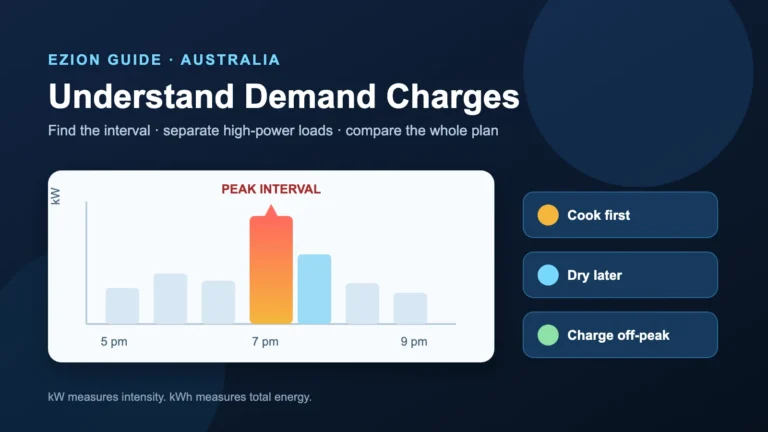
Without solar—or when the car is away during daylight—scheduling may shift charging to a lower-priced period. First read the actual offer. Electricity bills can include a daily supply charge and usage charges under single-rate, time-of-use or demand tariffs. A cheaper overnight usage rate can sit beside higher peak rates or a demand charge, so compare the whole household bill, not one attractive EV window. Our time-of-use tariff guide explains that broader comparison.
Smart charging should implement a decision already made from your tariff and routine. Set a departure target, charging window and current limit; avoid granting an app permission to charge whenever a marketing label says “off-peak.” Recheck settings after retailer, tariff, daylight-saving, Wi-Fi or firmware changes.
Renters, strata and apartment parking
A renter should obtain written landlord approval for a wallbox and clarify who owns it, pays for installation, restores the property and receives records at the end of the tenancy. If parking and the meter are not connected in an obvious way, resolve billing and cable routing before selecting equipment.
In strata-managed buildings, fixed charging generally requires an owners corporation process and compliance with applicable strata requirements. Begin with an energy assessment of the building: it can identify available capacity and upgrades. The owners corporation can then consider whether the approach is individual, shared or whole-of-building, how electricity is measured and recovered, who maintains the equipment, and whether load management is needed as more residents adopt EVs.
Do not treat one parking-bay installation as purely private if cabling crosses common property or uses common electricity. Obtain the required approvals before work starts. After installation, ensure the electrical compliance certificate and relevant charger, circuit, billing and maintenance records are supplied to the appropriate owner and retained by the building. For a wider home-energy decision framework, see the general home energy guide.
Installation quote checklist
- Exact charger model, RCM status, warranty and included cable or socket configuration.
- Vehicle compatibility, connector type and the maximum rate the vehicle can actually accept.
- Proposed circuit rating, configured charger limit and reason for that size.
- Switchboard, supply, protection, earthing and load-management work included or excluded.
- Cable route, trenching, penetrations, weather protection, mounting and parking-bay access.
- Solar, home-battery, tariff scheduling, metering, network and app configuration.
- Strata, landlord, network or other approvals that must exist before installation.
- Itemised fixed price, assumptions, variation process, lead time and who performs each trade.
- Testing, commissioning, user handover, electrical compliance certificate and records.
- Support responsibility if the charger, app, vehicle or energy-management integration fails.
Safe daily use
- Follow the vehicle and charger manufacturer’s operating, inspection and charge-limit instructions.
- For Level 1, connect directly to the suitable wall outlet; never use an extension lead or power board.
- Keep plugs, sockets and cables undamaged, clean, appropriately stored and protected from traffic or trip hazards.
- Stop using the equipment and seek qualified advice if there is damage, unusual heat, discolouration, smell, repeated tripping or an error that does not clear as instructed.
- Do not alter current limits, plugs, wiring or protective devices to bypass a fault or accelerate charging.
- Confirm the cable is disconnected and stored before driving away.
Your 7-day commissioning checklist
- Day 1: Have the installer demonstrate isolation, connection, app controls, current limit, schedule, fault response and documents.
- Day 2: Confirm the car reaches the required departure charge without unnecessary early charging.
- Day 3: Record charger or vehicle kWh and the tariff interval used.
- Day 4: Observe operation while other major household loads run; report tripping or unexpected load limiting.
- Day 5: If using solar, compare charging draw with available generation through changing conditions.
- Day 6: Inspect the cable path, plug, socket and mounting for heat, damage, water exposure or trip risk without opening electrical equipment.
- Day 7: Reconcile the week’s driving, metered kWh, schedule and tariff; adjust only user-configurable settings permitted by the manufacturer or ask the installer.
Official sources
- Australian Government — How to charge your electric vehicle
- Australian Government — Electric vehicle charging equipment
- NSW Government — Install a home electric vehicle charger (updated 9 July 2026)
- NSW Government — Making your apartment building EV ready (updated 4 December 2025)
- Australian Government — Find the best energy deal
- Australian Government Green Vehicle Guide — Home charging calculator