Reviewed: 17 August 2026 · Written by Jay Jung
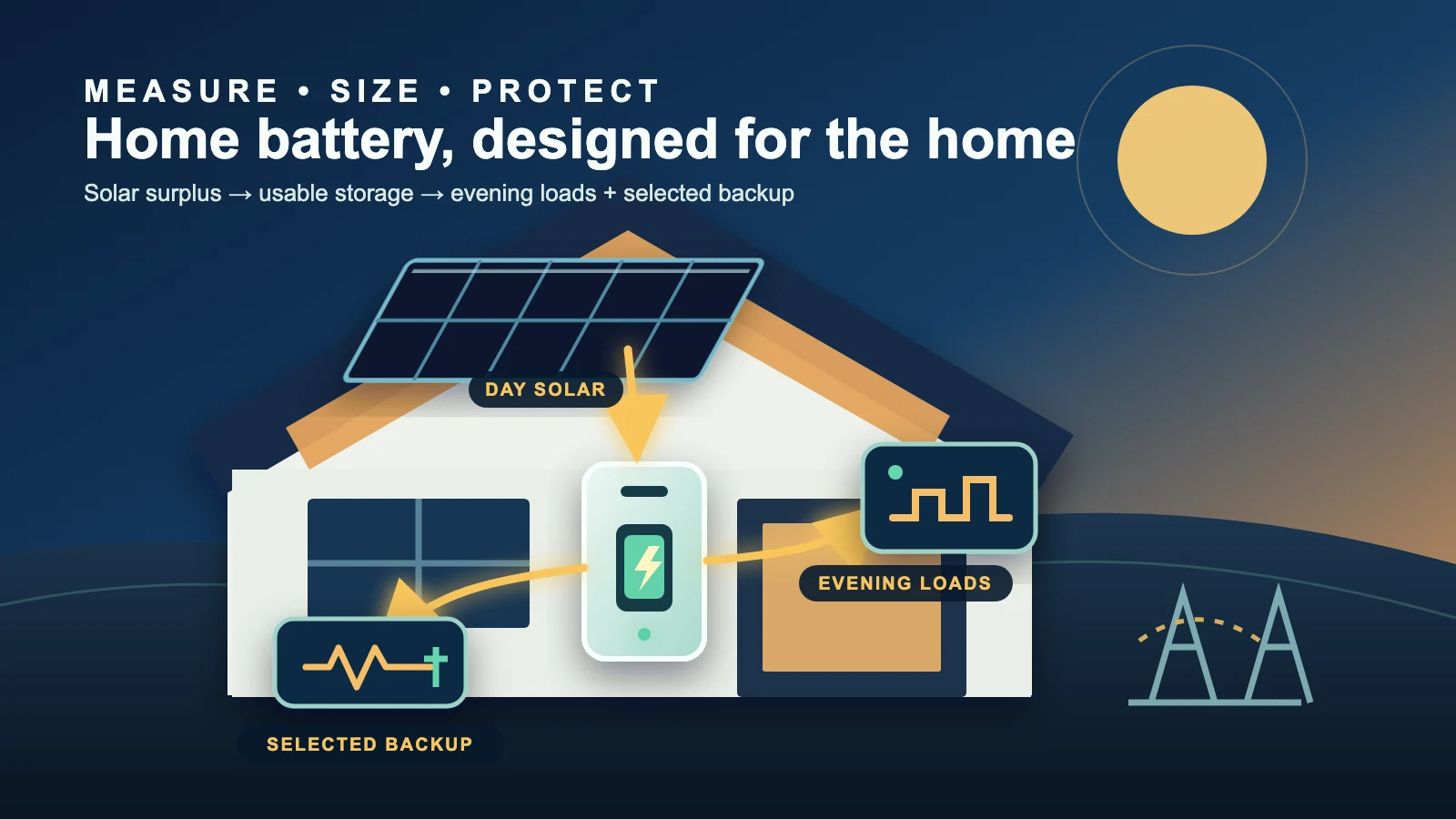
A home battery can move rooftop solar from the middle of the day into the evening, support selected circuits during some outages, and change how a household buys and exports electricity. It cannot create energy, erase supply charges or guarantee a lower bill. The useful question is not “How large a battery can I buy?” but “What usable capacity and output match my measured surplus solar, evening demand, backup priorities and tariff?”
Australia’s Cheaper Home Batteries Program can reduce the upfront price of an eligible installation. That support makes a fresh comparison worthwhile, but the discount is not proof that a particular battery is economical or suitable. This guide separates program eligibility from sizing, backup design, safety and household payback so an attractive rebate does not become the only buying criterion.
What the federal battery discount covers in August 2026
The Department of Climate Change, Energy, the Environment and Water says the program currently provides a discount of around 30% on eligible small-scale battery systems. Changes commenced on 1 May 2026. Support is delivered through small-scale technology certificates (STCs), is reviewed over time and is scheduled to decline as the scheme approaches 2030. “Around 30%” is therefore a program description, not a guaranteed percentage off every quote.
For the current eligibility settings, the battery system must generally be new, connected to a new or existing eligible solar PV system, and have 5–100 kWh nominal capacity. STCs are limited to the first 50 kWh of usable capacity. Grid-connected systems must be technically capable of participating in a virtual power plant; capability does not mean you must join one. Portable batteries and electric vehicles are not eligible under this program.
The battery must appear on the Clean Energy Council approved list and be installed by a Solar Accreditation Australia accredited installer with the relevant battery endorsement. Confirm the current rules before signing because products, certificate factors and eligibility can change. Ask the retailer to show the undiscounted price, estimated STC value, discounted price and assumptions separately. Do not treat a sales estimate as a government quote or approval.
Start with interval data, not a salesperson’s default size
Collect several weeks of smart-meter or inverter data, including ordinary weekdays, weekends and a season that matters to your household. Separate solar generation, export, grid import and total consumption where the system allows it. The battery’s everyday job is usually to absorb energy that would otherwise be exported and release it when the home would otherwise import.
Look at the recurring daytime surplus and the recurring demand after solar falls. If the home commonly exports 6 kWh but only imports 3 kWh before the next solar window, a much larger battery may sit partly unused. If evening demand is high but daytime surplus is low, the battery may need grid charging on an appropriate tariff or may cycle less than a sales forecast assumes. Weather, seasons, electric vehicles, heat pumps and future electrification can all move those numbers.
Our smart-meter guide explains how interval data and billing rights differ around Australia. Use the data as a design input, not as a promise: one sunny week is not a representative year.
Distinguish nominal capacity, usable capacity and power
Nominal capacity is the total energy the battery can hold. Usable capacity is the portion the control system permits you to use after reserve and depth-of-discharge limits. Compare usable kWh when estimating how long the battery can support household loads. The federal program’s 100 kWh eligibility ceiling uses nominal capacity, while its STC claim cap applies to the first 50 kWh of usable capacity.
Capacity in kWh is not the same as power in kW. A 10 kWh battery may store enough energy for several hours of modest loads but still be unable to start or run multiple high-power appliances together if the inverter’s continuous or surge output is too low. Ask for battery output, inverter output, surge limits, phase configuration and any export or network constraints in writing.
Reserve settings also matter. Keeping more energy for outages leaves less capacity for daily bill optimisation. A “10 kWh” label does not mean 10 kWh reaches household appliances after reserve, conversion losses and operating limits. Compare like with like and ask the installer to state the usable energy available in normal and backup modes.
A battery does not automatically provide blackout power
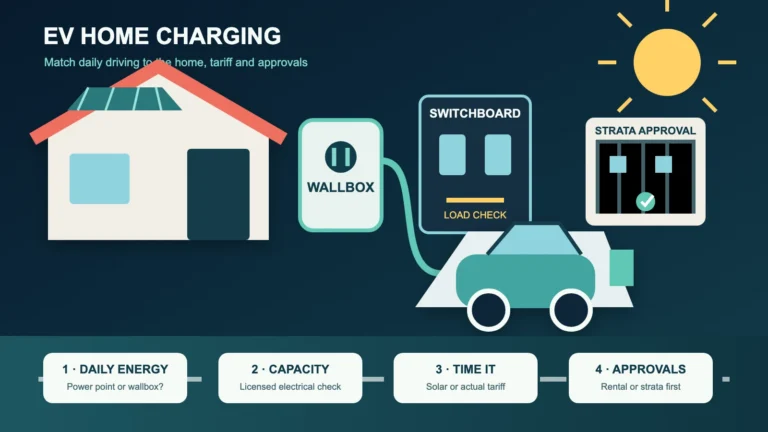
Standard grid-connected solar normally shuts down during a network outage to protect workers and equipment. A battery also needs compatible multimode or hybrid hardware, isolation, control equipment and a correctly designed backup circuit to operate when the grid is down. Some systems back up only selected essential circuits; others can support more of the home but remain limited by inverter output, stored energy and appliance starting loads.
List the loads that genuinely matter: refrigeration, a few lights, communications, garage access or medically important equipment. Record their running and starting power, then ask how the proposed design behaves when the battery is low, solar is unavailable, or a high-power appliance starts. Heating, cooling, pumps, ovens and electric vehicle charging can exhaust storage quickly or exceed backup output.
Do not rely on a general-purpose home battery as the primary power source for critical medical equipment without specialist advice and a documented contingency. Test the installed backup function safely with the installer, learn the isolation and shutdown procedure, and keep the emergency instructions accessible. Backup capability is a designed feature, not a side effect of owning storage.
Model value without calling exported solar “free”
Each stored kWh has an opportunity cost: without the battery, some solar may have earned a feed-in credit. With the battery, conversion losses mean less energy comes out than went in. A simple value estimate compares the avoided import price with the forgone export credit, then applies realistic usable energy, efficiency and cycling. It should also include the installed price after the transparent STC discount, maintenance, finance costs where relevant, and the possibility of capacity declining over time.
Use our rooftop solar self-consumption guide to separate avoided imports from lost exports. The time-of-use versus flat-tariff guide helps test whether evening imports are expensive enough to make shifting valuable. Do not assume every stored kWh avoids the highest advertised peak rate.
Check the product and workmanship warranties separately. Read warranted usable capacity or retention, years, cycles, throughput limits, operating conditions and exclusions. Compare the expected payback period with the warranty without claiming the warranty is a service-life guarantee. The ACCC notes that consumer guarantees cannot be excluded, but resolving a product fault and an installation fault may involve different businesses when they were purchased separately.
Compare quotes on the same scope
Obtain multiple itemised quotes. Give each supplier the same interval data, backup circuits, future-load assumptions and installation constraints. Require model numbers, usable capacity, continuous and surge output, inverter compatibility, switchboard work, meter or network work, backup hardware, monitoring, commissioning, permits, warranties, STC assignment and the final payable amount.
Ask who is responsible for the product, design, installation and after-sales support. Check the installer’s current accreditation and battery endorsement, and check the battery and inverter against current approved lists. Avoid pressure selling, “free battery” claims and savings forecasts that omit export credits, losses, tariffs or finance. A subsidy lowers cost; it does not remove ordinary Australian Consumer Law rights or the need to assess the contract.
For bill evidence and plan assumptions, the electricity-bill guide helps separate usage charges, supply charges, exports and demand components. A battery may alter usage and exports while leaving the daily supply charge unchanged.
Installation location and household safety
Battery placement is part of the electrical and fire-safety design. Australian installation requirements consider clearances, barriers, habitable-room boundaries, exits, ventilation, weather exposure, impact and manufacturer instructions. The correct location depends on the chemistry, equipment, building and applicable state or territory rules. Do not choose a cupboard, bedroom wall, escape path or hot outdoor position merely because it is convenient.
Use the accredited installer’s site assessment and ask them to explain why the location complies with current standards and local electrical safety law. Keep required clearances free after installation. Do not enclose, paint, drill, pressure-wash, move or modify the system unless the manufacturer and a qualified professional permit it.
Know the warning signs described by the manufacturer, such as unusual heat, swelling, smell, smoke, liquid, alarms or repeated faults. Do not touch or open a damaged unit. Move people away, call emergency services for fire, smoke or immediate danger, and tell responders that a battery energy storage system is present. Follow manufacturer and emergency-service advice rather than attempting an improvised repair.
Virtual power plants: capability is not consent
A virtual power plant coordinates many behind-the-meter batteries. An operator may charge or discharge the battery under agreed conditions in exchange for payments, credits or another benefit. Current federal eligibility requires technical VPP capability for relevant grid-connected batteries, but the government guidance says this does not require the owner to participate.
If considering a VPP, read the separate contract. Check who controls the battery, reserve limits, event frequency, payments, tariff requirements, exit fees, warranty interaction, data access and what happens during an outage. Compare the VPP offer with remaining outside it. Do not assume program eligibility, installer consent paperwork and voluntary participation are the same decision.
A practical decision checklist
- Download representative solar, export and import interval data.
- Define the battery’s primary job: bill shifting, backup, future loads or a combination.
- Size usable kWh against recurring surplus and later demand; check inverter kW separately.
- Specify essential backup circuits and test outage limits, reserve and restart behaviour.
- Model avoided imports minus forgone exports, conversion losses and finance.
- Confirm current federal eligibility, STC factor, approved equipment and accredited installer.
- Obtain multiple itemised quotes with the same scope and transparent discount.
- Review product, performance, installation and consumer-law remedies.
- Approve a compliant location and keep safety clearances and instructions accessible.
- Treat VPP participation as a separate contract decision.
Official sources
- energy.gov.au — Cheaper Home Batteries Program
- DCCEEW — Cheaper Home Batteries Program and 1 May 2026 changes
- DCCEEW — Program eligibility information
- Clean Energy Regulator — Solar batteries
- energy.gov.au — Solar PV and batteries
- YourHome — Batteries
- ACCC — Solar panel systems and home batteries
- Solar Victoria — What to know about backup power
Disclosure: Ezion Guide has no affiliate relationship with any battery maker, retailer, installer, energy provider, VPP operator or government program mentioned here. This general information does not guarantee eligibility, savings, payback, backup duration, safety or suitability. Rules, certificate values, prices, tariffs, products and household loads change. Confirm current official requirements, approved equipment, accreditation, electrical design, warranties and contract terms before purchasing or changing a system.