By Jay Jung · Reviewed 12 September 2026
A pool pump is easy to ignore because it works in the background, yet it can be one of the largest electrical loads in a home with a pool. The useful question is not simply “How many hours should I run it?” Pump size, speed, plumbing, filter condition, sanitation equipment, water temperature, debris and electricity tariff all affect the answer. This guide explains how to choose and operate a pool pump without trading away water quality or electrical safety. Use our appliance running-cost guide for the basic kWh calculation, our time-of-use versus flat-tariff guide before moving schedules, and our complete home-energy guide for priorities beyond the pool.
1. Start with the pool system, not the biggest pump
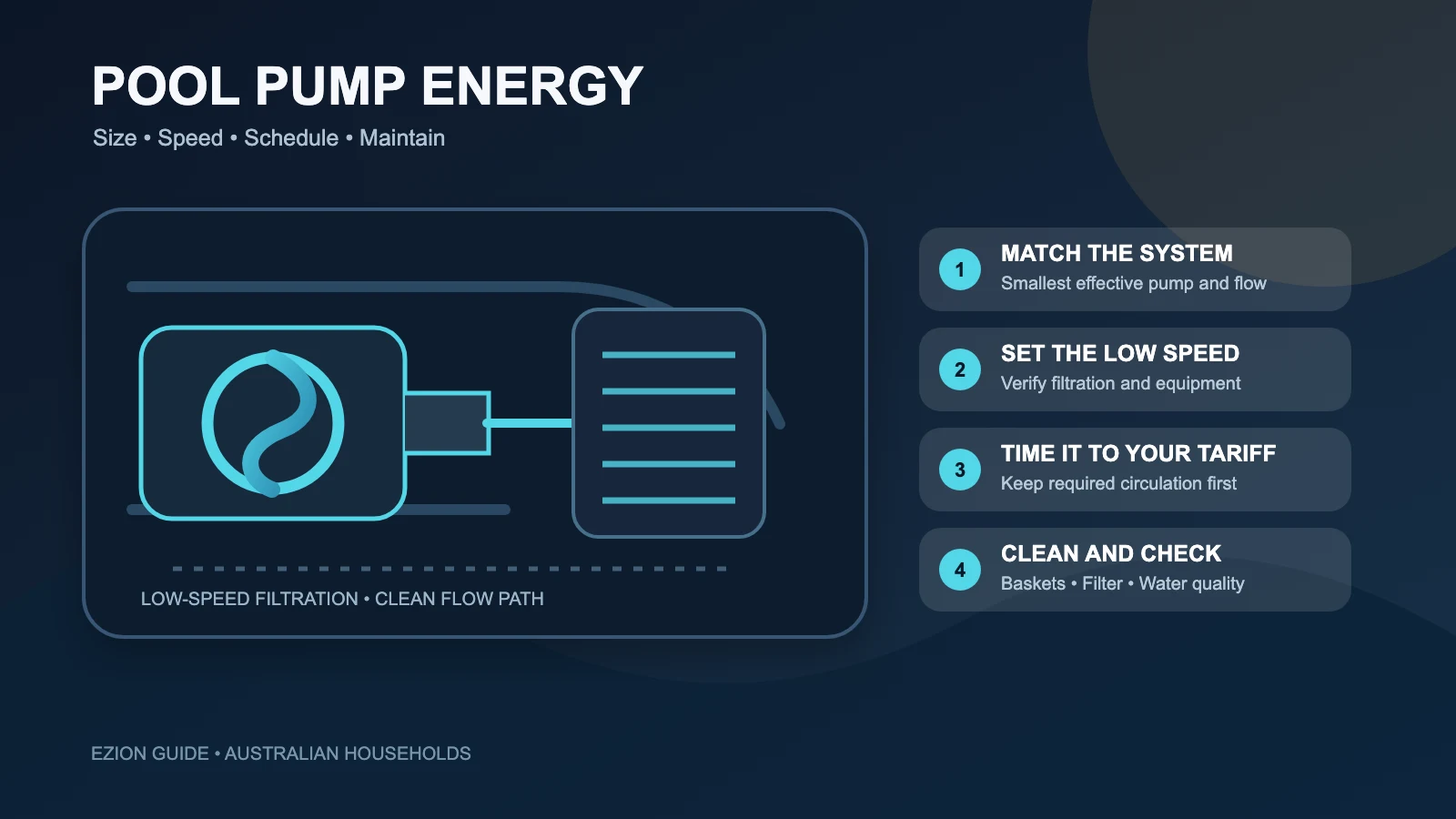
A pump moves water through a connected hydraulic system: skimmer and suction lines, pump basket, filter, sanitiser or chlorinator, heater or solar loop, return lines and fittings. A larger motor is not automatically better. Excess flow can waste energy, make noise, exceed the preferred flow of other equipment and increase pressure through restrictive plumbing. A pump that is too small or poorly matched may not provide the flow required by the filter, sanitation or heating equipment.
Write down the pool volume, pipe sizes, number of suction and return points, filter model, sanitiser, heater and any water features. Find the required and maximum flow ranges in each component’s current manual. Existing labels may be faded, so photograph model and serial plates before visiting suppliers. Ask a pool professional to assess the whole system rather than replacing a failed pump by matching horsepower alone.
The Australian Government’s pool-pump guidance recommends the smallest pump size effective for the pool or spa and professional advice before selection. That is a better starting point than an oversized “just in case” unit. Installation details such as long pipe runs, many elbows, elevation and a dirty filter change the resistance the pump must overcome, so two pools of equal volume can need different settings.
2. Read the pool-pump Energy Rating Label correctly
Swimming-pool and spa-pool pump units sold within the regulated scope must meet Minimum Energy Performance Standards and carry an Energy Rating Label. The label gives a star rating and estimated annual energy consumption. More stars indicate greater efficiency when comparing products with similar capacity and features; the annual figure helps estimate running cost. Do not compare stars across pumps that cannot perform the same job in your system.
Use the Energy Rating Calculator to compare eligible models, then read the product documentation. Check the tested flow, speed settings, input power, acoustic information, control interface, warranty, service path and compatibility with the existing filter and sanitation equipment. The label is a decision aid, not a promise of your household’s bill: actual energy depends on installed resistance, selected speed, runtime, maintenance and tariff.
Multi-speed and variable-speed pumps can run slowly for routine filtration and faster when another task genuinely needs more flow. Government guidance identifies these as more efficient than operating a single-speed pump continuously at high speed. The saving is not automatic. A variable-speed pump left at maximum speed, scheduled for excessive hours or forced against a clogged filter can still waste energy.
3. Establish a safe water-quality baseline before cutting runtime
Do not halve the schedule on day one and wait for the water to change colour. First record the current season, pump speed, daily schedule, filter pressure where the manufacturer provides a gauge, sanitiser setting and water-test results. Clean the baskets and service the filter as instructed. Confirm that valves are in their intended positions and that the pump primes and runs without leaks, persistent air or unusual noise.
The federal energy guide says it is usually enough to pass the pool volume through the filter once or twice a day, but also directs owners to consult the pump supplier for adequate runtimes. Treat turnover as one input, not a universal hygiene rule. Effective circulation and sanitation depend on pool use, temperature, rain, dust, leaves, algae pressure, chemical system, equipment layout and local requirements. A nominal calculation cannot show that every part of the pool is circulating well.
After establishing the baseline, make one modest change at a time. Reduce speed or runtime, then monitor clarity, measured disinfectant and pH according to the treatment system’s instructions, debris collection and any dead spots. Keep a short log. Reverse the change if sanitation, clarity, heating or equipment operation moves outside the required range, and obtain qualified pool-water advice when results are uncertain.
4. Use the lowest effective speed for routine filtration
Pump power can fall substantially when a correctly matched variable-speed pump runs more slowly, although the exact relationship and minimum usable speed depend on the installed system. Slow operation may need more clock time to move the required water, but it can still use less total energy. Find the lowest setting that maintains priming, filtration and required operation of connected equipment; do not copy another owner’s revolutions-per-minute setting.
Tasks may need different presets. Routine filtration can often use a lower speed. Backwashing, spa jets, suction cleaning, some heaters, chlorinators, solar controllers or water features may require a higher minimum flow. Confirm interlocks and flow requirements in every connected manual. If a heater or chlorinator reports low flow, do not simply bypass its safety control.
Listen and look after each change. Repeated loss of prime, cavitation-like gravel noise, bubbles returning to the pool, leaks, hot electrical smells, frequent trips or unstable pressure need investigation. Stop the equipment if it appears unsafe. Energy optimisation begins after the system is operating correctly, not as a workaround for a fault.
5. Schedule around the tariff without undermining the pool
A timer prevents accidental all-day operation and makes a tested routine repeatable. Choose schedule blocks that suit water treatment and household use. Circulation may be useful while swimmers are in the pool or while a sanitiser, heater or cleaner is operating. Some systems benefit from more than one block rather than one long run. Follow the equipment sequence and minimum-flow rules.
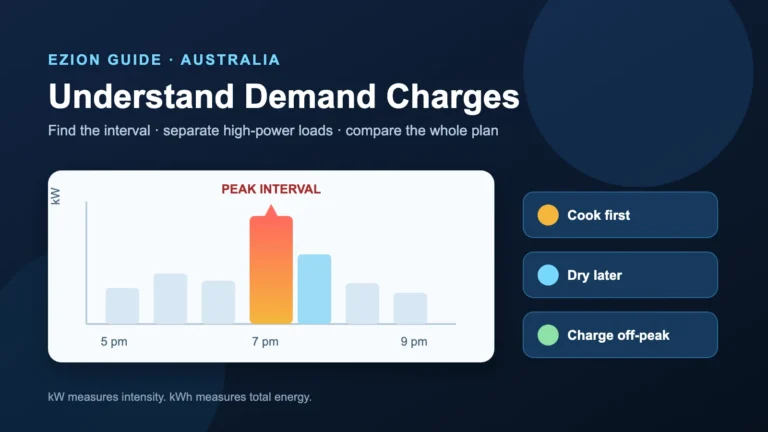
Energy Made Easy explains that time-of-use plans charge different rates in peak, shoulder and off-peak periods, while a single-rate plan charges the same usage rate throughout the day. Demand plans add charges based on how intensely electricity is used during specified periods. Before shifting the pump, read the current Basic Plan Information Document and your bill: tariff windows, seasons, meter requirements and demand calculations differ.
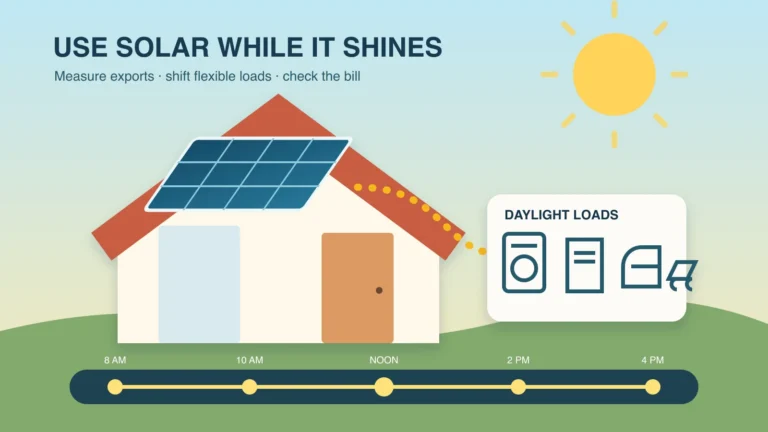
Moving routine filtration away from an expensive period may reduce cost without reducing kWh. Daytime operation may instead suit a home with surplus rooftop solar, but exported solar still has an opportunity value and cloudy days change the result. A pool heater, electric vehicle or air conditioner running at the same time can also affect a demand charge. Compare the whole bill and preserve the circulation schedule the pool actually needs.
6. Calculate the pump’s cost from measured or credible inputs
For a simple estimate, multiply input power in kilowatts by hours of operation, then multiply the resulting kWh by the applicable usage rate. A pump averaging 0.75 kW for six hours uses 4.5 kWh in that example. At 30 cents per kWh, the usage component is $1.35. This is arithmetic only—not a typical pump, tariff or recommended schedule—and it excludes supply and demand charges.
A plug-in energy monitor is not suitable for permanently wired or high-load pool equipment unless the device and connection are specifically rated and lawful for that use. Prefer the pump’s credible display, a dedicated meter installed appropriately, smart-meter interval data, or an electrician’s measurement. Variable-speed input changes with settings, so nameplate maximum power multiplied by timer hours can significantly overstate normal energy.
Compare before and after over a similar period, noting weather, pool use and equipment changes. If the interval data includes the whole house, switch only the pump schedule during a quiet test window or use several days to distinguish the signal. Do not claim savings from a single unusually cool, clean or unused day.
7. Reduce hydraulic resistance through ordinary maintenance
A blocked skimmer basket, full pump basket, dirty filter, closed valve or obstructed intake can reduce useful flow and make the system work poorly. Clean baskets and filters at the intervals and method specified by their manufacturers. Backwash only when the filter’s instructions or pressure change calls for it; unnecessary backwashing wastes treated water, while delayed service can restrict flow.
Keep the water level within the skimmer’s operating range and inspect accessible seals, lids and unions for air or water leaks. Do not open a pressurised filter or pump housing until power is isolated and pressure is safely released under the product instructions. Never reach into a suction fitting or moving pump. Persistent pressure, priming or leak problems belong with a qualified service technician.
A well-fitting pool cover can reduce evaporation, debris and heating demand. It may indirectly reduce some pump and treatment work, but it does not replace circulation, sanitation, barrier checks or supervision. Confirm that the cover material is compatible with the treatment system and store it so it does not create a trip or entrapment hazard.
8. Keep electrical work and water strictly separated
Pool electrical requirements are safety-critical and jurisdiction-specific. Queensland’s Electrical Safety Office, for example, says a licensed electrician must install and maintain pool wiring and electrical equipment, and describes safety-switch protection, equipment location, moisture protection and bonding requirements. Use that as a safety example, then check the regulator and rules for the state or territory where the pool is located.
- Keep extension leads, portable appliances and unsuitable cords away from the pool and wet areas.
- Keep protective and waterproof covers fitted; do not improvise a cover over damaged equipment.
- Use controls with dry hands and keep the equipment area drained, ventilated and accessible.
- Do not open fixed electrical equipment or defeat a safety switch, flow switch or interlock.
- Arrange licensed assessment for damaged cables, water ingress, corrosion, burning smells, shocks, repeated tripping or abnormal heat.
Before buying a replacement, confirm supply voltage, circuit and control requirements with an appropriately licensed electrician. Installation cost can include wiring, protection, bonding or control work, so include it in quotes rather than comparing pump prices alone.
9. Keep records, warranty evidence and recall checks
Record the pump, filter and connected-equipment models, serial numbers, installation date, settings, manuals, receipts and installer details. Photograph the normal valve positions and working filter pressure. These records make future maintenance and fault diagnosis safer and reduce the temptation to guess.
Australian Consumer Law includes automatic consumer guarantees separate from a voluntary manufacturer warranty. The ACCC explains that products must meet applicable guarantees such as acceptable quality and services must be supplied with due care and skill, subject to the law and circumstances. If a product or installation fails, contact the seller or service provider and keep written records.
Search the ACCC Product Safety recall database with the exact brand and model, particularly when buying second-hand or responding to an electrical, overheating or structural fault. A broad search for pool pumps also returns related pool heaters, cleaners, chlorinators and other equipment, so match the notice precisely. Follow the supplier’s recall remedy; do not improvise a repair.
A practical pool-pump action plan
- Identify the pool volume, plumbing, filter, sanitation, heating and water-feature requirements.
- Choose the smallest effective pump and compare similar-capacity models by label and annual energy.
- Establish clean equipment, safe operation and a measured water-quality baseline.
- Use the lowest effective speed for routine filtration and task-specific higher presets only where required.
- Adjust one schedule variable at a time and verify water quality and equipment operation.
- Compare tariff timing, solar availability and demand peaks without sacrificing required circulation.
- Measure real energy where practical, maintain the hydraulic path and keep records.
- Use licensed electrical help and check exact-model recalls when safety or installation is involved.
The lowest-cost schedule is not the shortest arbitrary runtime. It is the least energy-intensive combination of correctly sized equipment, effective low-speed circulation, clean hydraulics, suitable tariff timing and verified water quality that meets the requirements of the whole pool system.
Official and primary sources
- Australian Government energy.gov.au: Pool pumps
- Energy Rating: Pool pumps, labels and comparison
- Australian Energy Regulator, Energy Made Easy: Electricity tariffs
- Queensland Electrical Safety Office: Electricity around water
- ACCC: Consumer rights and guarantees
- ACCC Product Safety: Pool-pump recall search