Reviewed: 22 August 2026 · Written by Jay Jung
Draught-proofing is not about making a home completely sealed. It is about finding uncontrolled air leaks, fixing the low-risk ones, and preserving the ventilation that people, buildings and some appliances need.
Start with the right distinction
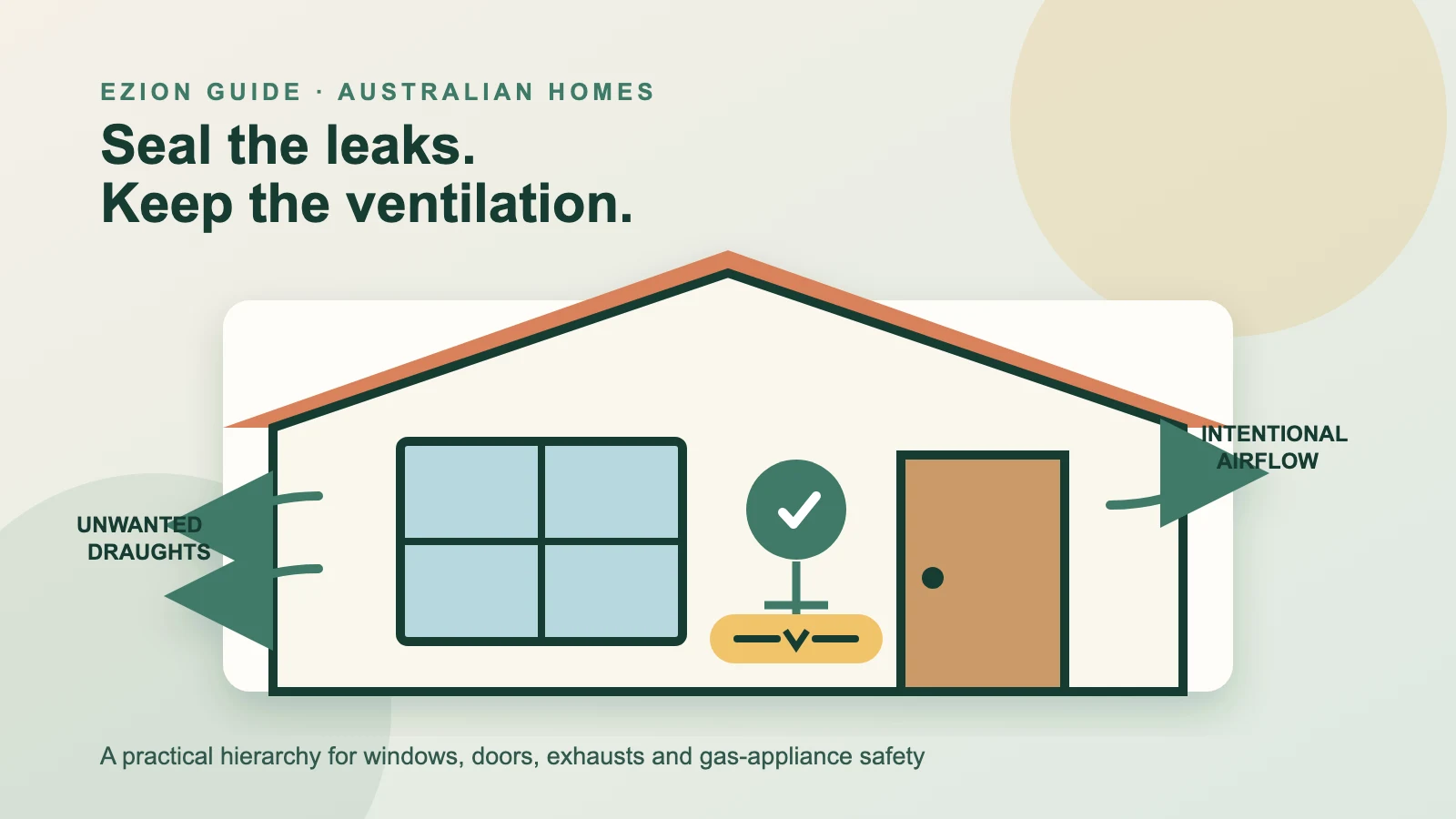
A draught is unintended air movement through gaps in the building. Ventilation is the intentional supply and removal of air. According to YourHome, a well-performing home needs both airtightness and ventilation: airtightness limits uncontrolled leakage, while ventilation introduces fresh air and helps remove moisture and indoor pollutants.
That distinction matters because “seal every opening” is unsafe advice. Some vents are deliberate. Exhaust systems need a way to discharge air. Evaporative cooling operates differently from conventional heating and cooling. Gas appliances may depend on ventilation or a flue arrangement. A successful draught-proofing job therefore removes avoidable leaks without interfering with designed airflow.
Australian Government guidance says sealing unwanted gaps may reduce winter heat loss by 15–25%. It can also reduce the amount of work required from heating and cooling equipment. This is only a general indication, not a savings promise: the result in a particular home depends on its construction, climate, existing gaps, ventilation, appliances and household operation.
For a broader view of insulation, glazing, shading and appliance use, see the home energy efficiency guide. This article has a narrower job: diagnose and safely seal uncontrolled air leakage.
Diagnose before buying seals
Begin with observation rather than a shopping list. Walk through the home on a cool or windy day and note where air movement is noticeable. Around windows, official guidance identifies rattling, whistling, moving curtains and a detectable breeze as useful clues. A room that is difficult to heat or cool may also justify a closer inspection, although temperature alone does not prove where a leak is located.
Inspect the common locations identified by energy.gov.au: windows, skylights, floorboards, skirting boards, wall junctions, external doors, vents, exhaust fans, appliances connected through walls and fireplaces. Look for an actual path between indoors and outdoors rather than treating every visible line or joint as a problem.
- Map the symptoms. Record which rooms whistle, rattle or feel breezy and whether the effect changes with wind direction or appliance use.
- Check moving components. Close windows and external doors normally. Examine the meeting edges, frames and thresholds for uneven contact or obvious light and air gaps.
- Check fixed junctions. Inspect skirting boards, floorboards and wall junctions for cracks that appear to connect to an unconditioned space or outdoors.
- Identify intentional openings. Note vents, exhaust outlets, fireplace components, evaporative-cooler ducts and openings associated with gas or wall-connected appliances. Do not cover them while investigating.
- Prioritise. Start with an obvious, accessible leak that can be addressed without altering an appliance, flue, electrical fitting or ventilation system.
Avoid using smoke or a flame around appliances or combustible materials. The supplied official guidance supports visual and comfort clues for household diagnosis and identifies blower-door testing and thermal imaging as professional tools. If the leakage pattern is unclear, a professional assessment is a safer next step than experimenting around services.
A low-risk DIY hierarchy
The simplest measures are often the best place to begin because they are visible, reversible and easy to check. Work through one area at a time so that you can tell what changed.
1. Improve window comfort without modifying the frame
Close-fitting lined curtains or blinds can reduce heat transfer at windows, and pelmets can improve their performance by limiting air circulation behind the covering. These treatments do not repair a leaking frame, but they can improve comfort while preserving normal window operation.
When conventional heating or cooling is operating, energy.gov.au recommends keeping windows closed. Evaporative cooling is the important exception because it requires different ventilation operation. Follow the appliance instructions rather than applying a universal “windows closed” rule.
2. Stop air beneath an ordinary external door
A door snake is a low-commitment response to a clear gap beneath a door. It can be placed when needed and removed easily. If a permanent treatment is appropriate, a correctly fitted door seal may address the threshold or perimeter. Check that the door still opens, closes and latches normally after installation.
3. Seal straightforward door and window gaps
Foam strips can suit accessible meeting edges where a door or window should close against a frame. Select and position a strip so it compresses without preventing secure closure. Do not stack material until the hardware is forced out of alignment. If the opening is warped, damaged or unable to close, repair may be more appropriate than adding thicker foam.
4. Fill suitable fixed cracks
Sealant or filler may be suitable for simple stationary gaps around skirting boards, floorboards or wall junctions. Confirm that the gap is not intended for drainage, movement, ventilation or appliance operation. Use a product suitable for the surfaces and location, and follow its instructions. Large, recurring or moisture-affected cracks deserve investigation rather than cosmetic filling.
5. Address exhaust backflow carefully
Backflow stoppers can reduce air entering through some exhaust systems when the fan is off. The component must remain compatible with the exhaust system and must not prevent air discharge during operation. If access, sizing or airflow is uncertain, use a qualified installer.
6. Treat evaporative-cooler vents seasonally
Government guidance identifies seasonal covers for evaporative-cooler vents as a draught-proofing option. “Seasonal” is essential: a cover must not remain in place when the system needs the vent. Establish a clear remove-before-use routine and follow the equipment instructions.
Draught-proofing complements rather than replaces appropriate temperature settings and equipment operation. For that separate topic, see the reverse-cycle heating and cooling guide.
Stop and call a professional when safety systems are involved
Never seal a vent merely because air can be felt through it. Energy.gov.au specifically warns not to seal necessary vents, particularly where an unflued gas heater is present. CSIRO likewise cautions against blocking ventilation around internal gas appliances.
Do not DIY-seal, cover or alter:
- a vent required by a gas appliance or specified in its instructions;
- a flue, fireplace component or combustion-air opening;
- an opening associated with an unflued or open-flued gas heater;
- an exhaust path if the change could prevent normal discharge;
- a wall penetration containing an appliance connection or service you cannot identify; or
- an evaporative-cooling outlet while the system may be used.
If a gas heater or other internal gas appliance is present, identify the appliance and its ventilation requirements before tightening the surrounding room. Where the arrangement is uncertain, stop and obtain advice from a licensed gasfitter. The Victorian weather-sealing program contains exclusions involving open-flued and flueless gas heaters and directs households towards licensed gasfitter advice. Those program details are specific to Victoria, so they should not be assumed to be national rules. Check the appliance instructions and the regulator or requirements that apply in your state or territory.
Questions about fuel choice, appliance replacement and operating costs are outside this diagnostic task; see the gas versus electric home energy guide for that separate comparison.
Renters: obtain approval before fitting products
Renters can still diagnose where discomfort occurs and use removable measures such as an appropriate door snake. Before fitting adhesive foam, permanent door seals, sealant, filler, exhaust components or vent covers, energy.gov.au advises checking with the landlord or property manager.
Provide a short record of the problem: the room, the location, the observed clue and when it occurs. A specific report such as “the closed bedroom window rattles and the curtain moves on windy evenings” is more useful than a general claim that the home is cold. Ask who will assess the gap and whether written permission is required before installation.
Manage condensation, mould and indoor air after sealing
Reducing unintended leakage changes how moisture and pollutants leave a home. YourHome warns that a home made too airtight without adequate ventilation can develop condensation, mould, elevated carbon dioxide and higher indoor pollutant levels. Draught-proofing should therefore be followed by observation, not treated as a one-time “seal and forget” job.
After each group of changes, watch for new condensation on glazing or other surfaces, persistent dampness, musty odours or visible mould. These signs do not automatically identify one cause, but they mean moisture and ventilation need attention. Continue using intentional ventilation and exhaust systems as designed. Do not respond by reopening a hazardous or unidentified appliance vent, and do not conceal recurring moisture with more filler.
Condensation risk depends on the building and how it is occupied, so complex or persistent cases may need professional assessment. Blower-door testing can measure overall air leakage, while thermal imaging can help locate temperature differences and possible leakage paths. These tools are especially useful where symptoms remain after obvious low-risk gaps have been addressed or where renovation aims to produce much higher airtightness.
Operate the home seasonally
A draught-control measure can be correct in one season and wrong in another. Close conventional windows while heating or cooling, but operate evaporative cooling according to its required ventilation pattern. Install seasonal evaporative-vent covers only for the period in which they are intended, and remove them before the system is used.
Use curtains, blinds and pelmets consistently: close them when they help separate the room from a hot or cold window, then open them when daylight, useful solar warmth or intentional ventilation is wanted. Move door snakes out of the way when access is required. Check adhesive seals periodically because compression, movement and wear can change how a door or window closes.
Verify the result
Revisit the original diagnostic notes after each change. On comparable weather, check whether the rattle, whistle, moving curtain or local breeze has reduced. Confirm that windows and doors still close, latch and operate safely. Run any affected exhaust fan and verify that it still discharges as intended. Remove any seasonal cover before operating the equipment it serves.
Then check the whole-room outcome. The space may feel more stable and the heating or cooling system may work less hard, but do not assume that comfort proves ventilation is adequate. Continue monitoring condensation, dampness, mould and indoor-air symptoms. If the result is uncertain, if an appliance is involved, or if sealing creates a new moisture problem, stop adding products and obtain qualified advice.
The practical endpoint is not a perfectly sealed house. It is a home with fewer uncontrolled leaks, intact intentional ventilation, normally operating appliances and no new moisture warning signs.
Official sources
Disclosure
This guide has no affiliate relationship. It provides general information only and does not guarantee savings, safety or suitability for a particular home. Confirm proposed work with your landlord or property manager where applicable, licensed tradespeople, appliance instructions and the relevant local regulator.