Reviewed: 11 August 2026 · Written by Jay Jung
Most advice about electricity bills starts in the wrong place. It tells you to switch off lights and take shorter showers, then leaves you with the same tariff, the same hot-water system and the same bill.
This guide works in the opposite order. It starts with the two things that set the size of your bill before you change a single habit — the tariff you are on and the appliances that run for hours at a time — and only then moves to the smaller wins. Each section is a summary; where there is more detail than fits here, there is a link to a dedicated guide.
Everything here applies to Australian households. Where rules differ by state or territory, that is called out.
Start here: three numbers that decide your bill
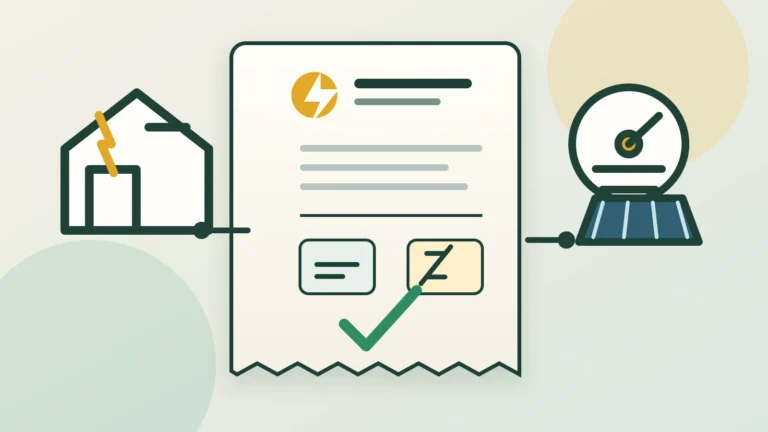
Before comparing anything, get three numbers off your most recent bill:
- Your daily supply charge (cents per day). You pay this whether or not you use any electricity.
- Your usage rate (cents per kWh) — and whether there is more than one rate.
- Your average daily usage (kWh per day), usually shown as a bar chart or a single figure.
If there is more than one usage rate, you are on a time-of-use or demand tariff, and when you use power matters as much as how much. If there is only one rate, you are on a flat tariff and only the total matters.
Getting these three numbers takes two minutes and makes every later decision concrete rather than theoretical. If the bill layout is confusing, work through Understanding Your Electricity Bill Line by Line, which walks through each charge in order.
What “average” usage actually looks like
Published averages vary widely by source and by state — Victorian households sit near the bottom of the range and Tasmanian households near the top, largely because of heating load. Treat any national average as a rough sanity check rather than a target: a two-person apartment and a five-person house with a pool are not the same household, and comparing yourself to a blended average tells you very little.
The more useful comparison is against your own usage twelve months ago, which most retailers show on the bill or in their app.
Step 1: Get the tariff right before anything else
Your tariff is the single decision with the largest effect on your bill, and it is the one most households never revisit.
Flat tariff — one rate, all day. Simple, and usually the right choice if your household uses power evenly or is home during the day with no way to shift big loads.
Time-of-use — different rates for peak, shoulder and off-peak periods. It rewards households that can move the dishwasher, washing machine, pool pump and EV charging outside peak windows. It punishes households that cannot.
Demand tariff — charges you based on your highest half-hour of usage in a billing period, on top of your usage charges. One hot afternoon with the air conditioner, oven and dryer running together can set a charge that applies for the whole period.
Controlled load — a separate, cheaper circuit for a single appliance, most commonly an electric storage hot-water system, which the network switches on during off-peak hours.
Switching tariff type is often free and can be done without changing retailer. The catch: some tariffs require a smart meter, and the right answer genuinely depends on your household’s daily pattern. Time-of-Use vs Flat Tariff works through the calculation with realistic household patterns.
Prices moved this year — check whether yours did
The Australian Energy Regulator sets the Default Market Offer, the benchmark price cap for standing offers in New South Wales, South East Queensland and South Australia. For 2026–27, effective 1 July 2026, the AER’s final determination lowered flat-rate residential standing offer prices in New South Wales and South East Queensland while South Australian prices rose slightly, and time-of-use standing offers fell across all three regions.
Two things follow from that:
- A price fall in the benchmark does not mean your specific plan fell. Retailers reprice market offers independently.
- If your bill did not change around July, that is a reason to compare, not a reason to relax.
Victoria runs its own equivalent, the Victorian Default Offer, and Western Australia, the Northern Territory and Tasmania operate under different arrangements again.
Step 2: Compare offers using the government tools, not ads
Use the official comparison service for your state:
- Energy Made Easy (AER) — for New South Wales, Queensland, South Australia, Tasmania and the ACT
- Victorian Energy Compare — for Victoria
Both are government-run, include every offer the retailer is required to list, and take no commission. Commercial comparison sites show a subset of the market and are paid on referral.
Two rules make the comparison honest:
- Compare estimated annual cost, not the headline discount. A 30% discount off an inflated rate loses to a lower base rate with no discount.
- Enter your real usage. Both tools accept a bill upload or your NMI, which produces a far more accurate estimate than the default household profile.
The full method — including conditional discounts, exit fees and the traps in “estimated annual cost” — is in How to Compare Electricity Plans in Australia. When you are ready to move, Switching Energy Retailers covers final meter reads, cooling-off periods and the double-billing mistake that catches people out.
Step 3: Find where the kilowatt-hours actually go
Households consistently misjudge this. The devices you notice are rarely the ones that cost the most; the ones that run for hours, unnoticed, usually are.
In most Australian homes the big four are:
- Heating and cooling — the largest single swing in the bill between seasons
- Hot water — typically the largest year-round load after climate control
- Refrigeration — small draw, but it never stops
- Everything with a motor or an element — dryers, ovens, pool pumps
The method for putting a dollar figure on any single appliance is in How to Calculate Appliance Running Costs. Do it once for your three biggest appliances and the priorities become obvious.
Hot water is usually the best-value fix
An electric storage system on a controlled-load circuit is cheap to run per litre but expensive if it is oversized, poorly insulated or on the wrong circuit. A heat-pump system uses a fraction of the electricity of a conventional electric element, and rebates exist in several states.
Because hot water runs every day of the year, a change here compounds in a way that a lighting change never will. See Hot-Water Systems in Australia for sizing and system choice.
Climate control is where the seasons hit
Reverse-cycle air conditioning is the most efficient common form of electric heating available to Australian households — significantly more efficient than a fan heater or an oil column heater, which convert electricity to heat at roughly one-to-one.
Two habits do most of the work:
- Set a moderate temperature and leave it. Each degree of extra heating or cooling increases running cost, and “blasting” a room to reach temperature faster does not work the way people assume.
- Heat and cool the room you are in, not the whole house, unless the whole house is occupied.
Details and per-hour cost estimates are in Reverse-Cycle Air Conditioning Running Costs and, for winter specifically, Heating a House Cheaply in an Australian Winter.
Standby power: small, constant, easy to forget
No single device on standby matters. Twenty of them, running every hour of the year, add up to a measurable line on the bill — and unlike most savings, this one requires no behaviour change once the worst offenders are dealt with. Standby Power covers how to find yours with a plug-in meter.
Step 4: Buy efficiency once, benefit for a decade
When an appliance is being replaced anyway, efficiency is close to free money — the price gap between a mid-tier and a high-tier model is often recovered within a few years of running costs, and the appliance stays in the house for ten or more.
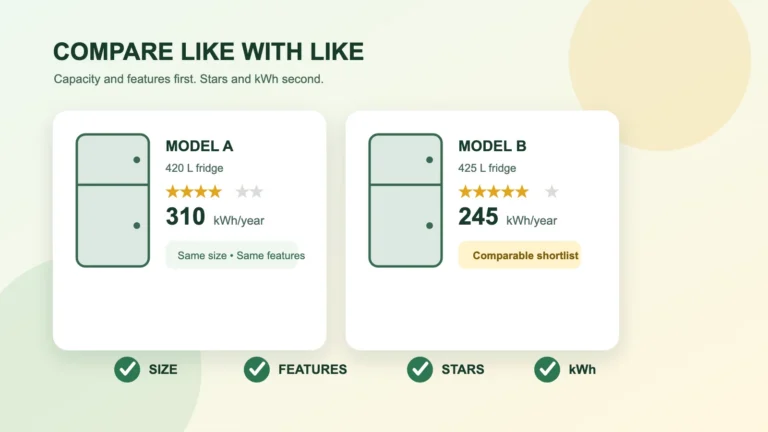
The Energy Rating Label is the tool for this, but it is easy to misread. The star rating compares models within the same size class, so a six-star large fridge can use more electricity than a three-star small one. The kWh-per-year figure printed on the label is the number that actually matters for your bill.
Energy Rating Labels: Compare Appliances in Australia explains how to read the label properly and where the comparison breaks down.
Step 5: Claim what you are entitled to
Every state and territory runs concessions and rebates, and take-up is incomplete — households that qualify frequently never apply. Eligibility commonly covers concession card holders, seniors, and people with medical equipment requirements, and there are separate schemes for hot-water and heating upgrades in several jurisdictions.
Amounts and eligibility change, often at the start of a financial year, so check the current figures on your state government’s page rather than relying on any article, including this one. The state-by-state summary is in Energy Concessions and Rebates by State.
Step 6: If you have solar — or are considering it
Solar changes the arithmetic completely. The value is no longer in what you export; feed-in tariffs across the National Electricity Market have fallen substantially from their earlier levels, and some retailers now apply charges for exporting at certain times of day.
The value is in self-consumption — using the power while it is being generated. That reframes the practical advice: run the dishwasher, washing machine and pool pump in the middle of the day rather than overnight.
- Solar Feed-in Tariffs in Australia — what you are actually paid, and why it keeps falling
- Solar Panel Sizing — matching system size to your usage profile rather than your roof space
- Home Battery Payback — the honest calculation, including cycle life and current rebates
Step 7: Measure, so the next decision is not guesswork
A smart meter records usage in half-hour intervals, which is what makes time-of-use tariffs, demand tariffs and any serious analysis of your own consumption possible. Most households can access this data through their retailer’s portal.
There are rights and obligations attached to installation, and bills sometimes change after a smart meter goes in for reasons that have nothing to do with the meter measuring differently. Smart Meters in Australia covers installation, consumer rights and what actually changes on the bill.
For per-appliance measurement, a plug-in energy meter or a smart plug with metering will settle any argument about what a device really draws.
The order that actually works
If you do nothing else, do these five, in this order:
- Read your bill and identify your tariff type
- Compare on Energy Made Easy or Victorian Energy Compare using your real usage
- Check your hot-water system — sizing, circuit, and whether a heat pump is worth it
- Apply for every concession you are eligible for
- Set heating and cooling to a moderate temperature and stop adjusting it
Steps 1 and 2 cost nothing and take an afternoon. They are also, for most households, where the largest single saving is found — which is why they come before any advice about light bulbs.
Official sources
- Australian Energy Regulator — 2026–27 Default Market Offer
- Energy Made Easy — Australian Government comparison service
- Victorian Essential Services Commission — Victorian Default Offer
- Victorian Energy Compare
- Your state or territory government’s concessions page
Disclosure: Ezion Guide has no affiliate relationship with any energy retailer, comparison service or manufacturer named in this guide. This is general information, not financial advice. Prices, rebates and eligibility change — verify current figures with the official sources above before making a decision.