Reviewed: 7 August 2026
Water heating is often about one-quarter of a typical Australian household’s energy use, although the share can vary substantially with household size, climate, equipment and habits. That makes a replacement system a long-lived energy decision, not just a tank to buy when the old one fails. A good choice starts with the home, matches capacity and recovery to normal demand, and gives the installer a practical brief.
This guide is about choosing, sizing, installing and controlling a household hot-water system. It does not repeat general bill arithmetic, retailer selection or appliance-label basics. Use our appliance running-cost guide, electricity plan guide and Energy Rating guide for those separate jobs.
Start with the household and site
Tell prospective installers how many people usually live in the home, when they shower, whether two outlets run together, whether baths are common, and how often guests stay. About 50 litres of hot water per person per day is a rough conversation starter from YourHome, not a sizing formula. A household with short, spread-out showers can need a different tank and reheat rate from one with several long showers before work. Size for normal demand, then discuss a sensible allowance for occasional peaks rather than buying for the largest imaginable day.
Map the site before comparing products. Note winter temperatures, frost exposure, unshaded roof area, rooftop solar, the existing electricity supply, any gas connection, available controlled load, apartment or strata restrictions, and the route between the heater and bathrooms or kitchen. For an outdoor heat pump, identify positions with free airflow, lawful condensate drainage, maintenance access and acceptable noise at bedroom windows and neighbouring boundaries. For solar thermal, roof orientation, shading, structure and collector-to-tank distance matter.
Storage and instantaneous systems solve different problems
A storage system heats water into an insulated tank and holds it ready. It can reheat at selected times, which may suit rooftop solar, a compatible controlled-load supply or a time-of-use schedule. Its trade-offs are tank space and heat lost through the tank, fittings and pipes. Oversizing increases those standing losses; undersizing may produce shortages or force reheating at an inconvenient time.
An instantaneous system heats water as it flows, avoiding tank standby loss and offering continuous delivery within its rated flow and temperature rise. It is not automatically cheaper. Gas instantaneous units still require a suitable gas supply, flue and ventilation arrangements, and their emissions and ongoing connection costs belong in the decision. Electric instantaneous units can impose very high electrical demand—YourHome notes that some draw up to 28 kW and commonly need three-phase power. Because they run when a tap opens, they cannot usually shift water heating into a sunny or cheaper period. Low-flow showerheads can also fall below the activation flow of some units, especially gas models, so confirm compatibility.
Compare the main technologies
Electric resistance storage
Resistance storage is established, simple technology and may have a lower purchase price, but converting electricity directly to heat uses much more electricity than a well-sited heat pump. It can still be a practical constrained-site choice where the tank is correctly sized, pipe runs are short and operation is matched to rooftop solar or a compatible controlled load. Confirm that the element rating, switchboard, tariff arrangement and recovery time suit the household rather than assuming an existing circuit makes any replacement suitable.
Heat-pump water heating
A heat pump moves heat from surrounding air into the water. Energy.gov.au says it uses about 30% of the energy of a conventional electric hot-water system, but that is a broad technology comparison, not a promise for every model or home. Performance changes with air temperature, inlet-water temperature, settings, demand and test conditions. In colder weather efficiency can fall and a resistance booster may run more often, so choose a model designed for the local climate and ask how it performs and recovers on a cold winter morning.
Check the declared operating temperature range, tank capacity, reheat rate, booster logic, fan and compressor noise, warranty and nearby service support. Integrated units place the compressor high on the tank; split units can offer different placement options. Both need manufacturer clearances, unobstructed airflow, condensate disposal and access for repair. Do not place one in a small sealed room merely to hide its noise.
Solar thermal
Solar hot water can provide a large renewable contribution—YourHome says up to 90% depending on climate—but the result is site-dependent. Collectors need suitable, substantially unshaded roof space. True north is optimal, although YourHome notes that a deviation of up to 45 degrees may not significantly reduce efficiency. Frost-prone sites may need an appropriate closed-circuit design. Most systems need electric or gas boosting, and morning-heavy demand can trigger boosting before useful solar heat is available. Active systems include pumps and generally need more maintenance than passive systems.
Compare solar thermal with a solar-PV-powered heat pump when roof area is limited. PV can serve other loads after the water is hot, while thermal collectors are dedicated to water heating. Neither option is universally better; roof, climate, electrical capacity, maintenance access and household timing decide.
Gas storage and instantaneous
Gas storage can recover quickly and gas instantaneous can be compact, but both retain combustion emissions and gas-specific installation, ventilation and servicing requirements. An existing gas connection is not by itself a reason to keep gas. Ask for a whole-system comparison that includes whether the home would otherwise disconnect from gas, but do not treat future energy prices or savings as guaranteed.
Choose a model, not a headline
For each realistic candidate, record usable storage volume, recovery rate, simultaneous-delivery capability, cold-climate performance, noise data, physical clearances, warranty terms and local repair options. Heat-pump coefficient-of-performance figures are not necessarily comparable when test temperatures and methods differ. Current household water heaters are not required to display the Australian Government Energy Rating Label. A 2026 Decision RIS recommends future minimum standards and later labelling for heat-pump water heaters, but a recommendation and planned regulatory process are not current law. Do not assume every heat pump will carry a label on a particular date.
Ask a licensed installer to explain why the proposed size fits the household’s normal draw pattern, how long recovery takes in winter, when any booster operates, and what happens after unusually heavy use. Obtain itemised quotes for the unit, valves, electrical or gas work, roof work, disposal, commissioning and certificates. Confirm the exact model number; similar names can conceal different climate performance, controls or incentive eligibility.
Installation details prevent years of waste
Place the heater close to the wet areas used most often where compliant and practical. Short hot-water runs reduce the wait at the tap and the heat left cooling in pipes. Insulate exposed hot-water pipework and fittings as permitted by the product instructions and plumbing requirements. If bathrooms are far apart, ask whether layout changes or a different design would reduce dead legs rather than accepting a long run by default.
A professional heat-pump installation must account for airflow, cold-air discharge, noise transmission, condensate drainage, clearances and service access. A solar installation must address collector orientation, shading, roof structure and frost suitability. All systems need correct valves, discharge arrangements and commissioning. Use appropriately licensed trades and retain compliance certificates, model details and control instructions.
Water-temperature safety has two distinct requirements. Stored water must reach at least 60°C once every seven days to control Legionella, while water delivered to outlets should be limited to 50°C to reduce scald risk, using compliant temperature control such as a tempering valve where required. Do not lower a storage tank below 60°C, alter valves, or undertake electrical, gas or plumbing work yourself. Ask the licensed installer to verify both storage and delivery temperatures.
Control when it runs without defeating safety
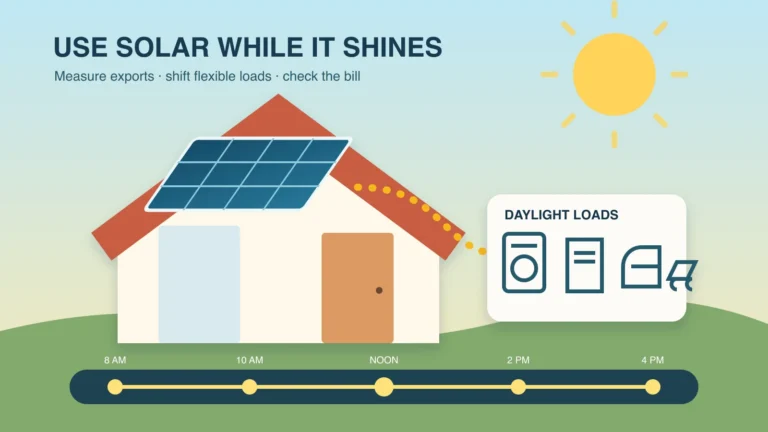
Compatible electric storage and heat-pump systems may be scheduled for rooftop-solar production, lower-price periods or warmer daytime air. The right schedule depends on tank size, recovery, household timing and the model’s controls. Controlled-load compatibility varies: some heat pumps cannot use it, while others need a longer supply window. A solar diverter intended for a resistance element may be unsuitable for a heat pump and can create standards, warranty or safety-cycle problems.
Never use a timer, smart switch or home-energy routine that prevents the manufacturer’s Legionella-control cycle. Have the installer explain booster and sanitisation behaviour before changing a schedule. Avoid leaving a booster permanently enabled if the system is intended to manage it automatically, but do not disable a safety function to chase a small saving. Use documented holiday mode where available and follow the manufacturer’s restart instructions after an extended absence.
Reduce demand before buying a larger heater
Showers usually dominate household hot-water use. Shorter showers and a suitable WELS-rated efficient showerhead can reduce both water and heating demand; YourHome notes that a WELS four-star showerhead can reduce shower water use by about half. Confirm minimum-flow compatibility with an instantaneous heater. Use the cold position on mixer taps when hot water is unnecessary, choose suitable cold or eco appliance cycles, run full dishwasher and washing-machine loads, and repair leaking hot taps promptly.
A dripping relief valve may indicate normal expansion at times or a fault; follow the manufacturer’s guidance and have persistent discharge assessed rather than blocking or modifying the valve. Reducing waste may allow a smaller replacement, but confirm that conclusion with the installer using the household’s actual peak pattern.
Verify incentives before signing
Only eligible solar water heaters and air-source heat pumps on the Clean Energy Regulator register can create small-scale technology certificates. Capacity and other conditions apply, and an installer or registered agent may offer an upfront discount in return for assigning certificates. State and territory rebates also change. Check the current energy.gov.au finder and the program owner, then verify the exact model, address, purchaser, installer and timing requirements before paying a deposit. Registration or a rebate is not proof that a model is best for a particular home.
Five-minute decision checklist
- Have we described usual occupants, shower timing, simultaneous use and occasional peaks?
- Does the technology suit winter climate, roof, electrical supply, gas plans and available space?
- Is the proposed size supported by recovery time and real demand, not only a rough litres-per-person rule?
- Are noise, airflow, condensate, frost, shading, pipe length and maintenance access resolved?
- Will storage reach at least 60°C while delivered water is limited to 50°C by compliant controls?
- Are solar, timer or controlled-load settings documented and compatible with the safety cycle?
- Have we confirmed the exact model, warranty, local service, certificates and current incentive rules?
Disclosure: Ezion Guide has no affiliate relationship with the products, installers, programs, schemes or regulators discussed here. This is general information, not financial, plumbing or safety advice. It does not rank products, guarantee savings or performance, or replace manufacturer instructions or licensed professional advice. Rules, rebates, eligibility, models and installation requirements can change. Verify current details with official program owners, the exact model supplier and appropriately licensed installers before deciding.
Official sources
- energy.gov.au — Hot water systems
- YourHome — Hot water systems
- Energy Rating — Water heating
- Clean Energy Regulator — Solar water heaters and air source heat pumps
- Energy Rating — Decision RIS on heat-pump water heaters
- energy.gov.au — Rebates and assistance
Part of Cut Your Australian Power Bill: Complete Home Energy Guide.