
The quickest way to understand an appliance’s electricity cost is to combine three numbers: its power draw, the time it runs and your electricity usage rate.
This guide shows the calculation, explains where to find each number on an Australian bill or appliance label, and highlights the shortcuts that can produce misleading estimates. It does not recommend a retailer or plan.
The running-cost formula
Running cost = watts ÷ 1,000 × hours used × electricity rate in dollars per kWh
Electricity retailers charge usage in kilowatt-hours (kWh). Dividing watts by 1,000 converts an appliance’s rated power to kilowatts. The separate daily supply charge on your bill is not caused by one appliance, so leave it out when comparing appliance running costs.
Worked example
Suppose a portable heater is rated at 2,400 watts, runs for five hours and your usage rate is $0.30 per kWh:
- 2,400 W ÷ 1,000 = 2.4 kW
- 2.4 kW × 5 hours = 12 kWh
- 12 kWh × $0.30 = $3.60
That is an illustrative maximum based on continuous rated power. A thermostatically controlled heater may cycle on and off, so measured consumption can be lower. Room size, insulation, thermostat setting and outside temperature also matter.
Illustrative appliance calculations
The following examples all use an assumed rate of $0.30 per kWh. Replace it with the usage rate shown on your own bill. Rated power and actual consumption vary by model.
| Example appliance | Assumed power | Use | Energy | Estimated cost |
|---|---|---|---|---|
| LED light | 10 W | 5 hours | 0.05 kWh | $0.015 |
| Television | 120 W | 4 hours | 0.48 kWh | $0.144 |
| Portable heater | 2,400 W | 5 hours | 12 kWh | $3.60 |
| Clothes dryer | 3,000 W | 1 hour | 3 kWh | $0.90 |
Step 1: find your electricity usage rate
Look for a line such as “general usage”, “peak usage” or “anytime usage” on the rates section of your bill. Rates are commonly displayed in cents per kWh. Convert cents to dollars before using the formula: 30 cents becomes $0.30.
If you have a time-of-use plan, calculate the appliance separately for peak, shoulder and off-peak periods. A single average rate can hide the cost of running high-power appliances at expensive times.
To compare available electricity plans, use the government comparison service that applies in your location. The Australian Energy Regulator operates Energy Made Easy. Victoria operates Victorian Energy Compare.
Step 2: find the appliance’s energy use
- Rating plate: check the back, underside or power adaptor for watts (W).
- Energy Rating Label: larger appliances may show estimated annual energy consumption in kWh.
- Product manual: use the manufacturer’s specification for the exact model.
- Plug-in power meter: useful for appliances that cycle or change power during operation, provided the appliance is suitable for the meter’s rating.
The Australian Government’s Energy Rating website explains labels and provides product comparison tools. When an energy label gives annual kWh, multiply that number directly by your $/kWh rate to estimate annual usage cost.
Step 3: estimate realistic usage time
Use a normal week rather than the longest day of the year. Record how many loads, cooking sessions or heating hours you actually use. For seasonal appliances, calculate summer and winter separately.
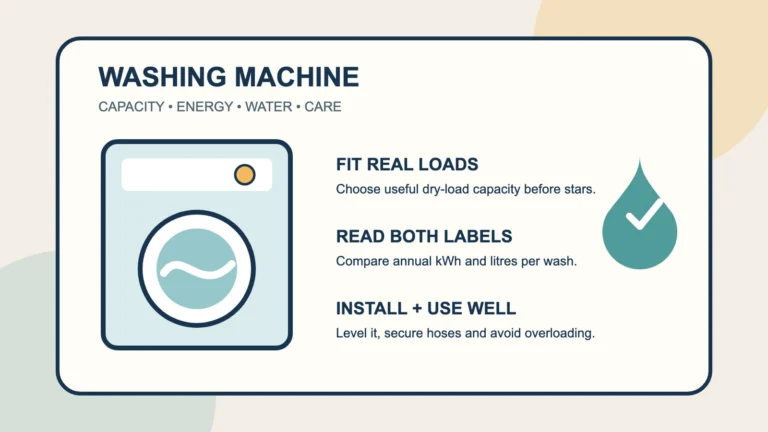
Do not assume every appliance draws its maximum rated power every minute. Refrigerators, heat pumps, air conditioners and thermostatically controlled heaters cycle. Washing machines and dishwashers also move through stages with different power use. A label’s annual kWh figure or a safe meter reading is usually better than rated watts for those appliances.
What to check before replacing an appliance
- Calculate the current appliance’s annual cost using your actual rate.
- Compare the replacement’s labelled annual kWh, not only its star count.
- Multiply the annual kWh difference by your rate.
- Compare the annual saving with the purchase price and expected useful life.
- Consider repair, delivery, installation and disposal costs.
A more efficient appliance can reduce usage, but replacing a working appliance is not automatically the cheapest decision. The saving needs to be large enough to recover the purchase and installation cost.
A five-minute home energy audit
- Write down your usage rate in $/kWh.
- List the appliances with the highest power or longest running time.
- Estimate normal weekly hours or cycles.
- Calculate weekly cost, then multiply by 52 for an annual estimate.
- Measure or refine the top two uncertain estimates before buying anything.
Common questions
Should I include the daily supply charge?
No, not when comparing individual appliances. You normally pay the supply charge regardless of which appliance is running.
Can I use the advertised electricity rate?
Use the rate on your latest bill or current plan fact sheet. Discounts, time-of-use periods and plan changes can make an advertised headline rate unsuitable for your calculation.
Why is my bill higher than the appliance estimates?
Your bill includes all household usage, the supply charge and possibly different rates by time or tariff. Estimates can also miss standby power, cycling behaviour, seasonal changes and extra use by other people in the home.
Last reviewed: 2 August 2026. This article provides general information, not personalised energy or financial advice. Check your current bill, product documentation and official comparison services before making a purchase or changing a plan.
Part of Cut Your Australian Power Bill: Complete Home Energy Guide.