By Jay Jung · Reviewed 10 September 2026
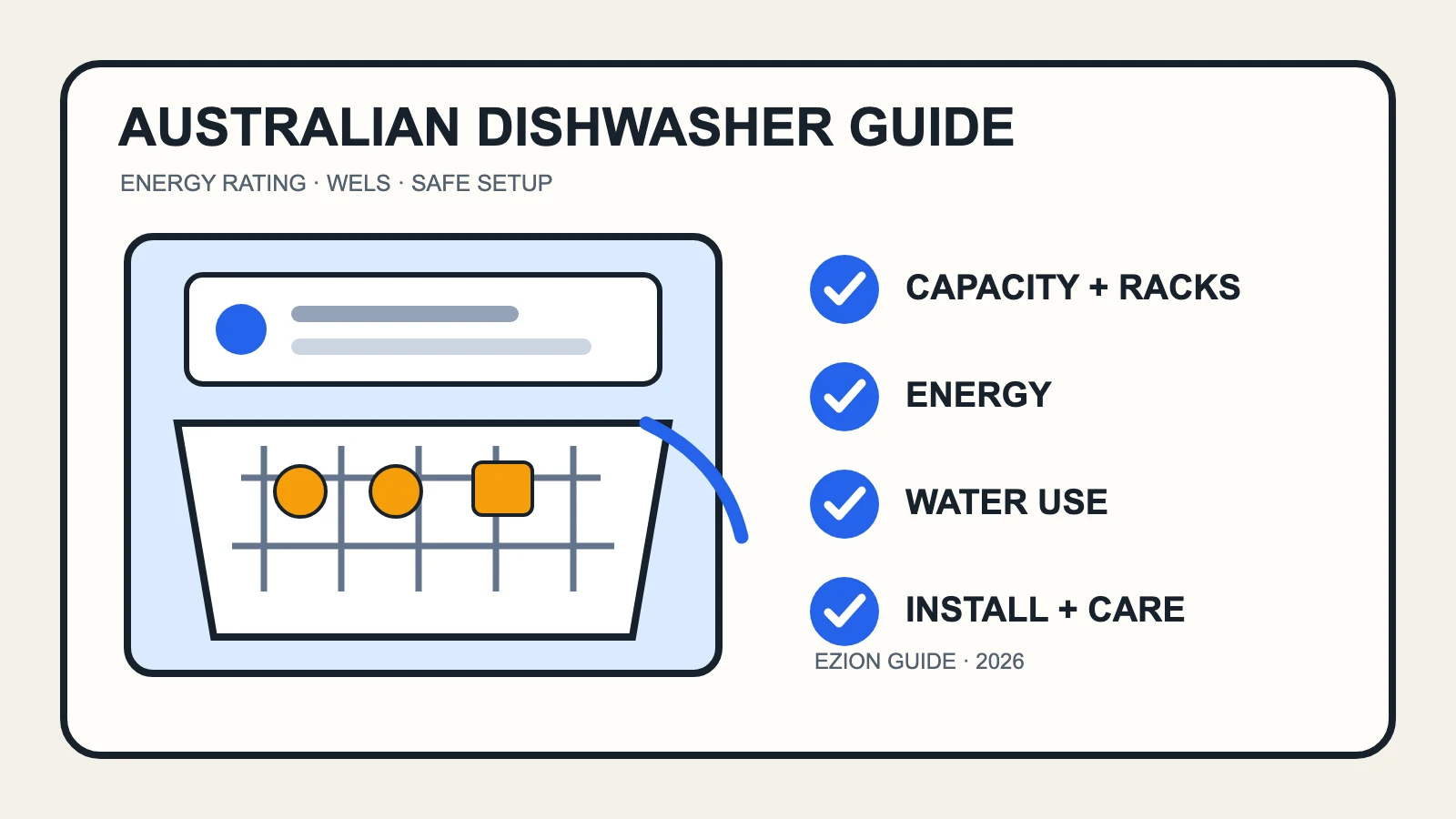
A dishwasher is easiest to choose when you start with the household and the kitchen, not a feature list. Work out how many dishes you normally create, how often you want to run a load, what will physically fit, and how the machine can connect. Then compare like-sized models using both the Energy Rating Label and the Water Rating Label. This guide keeps the focus on dishwasher decisions; use our appliance running-cost guide to estimate label kWh with your tariff, our Energy Rating Label guide for the broader rules, and our washing-machine guide for the neighbouring laundry decision.
1. Choose the format and capacity before comparing features
Begin with the installation format. A freestanding dishwasher is designed to stand as a finished appliance, while an under-bench or integrated model is intended to sit within cabinetry. Compact benchtop models may suit a small household or a kitchen without a full-size cavity, but they still need suitable water, drainage and power arrangements. Do not assume that two products described as “standard” have identical dimensions or connection requirements.
Australian energy guidance groups dishwasher capacity by place settings: full-sized models commonly hold 12 to 15 place settings, slimline models 9 to 10, and compact models up to 8. A place setting is a standardised collection consisting of a large plate, soup bowl, dessert bowl, cup and saucer, glass and cutlery. It is a comparison unit, not a guarantee that your large pans, lunch boxes or unusually shaped crockery will fit.
Choose capacity around a normal load. A larger family or a household that entertains regularly may benefit from more space. A couple or single-person household may be better served by a smaller model if a large unit would sit partly filled for days. Buying more capacity than you use can mean more electricity and water per completed load, while buying too little can force extra cycles. Bring a short list of the awkward items you wash often—large dinner plates, tall glasses, stockpots, chopping boards and reusable containers—and inspect the rack layout rather than relying only on the place-setting number.
Measure the whole installation path
- Measure cavity width, height and depth at more than one point; walls, floors and cabinetry may not be square.
- Check clearance for the door to open without striking an island, kickboard, handle or adjacent drawer.
- Allow for hoses, the power lead and any rear projections specified in the installation instructions.
- Confirm that the appliance can pass through doors, hallways and tight corners on delivery.
- For an integrated model, confirm panel dimensions, hinge system, ventilation and who will fit the cabinet front.
Rack design can matter as much as nominal capacity. Look for adjustable upper-rack height, folding tines, a removable cutlery basket or third tray, and a layout that still lets spray arms rotate when your everyday dishes are loaded. If noise matters in an open-plan home, compare the manufacturer’s declared sound information, but do not treat a showroom impression as a test of performance in your kitchen.
2. Read the Energy Rating Label in the right order
Household dishwashers sold in Australia must meet Minimum Energy Performance Standards and display an Energy Rating Label in stores. The dishwasher label identifies the brand and model, rated capacity, tested program, primary water connection, star rating, estimated annual electricity consumption and program time. The annual consumption estimate assumes seven uses per week and includes the standardised basis shown on the label; your result can be higher or lower.
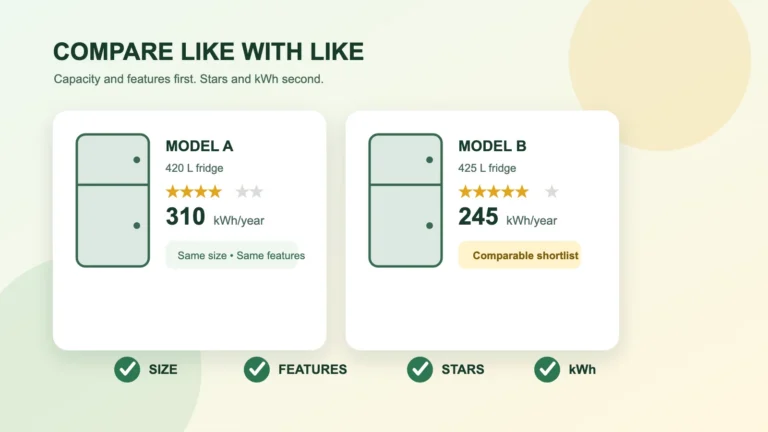
- Match capacity and useful features first. Star ratings are intended for comparison between products with similar capacity and features.
- Compare the stars. Within that like-for-like group, more stars indicate better energy efficiency.
- Compare annual kWh. The lower annual consumption number gives the clearer indication of which similar model is expected to use less electricity under the label assumptions.
- Read the tested program and time. The displayed program time is the duration of the program used for energy testing, not necessarily the duration of every cycle.
Do not compare stars across very different capacities as if they were absolute scores. Official guidance gives the example that a five-star 10-place-setting dishwasher can use more electricity than a five-star six-place-setting model. Also note that revised Energy Rating Labels began phasing in from 4 October 2024, while older labels may remain visible during the transition. Match the exact model number and use the current label data rather than judging a machine by label artwork alone.
If an online listing omits energy information, ask the seller for the label or exact model data before paying. You can also check registered product information through the official Energy Rating Product Database and compare similar registered appliances using the Energy Rating Calculator. Use your own electricity tariff when converting kWh into dollars; do not treat a retailer’s generic cost estimate as your household result.
3. Read the WELS Water Rating Label separately
Energy and water efficiency are separate ratings. Dishwashers regulated under Australia’s Water Efficiency Labelling and Standards (WELS) scheme must be registered and carry the required water-rating information in store or online. On a dishwasher label, check the water-efficiency stars, litres per wash, load capacity, exact model and the cycle used for testing. More WELS stars mean greater water efficiency, but litres per wash remains useful when comparing models with similar capacity.
The tested cycle matters. If one label is based on an eco cycle and another on a normal cycle, note that difference instead of assuming the figures describe every program. A fast, intensive or hygiene cycle may use a different amount of water and energy. The label is a standardised comparison tool, not a prediction for every load.
Before buying—especially from an overseas or marketplace seller—search the official WELS product register using the exact model name or registration number. The regulator says products absent from its database are not registered and that supplying unregistered regulated products is illegal. Check the Energy Rating and WELS records independently because the two schemes report different attributes.
4. Check installation requirements before delivery
Download the exact model’s installation instructions before ordering. Confirm the cavity, water inlet type, permitted supply-water temperature, drain-hose arrangement, electrical supply, ventilation and required clearances. Some dishwashers heat cold water internally; others may permit or rely on a hot, cold or mixer connection. Newer and older buildings can have different connection arrangements, so a connection that worked for the previous machine does not automatically suit the replacement.
Plan a reachable water isolation point and a drain connection that complies with the manufacturer’s instructions and local requirements. The hose must not be crushed, stretched or routed in a way that encourages leaks or backflow. The unit should be level and secured as directed so the racks move correctly and the open door does not make the appliance unstable. Use an appropriate licensed tradesperson whenever plumbing, electrical or cabinetry work requires one in your state or territory.
On delivery, check the model number and visible condition before installation. After installation, keep the receipt, serial number, installation record and manuals together. Run the commissioning procedure specified by the manufacturer and inspect the inlet, drain and surrounding cabinetry for leaks. Do not leave the first cycle unattended.
5. Load for water access, not maximum crowding
Scrape food scraps into the bin or compost. Official dishwasher guidance recommends scraping leftovers and rinsing or wiping only heavily soiled items rather than pre-rinsing every dish under the tap. Unless the manual says otherwise, a full load is generally the efficient target—but “full” means correctly loaded, not packed so tightly that water cannot reach surfaces.
- Face dirty surfaces toward the spray and angle hollow items so they drain.
- Keep tall utensils and plates clear of rotating spray arms and detergent dispensers.
- Do not nest spoons, bowls or containers so closely that wash water cannot enter.
- Place light plastic items where the rack design secures them and follow the item maker’s dishwasher guidance.
- Keep wood, delicate finishes, sharp knives and other questionable items out unless their care instructions permit dishwashing.
Use dishwasher detergent in the quantity and form allowed by the manual; hand-dishwashing liquid can create excessive foam. Adjust rinse aid and dishwasher salt only if the model uses them and local water conditions require it. More detergent is not automatically better and may leave residue.
6. Match the program to the soil
Eco is a sensible default for a normally soiled full load when time allows. Its longer duration does not by itself mean higher consumption; the label’s tested program and figures provide the relevant standardised comparison. Use auto or normal where the manual recommends it, a gentle program for suitable delicate items, and intensive or hygiene options only when the load genuinely needs their higher-temperature or heavier-wash approach.
A short program is primarily a time choice, not proof of lower water or electricity use. Half-load and load-sensing modes can be useful when waiting for a full load is impractical, but their benefit depends on the machine. Delay start may help a household align a cycle with its electricity tariff or daytime rooftop solar generation, provided the load is suitable to wait and the appliance can be operated safely. Check your tariff rather than assuming a particular time is off-peak.
If the model allows it, turn off heated drying or use an automatic door-opening or air-dry option. Official guidance suggests air-drying dishes after the wash. Follow the manual, take care around hot steam, and do not defeat a safety feature to force the door open.
7. Maintain the parts that affect cleaning and drainage
Follow the manual’s schedule rather than inventing a universal interval. Regularly remove and clean the filter, check spray-arm holes for obstruction, wipe the door seals and edges, and remove debris from the sump area only as instructed. Check hoses and connections for moisture, swelling, kinks or damage. Clean mineral scale or grease with a manufacturer-approved method and product; avoid mixing cleaners or using corrosive chemicals.
Poor results are often a loading, program or maintenance issue rather than immediate proof of failure. If dishes remain dirty, check spray-arm movement, filter condition, detergent storage and dose, program choice, water supply and whether items blocked the dispenser. For cloudy glassware or residue, review detergent, rinse aid, water-hardness settings and item care instructions. If the machine will not drain, switch it off safely and inspect only the user-serviceable filter and hose checks described in the manual.
8. Treat leaks, electrical symptoms and recalls as stop signals
Stop using the dishwasher if you see an active leak, smoke, scorching, a burning smell, damaged wiring, repeated electrical tripping or unusual overheating. Isolate power or water only when it is safe to do so, keep people away from the hazard, and arrange qualified service. Do not remove fixed panels or attempt electrical or pressurised-water repairs unless you are authorised and competent to perform that work.
For a recurring fault code, record the full code and when it appears, then consult the exact model manual. Check warranty or Australian Consumer Law options before authorising a paid repair. When buying used—or whenever a safety concern arises—search the ACCC Product Safety recalls database using the brand and exact model. If a recall applies, follow the recall notice and supplier instructions rather than continuing to use the appliance or improvising a repair.
A practical shortlist
- Measure the cavity, access path and door clearance.
- Choose the smallest capacity that handles a realistic full load.
- Compare rack layout using your awkward everyday items.
- Compare Energy stars, annual kWh, tested program and program time across similar models.
- Compare WELS stars, litres per wash, capacity and tested cycle.
- Verify the exact model in the official energy and WELS product records.
- Read installation requirements before purchase and budget for any necessary qualified work.
- Keep the receipt, serial number and manuals, and check recalls over the appliance’s life.
The best choice is not automatically the machine with the most programs, the largest rack or the highest single rating. It is the correctly sized model that fits the kitchen, can be installed as specified, performs the cycles your household will actually use, and has clearly verifiable energy and water information.