Reviewed: 27 August 2026 | Author: Jay Jung
An efficient summer cooling plan starts before the air conditioner. Stop avoidable heat entering the home, use outdoor air only when it is genuinely cooler and safe, move air across people with fans, then cool the smallest useful zone. That order reduces the load on mechanical cooling without pretending every Australian climate, building or household has the same needs.
This guide is about operating a home through hot weather. It complements our winter-focused reverse-cycle heating article and our draught-proofing guide; it does not repeat their heating or permanent sealing work. Comfort and energy use vary with climate, humidity, insulation, glazing, occupancy, equipment and electricity prices. During dangerous heat, health and medical advice outrank a bill-saving target.
1. Read the day before choosing a cooling mode
Check the forecast maximum, overnight minimum, humidity, wind and any local heatwave or smoke advice. Then compare outdoor and indoor conditions rather than following a fixed clock. Opening the house can help when outside air is cooler and clean; it can add heat when the outside is hotter, humid, smoky or still. Security, insects, noise and children also affect whether an opening is practical.
Walk through the home in the morning and identify the surfaces that receive direct sun, especially east-facing glass early and west-facing glass in the afternoon. Note which rooms must stay usable and which can be closed. A household that works in one room needs a different plan from a household with a baby, an older person, shift workers or someone whose health requires controlled temperature.
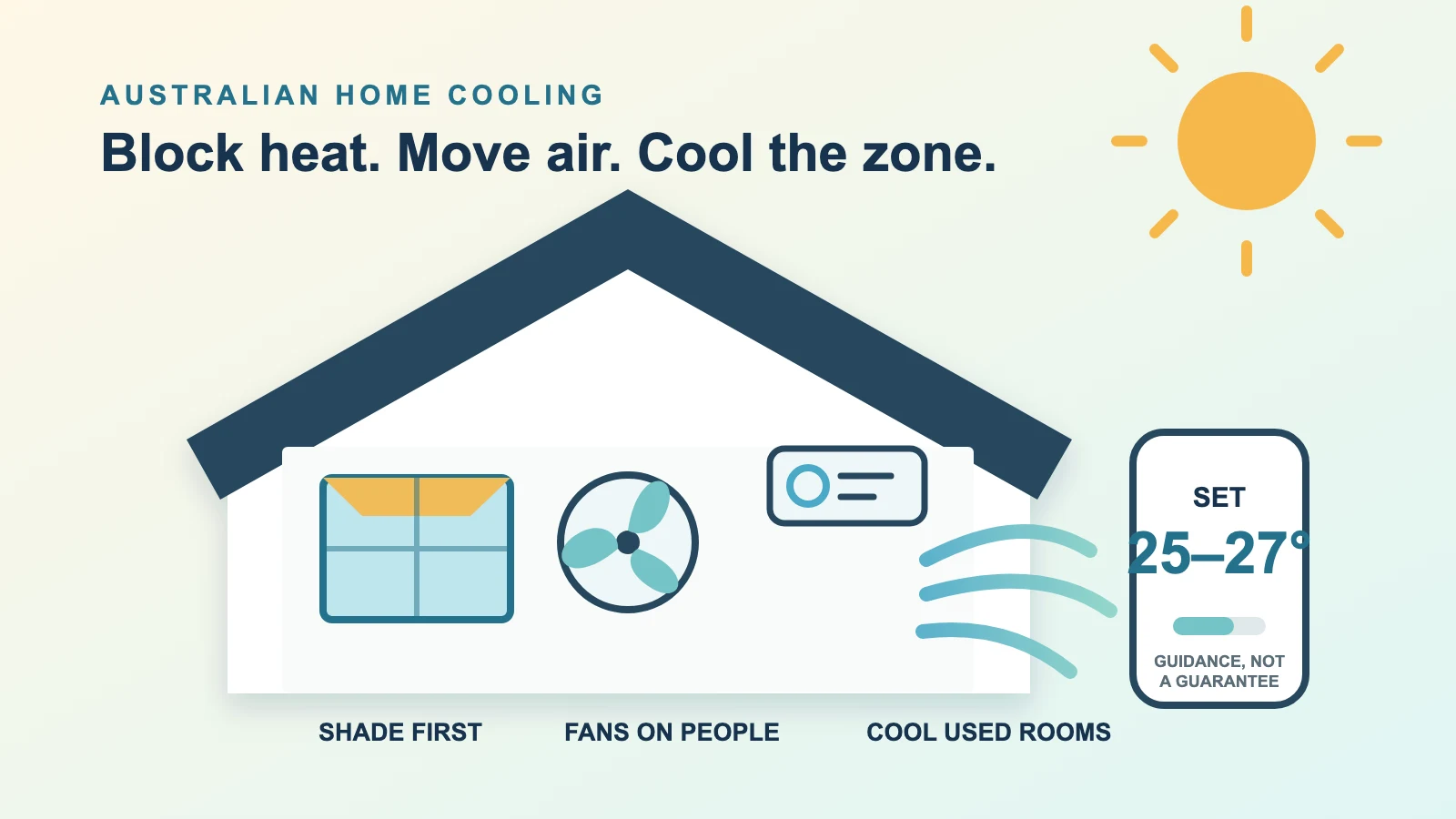
Use a simple hierarchy:
- Exclude heat: shade sunlit glass and reduce unnecessary internal heat.
- Ventilate selectively: purge stored heat only when outdoor conditions improve.
- Cool people: place fans where occupied people feel the airflow.
- Condition a zone: run air conditioning in the rooms that need it, with doors and windows managed for that mode.
- Escalate for safety: if the home remains dangerously hot, use effective cooling or move to a cooler place and follow public-health advice.
2. Keep solar heat outside
Glass can admit strong solar heat long before the room feels uncomfortable. External shading usually intercepts sunlight before it reaches the glass; internal blinds and curtains can still help when external changes are impossible. Use existing eaves, awnings, shutters, outdoor blinds or safe temporary shade as intended, without blocking required exits, vents or appliance clearances. Renters should obtain approval before fixing anything to the building.
Close coverings on the side receiving direct sun, then reopen them when that exposure has passed if daylight is useful. Do not darken every room all day by habit. The useful action is to block direct gain at the relevant window while preserving safe movement and enough light for the occupants.
Reduce avoidable internal heat as well. Delay heat-intensive cooking, clothes drying and other large loads when practical; use extraction as designed; switch off lights and appliances that are not needed. This is not a reason to skip meals or necessary equipment. It is simply a way to avoid adding heat at the same time the cooling system is trying to remove it.
Insulation, glazing, roof colour, permanent exterior shading and landscaping can reduce future cooling loads, but they are building projects, not emergency tips. Compare those upgrades in the context of the whole home, winter performance, moisture control, bushfire or cyclone requirements, approvals and budget.
3. Ventilate when outdoor air is the better heat sink
Night purging means replacing warm indoor air with cooler outdoor air. It works best when the overnight outdoor temperature drops enough, there is a usable path through the home, and the air is safe to bring inside. Openings on more than one side can create cross-flow; a fan near an opening can assist. But natural ventilation is not guaranteed simply because it is night.
Before opening windows or doors, check outdoor temperature, humidity, smoke, pollen, wind, rain, security and noise. Keep flyscreens, restrictors and locks operating as designed. Never compromise pool barriers, child safety or home security for airflow. In hot humid conditions, bringing in outdoor air may add moisture without delivering much relief. In smoke events, follow official air-quality and emergency advice instead of this general cooling sequence.
Close the house again when outdoor conditions become less favourable, then shade sunlit openings. A thermometer in the living zone and another outdoors can make the decision clearer than guessing. The aim is not to keep the home sealed or open continuously; it is to switch modes when the direction of useful heat flow changes.
4. Use fans to cool people, not empty rooms
Fans move air and can improve how people feel, but they do not lower the room’s air temperature. The Australian Government says the perceived effect can be around 3°C. Treat that as an explanation of comfort, not a measured result promised for every person or room. Humidity, air speed, clothing and individual health all matter.
Place a pedestal, desk or ceiling fan so airflow crosses the occupied area. A ceiling fan over seating or a bed is more useful than one centred over an empty walkway. Turn personal fans off when no one is benefiting, unless they are intentionally helping exchange air through an opening. Use stable placement, guards and cords as designed, especially around children, pets and walkways.
Fans and air conditioning can work together. Air movement may let occupants feel comfortable at a higher thermostat setting, reducing the temperature difference the air conditioner must maintain. This is an operating choice, not a universal prescription: anyone with heat-sensitive health needs should follow their clinical or public-health advice.
5. Run air conditioning as a controlled zone
When air conditioning is needed, close exterior doors and windows in the conditioned zone and close doors to rooms that do not need cooling, unless the system design or safety instructions require another arrangement. Keep supply and return-air paths unobstructed. Avoid placing heat-producing equipment or direct sun near a thermostat where it can distort the reading.
Federal household guidance recommends a summer setting between 25°C and 27°C and notes that each degree of extra cooling can increase energy use by 5% to 10%. Those figures are general guidance, not a guarantee of comfort, safety or savings in a particular home. Start from an appropriate safe setting for the occupants, use fans where suitable, and adjust based on real conditions.
Do not repeatedly force the set point far below the desired room temperature in the belief that the unit will cool faster. Use the normal cooling mode, a practical set point and a timer or schedule if the manufacturer supports it. On a forecast very hot day, official northern-Australia guidance suggests that starting before the home becomes extremely hot can help the system maintain conditions more efficiently. Whether that helps depends on the building, tariff, solar generation and equipment.
Clean filters at the interval in the manufacturer’s instructions and stop if safe access is not available. Keep outdoor and indoor units clear as specified; do not open electrical or refrigerant components. Unusual noise, leakage, ice, burning smell, repeated tripping or poor cooling after basic user maintenance warrants qualified service. A dirty filter or blocked airflow can reduce performance, but not every performance problem has a do-it-yourself fix.
6. If buying a unit, size the room before comparing stars
An oversized unit is not automatically better, and an undersized unit may run hard without maintaining the space. Capacity depends on floor area and volume, insulation, window size and orientation, shading, occupancy, local climate and other heat gains. Ask a suitably qualified supplier or technician to explain the sizing assumptions rather than accepting a floor-area shortcut alone.
For non-ducted household air conditioners, use the Zoned Energy Rating Label. It provides cooling and heating capacity, climate-zone star ratings, estimated annual energy use under standard assumptions and indoor/outdoor noise information. Compare models of a suitable type and capacity in the zone that applies to the property. More stars do not rescue a unit that is the wrong size or poorly installed.
The annual kWh on the label is a comparison estimate, not your future bill. Actual use depends on weather, set point, hours, building performance and tariff. To turn measured electricity into a household cost, use the method in our appliance running-cost guide. For a broader explanation of label assumptions, continue with our Energy Rating Label guide.
Installation quality matters. Ask about indoor airflow, outdoor-unit shade and clearance, drainage, electrical work, refrigerant handling, controls, commissioning and maintenance. Use appropriately licensed trades and retain compliance and warranty records. Renters and strata residents should obtain required written approval before fixed work.
7. A practical 24-hour hot-day plan
- The evening before: read the local forecast and warnings; identify who needs the coolest room and whether medical or emergency plans apply.
- When outside becomes cooler: ventilate only if air quality, humidity, weather and security allow. Use cross-flow or a fan to remove stored heat.
- Early morning: close openings when the outdoor advantage ends. Shade the glass that will receive sun and prepare water, meals and necessary medicines.
- Before peak heat: minimise avoidable indoor heat, keep people in the best-performing zone and use fans directly on occupants where appropriate.
- When mechanical cooling is needed: condition the useful zone, close it appropriately, choose a safe practical set point, and combine with a fan if suitable.
- Through the afternoon: check people, not just the thermostat. Watch local advice and do not wait for the building to become unsafe before escalating.
- After outdoor conditions improve: decide whether to switch back to ventilation. Record what worked so the next hot day starts with evidence.
For renters, the same sequence works without structural alterations: existing blinds or curtains, safe window timing, portable fans, closing internal doors where appropriate and using installed cooling correctly. Report broken blinds, unsafe windows, failed installed cooling or other property issues through the proper tenancy channel. Do not improvise electrical work or unsafe window coverings.
8. Know when energy saving stops being the priority
Heat can be dangerous. Babies, older people, pregnant people, outdoor workers and people with some disabilities, medicines or chronic conditions may be at greater risk. General thermostat guidance is not medical advice. Follow current state or territory health warnings, a clinician’s plan and emergency instructions. Check on vulnerable household members and neighbours where safe to do so.
If effective cooling is unavailable, consider an accessible cooler location before conditions become severe. In an emergency, use the emergency services appropriate to your location. Saving energy should never require remaining in unsafe heat, ignoring symptoms or turning off medically necessary equipment.