Portable power station planning
Match the load before you choose the battery
Editorial disclosure: Ezion Guide has no affiliate relationship with portable power station brands mentioned by readers, and this guide does not recommend a product. We have not hands-on tested or ranked individual units. Examples are planning aids only; they do not guarantee savings, usable capacity, performance or runtime.
A portable power station is a rechargeable battery unit with outlets for plug-in appliances and electronics. It can keep selected essentials running during an outage, support a campsite or provide power where a wall outlet is inconvenient. It is not the same as a fixed home battery, and it must never be improvised into a home switchboard or power point.
The useful question is not “Which unit is best?” It is “Which loads must I support, for how long, and can this unit supply them safely?” Start with the appliances, not a brand or a large capacity number.
First decide what the unit must do
Write a short priority list. During an outage, it might include a modem, one lamp, phones, a laptop and perhaps a refrigerator. Separate necessities from conveniences. Kettles, portable heaters, hair dryers, coffee machines and cooking appliances can demand far more power than communications gear and lighting, so one high-power appliance can determine the size of the whole system.
- Outage communications: modem/router, charged phones, radio and a light.
- Food or medicine: a refrigerator, freezer or approved medical device, with a separate contingency plan.
- Work: laptop, monitor and internet equipment.
- Occasional use: camping equipment or tools within the unit’s outlet and environmental limits.
If your priority is internet continuity, first reduce the load and understand which network equipment still operates during a wider outage; see our NBN outage planning guide. For whole-home solar storage, tariffs and fixed installation questions, use our fixed home battery guide instead.
W and Wh answer different questions
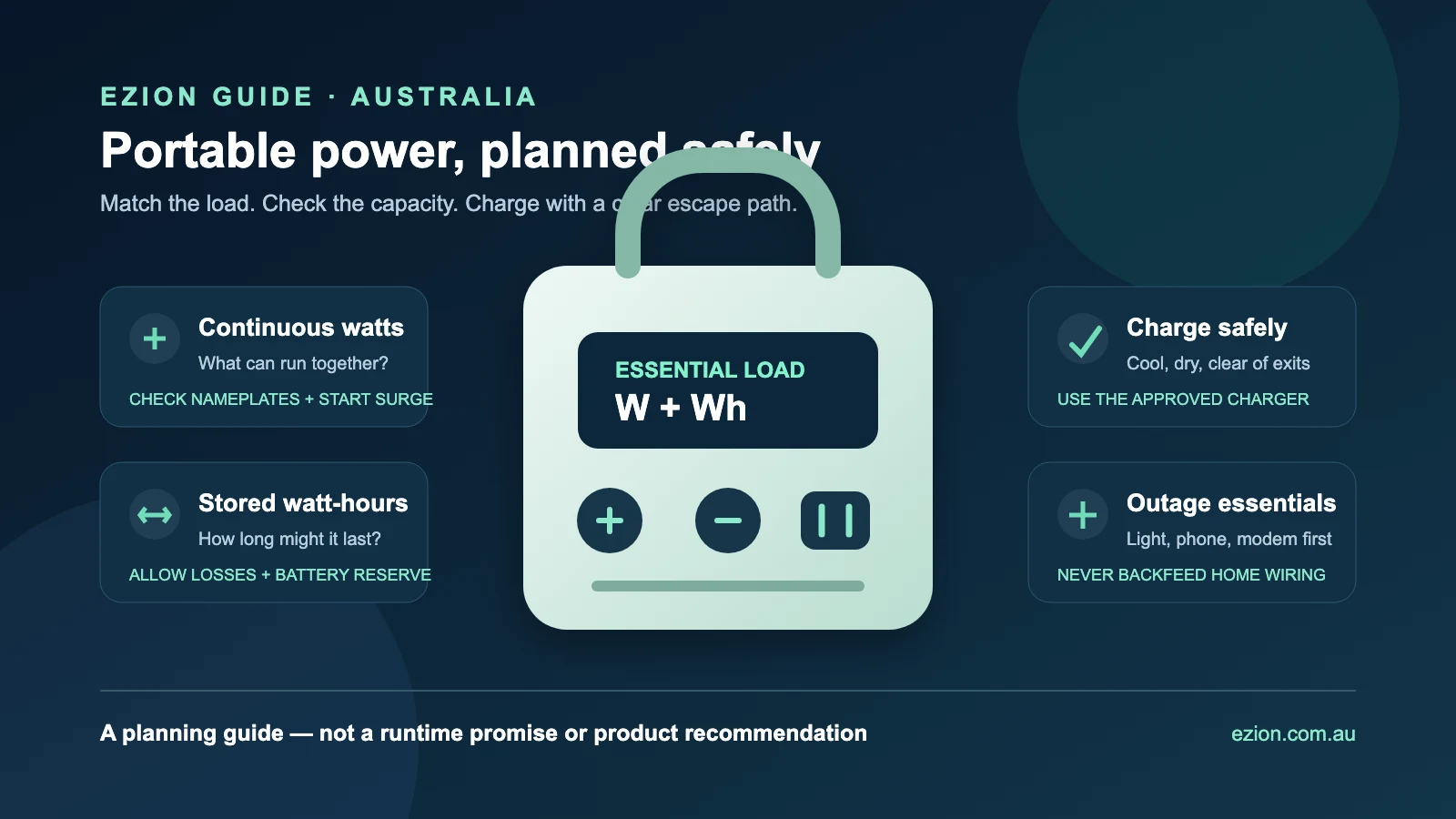
Watts (W) describe instantaneous power: how much power connected equipment asks for at a moment. A power station’s continuous AC output must cover the combined running watts of everything used at once. Equipment with a motor or compressor may also draw a brief starting surge, which must remain within the manufacturer’s stated surge limit and conditions.
Watt-hours (Wh) describe stored energy. A 1,000 Wh label is not a promise that 1,000 Wh will reach an AC appliance. Inverter conversion, battery management, temperature, cable losses, the type of load and a protective battery reserve all reduce usable output. Compare capacity on a consistent basis and read how the manufacturer defines rated and usable capacity.
| Check | Planning method | Important limit |
|---|---|---|
| Running load | Add the nameplate watts of devices used together. | Keep the total within continuous output. |
| Starting load | Identify motors and compressors; check their documented start demand. | Keep the event within the stated surge limit and duration. |
| Energy required | Device watts × hours of use = estimated Wh. | Add realistic allowance for losses and reserve. |
| Rough runtime | Estimated usable Wh ÷ combined load W = planning hours. | Not a guarantee; real loads and conditions vary. |
Example: a 15 W modem used for six hours represents 90 Wh before losses. A 60 W laptop used for three hours represents 180 Wh. Together that is 270 Wh before allowing for conversion losses and reserve. This arithmetic helps compare requirements; it does not predict an exact runtime. A refrigerator is harder to estimate because its compressor cycles and may have a much higher start demand than its ordinary running draw.
Make a load sheet before buying
- Read each device’s rating label or manual. Do not rely on a generic online wattage list when the actual nameplate is available.
- Record watts. If only volts and amps are shown, ask the appliance or power-station manufacturer for appropriate guidance rather than assuming a simple calculation captures power factor or surge behaviour.
- Mark which devices must run simultaneously and which can be scheduled one at a time.
- Check the power station’s continuous output, surge limit, outlet-specific limits and any lower limit that applies while charging and supplying power together.
- Estimate daily Wh, then include conversion losses and a reserve rather than planning to drain the displayed capacity completely.
Queensland’s generator guidance correctly illustrates the load principle: add connected appliance wattages and account for higher motor starting demand. A portable battery power station, however, is not a petrol or diesel combustion generator. It produces no exhaust in normal operation, has different operating limits, and its manual—not generator rules of thumb—controls its use.
Check the product, supplier and charger
Buy from a reputable supplier that provides clear Australian contact details, warranty support, a readable manual and specifications for continuous output, surge output, charging and operating temperatures. Keep the receipt, model and serial number. Check Product Safety Australia recalls before purchase and periodically during ownership.
There is no general mandatory safety standard covering lithium-ion batteries or products containing them. The Regulatory Compliance Mark (RCM) is relevant to electrical equipment that falls within the applicable Australian electrical equipment framework, including an in-scope mains charger. It is not a universal certification of battery-cell quality, total product safety or suitability for your intended load. Check the equipment and charger markings, but also assess the supplier, instructions, protections and recall status.
Use only the charger supplied with the unit or a compatible, manufacturer-approved replacement. “The plug fits” is not proof of compatibility. Do not modify the battery, charging port, cable or inverter, and do not combine parts from unrelated systems unless the manufacturer expressly approves that configuration.
Charge and store it with a clear escape path
Lithium-ion batteries can be highly flammable. Charge the unit in a cool, dry, ventilated location on a stable non-combustible surface, away from beds, sofas, carpet, curtains, paper and other combustible material. Keep it away from direct sun, rain, heaters and hot parked vehicles. Do not charge or store it in an exit, stairway or route people need to escape.
- Follow the manual’s clearances and never block cooling vents.
- Allow the battery to cool after heavy use before charging.
- Monitor charging and disconnect it when the manufacturer instructs; do not routinely leave it charging unattended or while everyone is asleep.
- Keep plugs, leads and outlets dry. Fully inspect cables before use and avoid overloaded boards or unsuitable extension leads.
- Prevent children or pets from accessing buttons, outlets and cables.
Some models advertise pass-through or UPS-like operation. Do not assume either feature is suitable for critical medical equipment or every appliance. Check transfer behaviour, grounding arrangements, output waveform, manufacturer limitations and the requirements of the connected equipment. For life-support or temperature-sensitive medicine, obtain advice from the equipment or healthcare provider and maintain a backup plan that does not depend on one consumer battery.
Never connect it into home wiring yourself
Plug approved appliances directly into the power station within its instructions. Never use a double-ended lead, “suicide lead”, modified power board, wall outlet or other method to feed power backwards into household wiring. Backfeeding can energise wiring unexpectedly and expose occupants, neighbours and electrical workers to fire or electric-shock hazards.
A portable unit is not a substitute for a compliant fixed backup installation. Any connection intended to supply fixed home circuits, a switchboard or transfer equipment must be assessed and installed by a licensed electrician using equipment designed and approved for that purpose. Do not open, earth, bond or alter a unit based on social-media advice.
Inspect before every important use
Stop using and charging the unit if you notice swelling, leaking, hissing, unusual odour, smoke, excessive heat, discolouration, a cracked or crushed case, damaged ports, water exposure or a dropped unit that may have internal damage. Disconnect power only if it is safe to do so, keep people away and follow the manufacturer’s damaged-battery instructions. Do not puncture, compress or attempt a DIY cell repair.
Test an outage plan before storm season without deliberately overloading the unit: charge it according to the manual, power only the planned devices, confirm cables reach safely without crossing walkways, and note the displayed energy use. Recheck the plan when appliances change. A low-power lighting and communications plan usually gives more flexibility than trying to run every normal household load.
If it smokes or catches fire
Treat smoke, popping, violent hissing, flames or rapidly increasing heat as an emergency. Warn others, evacuate to a safe place and call Triple Zero (000). Do not remain near the unit to unplug, move or fight it. Lithium-ion battery fires can be difficult to extinguish and may reignite. Product Safety Australia says extinguishers marketed for lithium-ion battery fires should be used only by trained professionals and are not safe for the general public; this guide therefore does not recommend a consumer extinguisher method.
Recalls, transport and end of life
Register the product if the supplier offers safety notices, and search recalls by brand and model. If it is recalled, follow the recall instructions rather than continuing to use, charge, sell or give it away. Before transporting a unit, check its manual and the carrier’s rules; airline and freight restrictions can depend on battery specifications and are not covered by this general guide.
Do not put a lithium-ion power station or battery in household rubbish, kerbside recycling or hard-waste collection. Batteries can be crushed in trucks and facilities. Ask your council, an approved battery-recycling service or the supplier for an appropriate drop-off route. Tell the facility in advance if the unit is damaged, swollen or recalled, and follow its acceptance and packaging directions rather than transporting an unstable battery without advice.
A practical outage checklist
- List essential devices, nameplate watts, start loads and daily hours.
- Confirm total continuous W, surge W and estimated Wh fit the unit’s documented limits.
- Keep charged torches, a radio, phone power banks and non-electric alternatives as redundancy.
- Store manuals, model details and emergency numbers where the household can find them.
- Place the unit away from combustibles, moisture, heat and escape routes.
- Check damage, leads, vents and recall status before use.
- Use appliances directly; never feed a home circuit.
- Review normal appliance costs separately in our appliance running-cost guide; a power station does not create free energy or guarantee a lower bill.
Official sources
- Product Safety Australia: Lithium-ion batteries guide
- ACCC: Use and store lithium-ion batteries safely
- Fire and Rescue NSW: Battery and charging safety
- Electrical Safety Office Queensland: Buying and using electrical equipment
- Electrical Safety Office Queensland: Powering appliances with generators (load principles; a battery power station is not a combustion generator)
- Product Safety Australia: Consumer product recalls
Bottom line: choose from a written load plan, verify both W and Wh, leave room for losses and starting demand, and treat charging location and condition checks as part of ownership. If your plan involves fixed wiring, critical equipment or an unclear electrical arrangement, stop and get advice from the manufacturer, a licensed electrician or the relevant professional.