Reviewed: 18 August 2026 · Written by Jay Jung
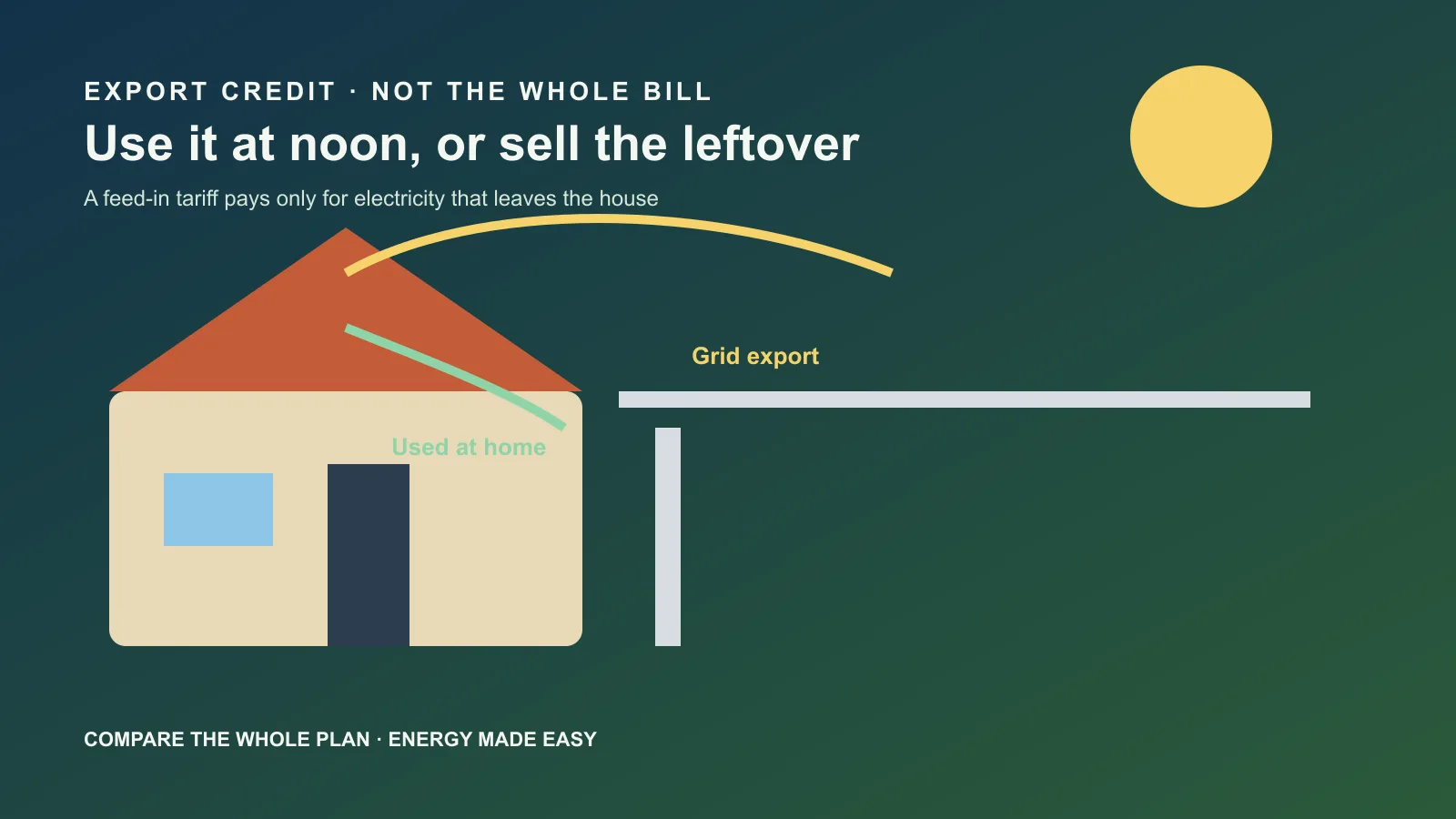
A rooftop solar system does two money jobs. The first, and the larger one for most households, is electricity you do not buy because you used it yourself. The second is a feed-in tariff: a credit for unused generation that leaves the house and enters the grid.
Those two jobs are easy to mix up. A high advertised feed-in rate looks like the whole solar story. It is not. The Australian Government describes feed-in tariffs as payments for excess small-scale solar or wind generation, and it is explicit that plans and amounts vary among retailers. There is no single national rate you can bank on.
This guide is about that second payment: who sets it, how to read a benchmark, why it is usually much smaller than the retail price you pay, and when chasing a headline rate is the wrong decision. How to move washing, hot water and other flexible loads into the solar window belongs in our rooftop solar self-consumption guide. How to size and specify a battery belongs in our home battery guide.
What a feed-in tariff actually pays
A feed-in tariff is a credit for exported kilowatt-hours. It is not a rebate on the system purchase, not a discount on the daily supply charge, and not a guaranteed return on the panels. You earn it only on electricity that left the property.
The Commonwealth comparison site Energy Made Easy is the place official pages send households for solar plans. The energy.gov.au feed-in tariff page is a short national summary: retailers set the offers, amounts vary, and you compare the plan rather than a single number.
If you still have a closed legacy premium scheme from an earlier state program, that contract is a separate legal object. This article is about the open market offers a household can take or leave today.
Who sets the rate
In New South Wales, IPART is clear. Retailers can choose whether to offer a solar feed-in tariff at all, and they decide the level. Most offers are a single all-day rate. A smaller number vary by the time of export.
IPART does not force retailers to sit inside its benchmark. The benchmark is a guide to what exported solar is roughly worth, based on the wholesale price retailers would otherwise have paid in the National Electricity Market.
Victoria has its own Essential Services Commission process for minimum feed-in tariff settings. Do not copy a comparison-site figure into a decision. Open the current ESC determination, then still compare the whole retail offer. Other states and territories also leave the live offer with retailers. Treat any unofficial table of “best rates” as advertising unless it cites the current official instrument.
The NSW 2026–27 benchmark is a ruler, not a promise
IPART’s all-day solar feed-in benchmark for 2026–27 is 3.4 to 6.5 cents per kilowatt-hour. That is slightly lower than the 2025–26 range of 4.8 to 7.3 c/kWh. IPART says the move reflects wholesale prices expected to be a bit lower in 2026–27 at the times solar is exporting.
Read the units. The official page writes the 2026–27 all-day range as 3.4 to 6.5 c/kW in one table heading and discusses cents per kilowatt-hour in the surrounding explanation. The quantity being valued is exported energy, so the working comparison is cents per kilowatt-hour.
A retailer offer below the range is not automatically unlawful. A retailer offer above the range is not automatically a better bill. IPART’s own advice is to look at the entire energy plan, your consumption and your solar exports on Energy Made Easy, because a higher feed-in rate can sit next to higher usage prices or extra conditions.
Why the credit is smaller than the price you pay
Households often expect export to be paid at the same rate they buy electricity. IPART explains why that does not happen. When exported solar is supplied to someone else, the retailer still pays network charges for using the grid — IPART notes those can be around 30 c/kWh during peak times — plus environmental obligations and the cost of running billing and customer service. Those costs sit on the retail price. They do not sit on the wholesale value of midday solar.
So a household that exports at five cents and later buys at thirty-plus cents is not being short-changed by a hidden fee so much as paying for a different product: delivered, networked electricity at a different time of day.
That is also why using a kilowatt-hour at noon, instead of exporting it and buying another one at 7pm, is usually the higher-value move. Our rooftop solar self-consumption guide walks through that shift. This page stops at the export credit.
Time-of-day credits and export charges
A small number of NSW retailers pay different rates depending on when you export. IPART publishes separate time-of-day benchmark ranges for that reason. Midday solar is abundant. Evening electricity is more expensive to buy in the wholesale market. A time-varying credit tries to reflect that shape.
Separately, IPART describes network tariffs for solar exports introduced in 2024. Distributed network service providers — Ausgrid, Endeavour Energy and Essential Energy — set those tariffs subject to Australian Energy Regulator approval. They can include a charge for solar exports during certain daytime hours after a free threshold, and a rebate for exports in the evening peak. IPART does not set those network charges. It says its 2026–27 benchmarks already fold their effect in: the bottom of the all-day range moves by less than 0.1 c/kWh, midday time-of-day benchmarks are 0.4 to 0.6 c/kWh lower, and evening benchmarks are around 4 to 12 c/kWh higher.
If your bill suddenly shows an export charge, that is a network price signal, not a broken inverter. Confirm the threshold and the hours with your network and retailer before you change hardware.
Compare the whole plan, not the headline cent
Energy Made Easy is the official comparison service. Use it with your postcode, your usage, and a recent solar export figure from the bill or inverter app. A plan that advertises a high feed-in rate can still cost more if the usage rate, daily supply charge or controlled-load rate is worse for your pattern.
Our electricity-plan comparison guide covers the rest of that bill. Our home energy guide is the hub for this cluster. Come back here only for the export line.
Watch for conditions: a high rate that applies only to the first few kilowatt-hours each day, a rate that requires you to buy the system from the same retailer, or a rate that expires after a promotional period. Those conditions are part of the price.
When a load shift or a battery beats a better feed-in tariff
IPART’s own page asks whether you should invest in panels or a battery and then sends you to the Australian Government Solar Consumer Guide and to SunSPOT, a not-for-profit calculator. That is the right order. A feed-in tariff is a residual. It pays for electricity you could not use.
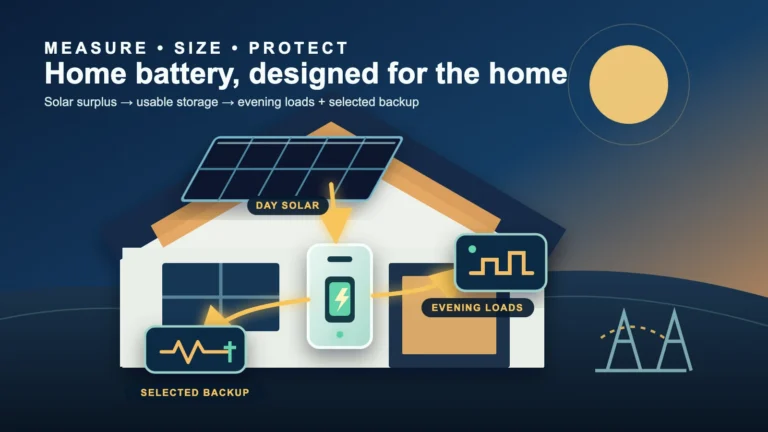
If your inverter app shows a large midday export and a large evening import, the next design question is not which retailer pays one cent more for export. It is whether a timed load or a battery can keep more of that midday energy in the house. Our home battery guide covers usable capacity, federal certificate support, backup circuits and warranties.
No calculator, including SunSPOT, can promise your bill. Roof, usage, tariffs, export charges and hardware all move. Recheck the same inputs after a move, a new work-from-home pattern, or a large evening load such as a car charger, because those changes move the value of leftover export.
Feed-in tariff checklist
- Read the export line on a recent bill. Write down kilowatt-hours exported and the credit rate.
- Confirm whether you are on an open market offer or a closed legacy scheme.
- Compare whole plans on Energy Made Easy with your usage and export, not the feed-in rate alone.
- If you are in NSW, treat 3.4–6.5 c/kWh as IPART’s 2026–27 all-day ruler, not a legal minimum.
- If you are in Victoria, open the current ESC minimum feed-in tariff determination rather than a blog table.
- Check whether the offer is all-day or time-of-day, and whether a daily cap applies.
- If an export charge appears, confirm the network tariff hours and free threshold before changing equipment.
- If you export at noon and buy at night, read the self-consumption and battery guides before chasing a higher feed-in tariff.
- Recheck the offer when the next financial-year benchmarks are published.
Official sources
- energy.gov.au — Solar feed-in tariff
- Energy Made Easy — Solar plans
- Energy Made Easy — Compare energy offers
- IPART — Solar feed-in tariffs
- Australian Government — Solar Consumer Guide
- energy.gov.au — Solar PV and batteries
- Essential Services Commission Victoria — Minimum feed-in tariff
- SunSPOT — Solar and battery calculator
Disclosure: Ezion Guide has no affiliate relationship with any energy retailer, network business, calculator or government body mentioned here. This general information does not guarantee any credit, saving, payback or eligibility. Retailer offers, network export tariffs, state determinations and hardware rules change. Confirm current details with your retailer, network and the relevant regulator.