By Jay Jung · Reviewed 11 September 2026
An induction cooktop can be quick, controllable and practical, but the right choice starts before you compare brands. Check the kitchen opening, electrical capacity, cookware, ventilation and the way your household cooks. A portable single-zone unit can be a low-commitment trial; a built-in cooktop is a fixed electrical and cabinetry project. This guide owns that induction-specific decision. Use our gas-versus-electric home guide for the whole-home fuel choice, our appliance running-cost guide for tariff calculations, and our complete home energy guide for upgrade priorities beyond the kitchen.
1. Decide whether induction suits your kitchen and cooking
Induction creates a changing magnetic field beneath the glass, which heats compatible cookware rather than relying on a glowing element or gas flame. The pan becomes the main heat source. That generally gives fast response and leaves less waste heat around the cooktop, although the glass can still become hot from the pan. It is not “cold cooking”, and normal burn and fire precautions still apply.
Start with real meals. Count how many pans you use at once, note the diameter of their flat bases, and identify anything unusually heavy or wide. A nominal four-zone surface may not run four large pans comfortably, and some models reduce power when several zones share one electrical supply. Flexible or bridging zones may help with long cookware, but only if their stated dimensions match what you own.
Controls deserve a practical check. Wet fingers, spills, small labels and crowded pans can make some touch panels awkward. Look for clear heat levels, a positive off control, a timer you understand, a child or control lock where useful, and visible residual-heat warnings. If someone in the household has limited vision, dexterity or hearing, assess contrast, feedback and reach rather than assuming a premium interface is easier.
2. Test cookware before replacing it
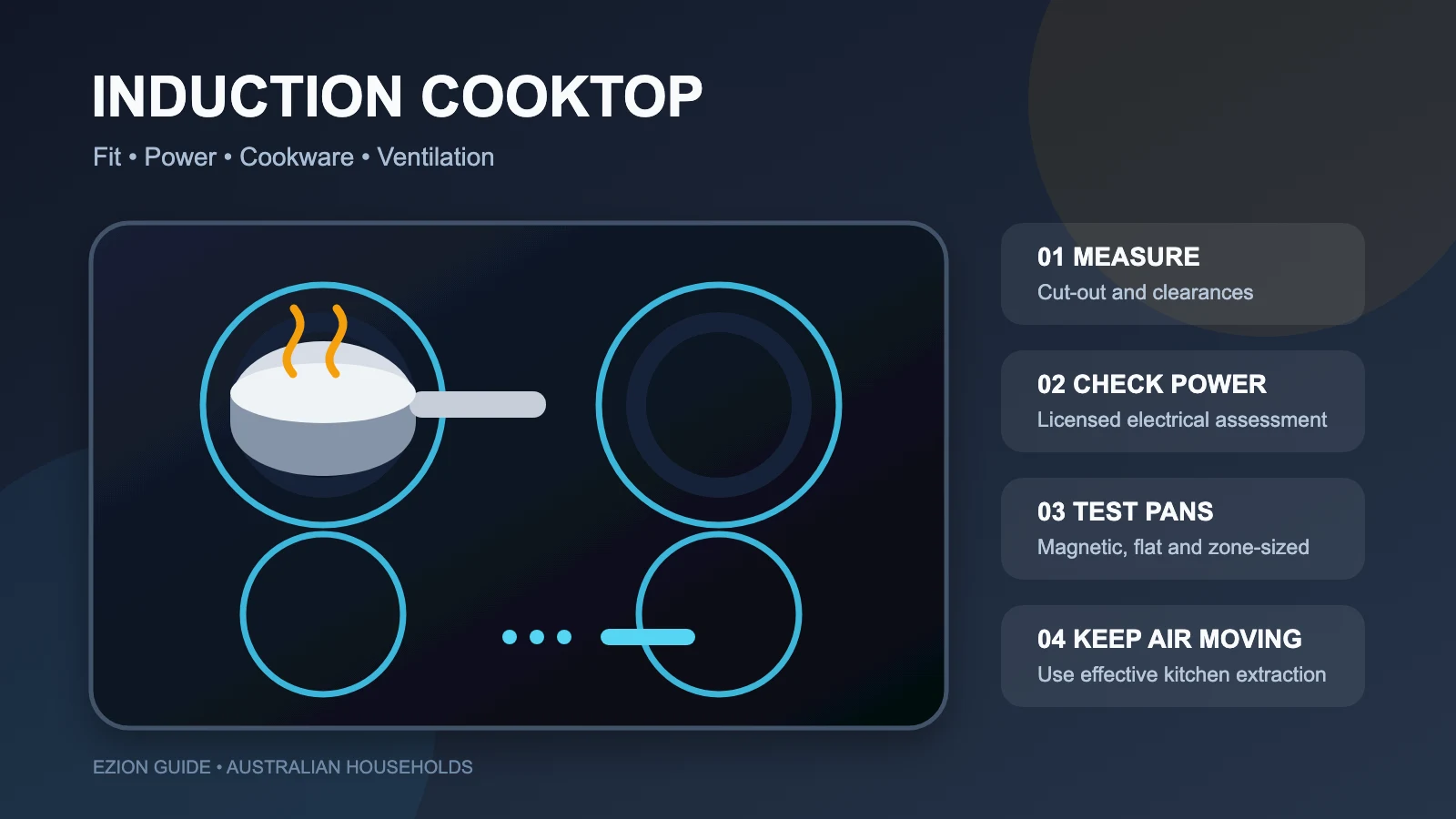
Induction needs a magnetic base. Cast iron and many magnetic stainless-steel pans work; aluminium, copper, glass and some stainless steel will not work unless the base contains a suitable magnetic layer. Put an ordinary fridge magnet on the flat underside: a firm attraction is a useful first check, but the cooktop maker’s size and material rules still decide compatibility.
Inspect more than the magnet test. The base should be flat enough to make stable contact, large enough for the zone to detect, and free of grit that could scratch the glass. Warped pans may heat unevenly or trigger poor detection. Very small coffee pots, rounded woks and oversized griddles can need a purpose-designed zone or accessory. Do not assume an “induction-ready” label means every item fits every cooktop.
If most of your cookware fails, include replacement cost in the decision. Keep good compatible pans instead of buying a matching set for appearance. For a built-in purchase, take the base diameter of your smallest and largest regular pans to the showroom or compare them against the manual’s detection ranges.
3. Treat the electrical check as a buying step
A built-in induction cooktop can be a substantial fixed load. Before ordering, give a licensed electrician the exact model installation sheet and ask them to assess the switchboard, available circuit capacity, cabling, isolation, protective devices and the manufacturer’s connection options. Some models can be configured to a lower maximum demand; that may reduce simultaneous full-power performance. Do not choose a product on the assumption that an old electric or gas cut-out can simply be reused.
Australian Government electrification guidance says electrical and gas work may legally require qualified professionals and can be dangerous. The Household Energy Upgrades Fund page is also explicit that any electrical work for an eligible induction-cooktop installation must be completed by an electrician holding a current licence for the relevant state or territory. Requirements differ across jurisdictions, so a retailer’s national installation package is not a substitute for a site-specific check.
Measure the benchtop cut-out, overall appliance size, depth below the bench and clearances to drawers, ovens, combustible surfaces and ventilation paths. Check whether the existing cut-out is too large as well as too small. Stone cutting, cabinet changes, a new circuit or switchboard work can dominate the project cost. In an apartment, also check owner or strata approval, building access and any restrictions on gas disconnection before committing.
4. Keep cooking ventilation in the plan
Moving from gas to induction removes combustion at the cooktop, but cooking itself still creates steam, grease, odours and particles. The Australian Centre for Disease Control identifies gas cooktops and stoves as possible indoor sources of carbon monoxide and nitrogen dioxide, and recommends using a high-efficiency exhaust fan vented outdoors when cooking. Induction changes the combustion source; it does not make extraction unnecessary.
Check that the rangehood covers the cooking area, vents where intended, has clean filters and can be operated whenever cooking produces fumes or moisture. Recirculating systems and ducted systems behave differently. Follow the appliance and rangehood clearance instructions and obtain qualified advice if cabinetry or ducting must change. Open a window only when outdoor air is suitable and doing so does not conflict with bushfire-smoke or other air-quality advice.
5. Compare useful specifications, not feature count
Australian cooking appliances generally do not carry the familiar appliance Energy Rating stars. The government’s appliance guidance says larger cooking appliances often use more energy, while induction is an efficient electric alternative to an old gas cooktop. Without a star label, compare models using the exact documentation and your intended use rather than a retailer’s broad “energy saving” badge.
- Zone fit: usable diameters and whether adjacent pans can sit flat without covering controls.
- Power management: total connected load, configurable limits and what happens when boost is used on shared zones.
- Controls: direct level selection, timer behaviour, lock, pause and clear residual-heat indication.
- Cleaning: edge treatment, frame or frameless join, and access around the controls.
- Service: warranty terms, local repair path, parts availability and the process for a cracked surface or failed zone.
Do not equate maximum wattage with normal consumption. Energy is power multiplied by time, and the cooktop cycles or adjusts output after the pan reaches temperature. Your bill depends on cooking duration, heat level, pan fit, food quantity and electricity tariff. Use the model’s rated input to check installation; use measured or realistic cooking time with your tariff to estimate cost.
6. Calculate running cost without promising savings
For a simple estimate, multiply electrical energy in kilowatt-hours by your usage tariff. If a cooking task averages 1.2 kW for 30 minutes, the energy is 1.2 × 0.5 = 0.6 kWh. At 35 cents per kWh, that example costs 21 cents. It is an illustration, not a measured result for a particular cooktop.
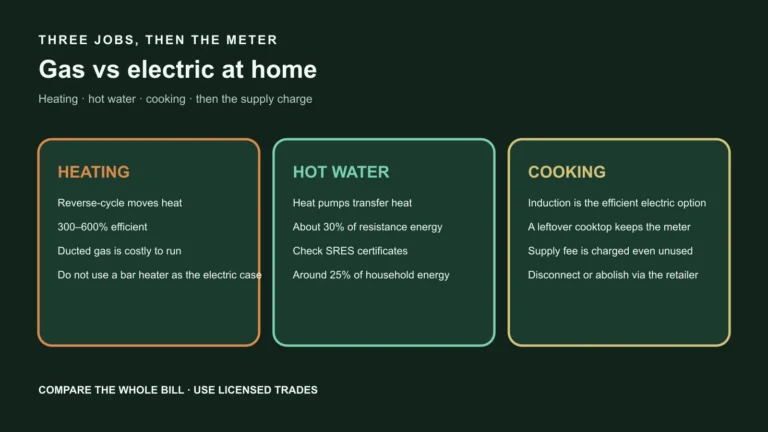
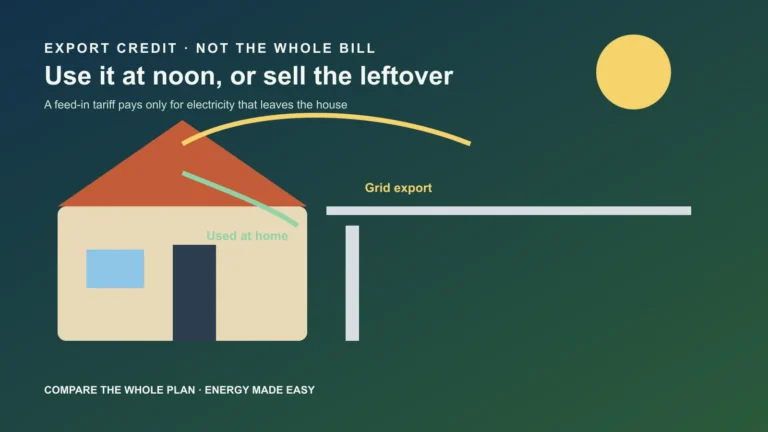
Compare the whole bill, not only the cooking event. Removing the final gas appliance may allow a household to stop paying a gas daily supply charge, but disconnection or abolishment has its own process and cost, and an apartment may share infrastructure. If gas remains for hot water or heating, that fixed charge remains. Rooftop solar can reduce imported electricity when cooking occurs during generation, but solar output and opportunity cost vary.
Government electrification guidance says all-electric homes can lower costs, while also warning about upfront appliance and installation costs and household-specific outcomes. Get itemised quotes and compare the cooktop, cookware, electrical, benchtop, cabinetry, ventilation and gas-work costs together. Do not turn a national program or case study into a guaranteed household payback.
7. Use induction safely and predictably
- Centre a stable, dry pan on a correctly sized zone before applying high power.
- Start lower than you would on a slow radiant element; oil and empty cookware can heat quickly.
- Keep handles turned away from edges and controls, and keep packaging, cloths and utensils off the glass.
- Use control lock features where appropriate, but never treat them as supervision.
- Remember residual-heat indicators refer to hot glass; wait until the surface is safe before cleaning.
- People with implanted medical devices should follow advice from their device manufacturer and clinician about electromagnetic equipment.
Noise is not automatically a fault. Fans, relays and cookware can hum, click or pulse as power changes. Read the manual for expected sounds. Stop using the cooktop if there is smoke, scorching, a burning smell, cracked glass, exposed wiring, repeated tripping, uncontrolled heating or liquid entering damaged controls. Isolate it only if that can be done safely, keep others away and arrange qualified assessment.
8. Clean gently and respond to faults by model
Let the surface cool as directed, remove loose grit, and use the cleaner and scraper method approved by the manufacturer. Avoid abrasive pads and dragging rough cookware. Sugary spills or melted plastic can require prompt model-specific treatment because they may bond to hot glass. A cracked or chipped surface is not a cosmetic cleaning issue; stop use and follow the manufacturer’s safety instructions.
Record the full fault code and which zones were in use before restarting anything. Check only user-serviceable items in the manual, such as control lock, pan compatibility or ventilation obstruction. Do not open the fixed appliance. Keep the receipt, model, serial number, installation certificate and electrician details together.
Australian Consumer Law provides automatic consumer guarantees separate from a voluntary warranty. The ACCC says products must be of acceptable quality and services must be provided with due care and skill, subject to the law’s application and circumstances. Start with the seller or installer when something goes wrong and keep written evidence. For a safety concern, search the ACCC Product Safety recalls database using the exact brand and model; follow a recall notice rather than improvising a repair.
A practical induction-cooktop shortlist
- List the pan sizes and number of zones you use in a normal meal.
- Magnet-test cookware, then confirm the manual’s material and diameter limits.
- Have a licensed electrician assess the exact model and the home before purchase.
- Measure the cut-out, depth, clearances, controls and ventilation path.
- Compare total load, power-sharing behaviour, zone fit, interface and service support.
- Price cookware, electrical, cabinet, benchtop, extraction and any gas work—not just the appliance.
- Keep model, serial, receipt and installation records, and check current recalls.
The best induction cooktop is not automatically the largest or most powerful. It is the model whose zones fit your pans, whose controls work for your household, whose electrical demand and physical dimensions suit the home, and whose installation and ventilation can be completed correctly.