By Jay Jung · Reviewed 30 August 2026
If electricity in your apartment is billed by the building, strata manager or a specialist utility company rather than an ordinary retailer, you may be in an embedded network. That changes who owns the wiring behind the main grid connection, who reads your apartment’s submeter and which rules apply. It does not remove your consumer rights, but the details depend on your state, the seller’s status and the physical metering arrangement.
This guide explains what to check before accepting a bill or trying to change supplier. For ordinary market offers, use our electricity plan comparison guide. If a retailer confirms that it can serve your embedded-network meter, follow the energy retailer switching guide. If payment is already difficult, go directly to the energy-bill help guide.
Important: This is general information, not legal, tenancy, electrical or financial advice. It contains no affiliate links. Embedded-network rules differ by state and can change; retailer choice depends on location, retailer willingness, wiring and metering. No price reduction, retailer offer or successful switch is guaranteed. Confirm current requirements with your seller, state regulator, ombudsman and proposed retailer before acting.
What an embedded network means
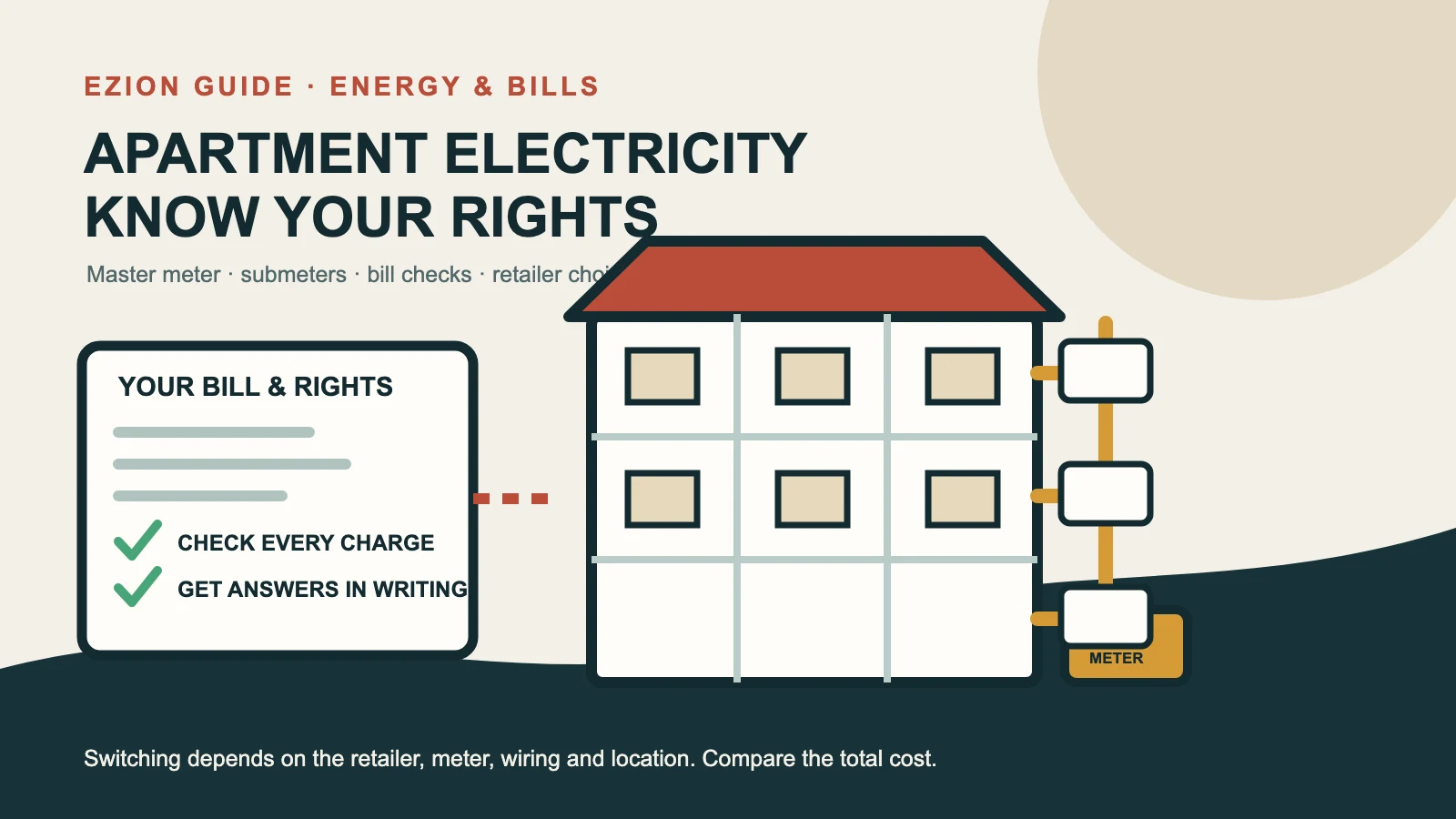
An apartment embedded network normally has one connection from the local distribution grid to the site. The site owner or operator buys electricity at that master meter, distributes it through privately operated wiring and measures each apartment through a submeter. The operator then on-sells electricity to residents, sometimes through a contracted billing company. Similar arrangements appear in retirement villages, residential parks, caravan parks and shopping centres.
The name on the bill is the practical starting point. Ask whether that organisation is an authorised retailer, an exempt seller or an agent billing for the site owner. Ask for the seller’s exemption or registration details, the network operator’s contact details, the meter identifier and the written terms that apply to you. In the national framework, most embedded-network sellers are exempt from becoming authorised retailers, but an exemption carries conditions. Western Australia has a separate licensing and exemption framework, so national guidance should not be assumed to describe every WA right.
Do not decide that the arrangement is good or bad from the label alone. Bulk purchasing can produce a competitive rate, but it does not prove that your total bill is cheaper. Conversely, a private network is not automatically more expensive. Compare the complete amount for your own usage, including daily supply or network charges, demand charges, common-area allocations, meter fees, discounts and any proposed switching costs.
Read the bill as evidence, not just an amount due
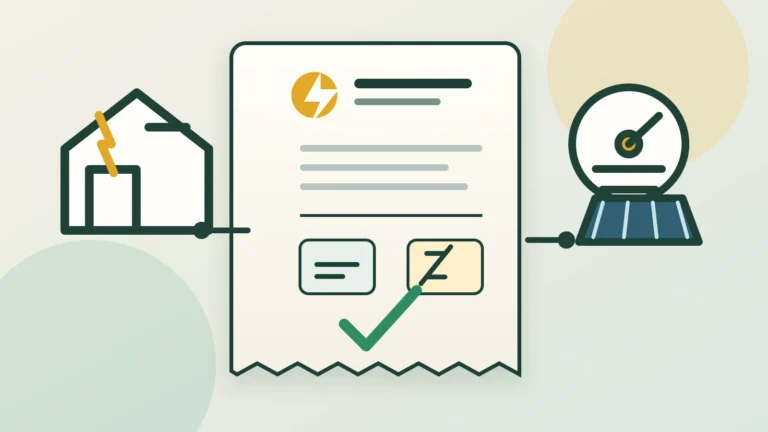
Keep the full bill and check the billing period, previous and current meter readings, whether each reading is actual or estimated, usage in kilowatt-hours, tariff, daily charge, taxes or other fees, due date, payment methods and complaint contact. Match the meter number on the bill to the meter allocated to your apartment. If access is safe and permitted, photograph the display with the date; do not enter locked electrical rooms or touch sealed equipment.
Ask for a plain explanation of every charge you cannot reproduce. In Queensland, official guidance says the site owner generally charges occupants for their electricity use, a share of distribution or daily supply charges and a share of common-area electricity. That description is useful for understanding the structure, but your own contract and state rules still control what can be charged. A common-area amount should not be silently presented as your apartment’s measured consumption.
Compare like with like. A low usage rate may be offset by a high daily charge. A retailer quote that appears cheaper may omit charges that the embedded-network operator will continue to collect. Save the seller’s current price sheet, your latest twelve months of bills if available and any retailer quote. These records make a complaint or later comparison much clearer.
Your core protections still matter
The AER says residential customers buying from an exempt seller in the national framework have protections including clear billing timeframes, flexible payment options for financial difficulty, complaint handling and reasonable disconnection procedures. Exempt sellers must tell customers about their rights at the beginning of the agreement and provide their exemption conditions. The exact protections and enforcement path depend on jurisdiction and seller type, so use that list as a checking framework rather than a substitute for local advice.
If a bill is unaffordable, contact the seller before the due date, state that you are experiencing payment difficulty and ask what assistance, instalment plan, concession or rebate process applies. Do not assume an embedded-network account is excluded from government concessions: eligibility and application channels vary. Keep written records of what was offered. Disconnection is not an acceptable shortcut around required notice, hardship, life-support and dispute processes.
Register life-support equipment through every required channel and ask for written confirmation. Tell the retailer or exempt seller and the network operator, because the entity that bills you and the entity that controls the private wiring may be different. Registration does not guarantee uninterrupted supply. Maintain the equipment provider’s outage plan and backup arrangements.
Can you choose another retailer?
Sometimes—but not merely because a general right to seek an authorised retailer exists. The AER says embedded-network customers can buy from an authorised retailer or an exempt seller, yet changing can be difficult because of the site wiring or because retailers may not want to make an offer. Queensland similarly says a resident can choose a retailer if that retailer is willing to offer service. Location, market arrangements, meter capability and the work needed to identify your connection all matter.
Start by asking the network operator whether your submeter is suitable for an outside retailer, whether it has the required identifier and whether a meter replacement or wiring change is needed. Then tell each proposed retailer explicitly that the address is inside an embedded network. Ask it to confirm in writing that it will make an offer for that exact meter, what work is required, who arranges it, the one-off cost and the expected timing. A generic online quote for the building address is not confirmation that the retailer can transfer your apartment.
A physical “wire-out” to the main distribution network may be possible in some circumstances, but it can involve infrastructure changes, approvals, delay and a customer contribution to costs. Do not authorise electrical work yourself. Obtain written responsibilities and quotations from the site operator, proposed retailer and relevant distributor before treating direct connection as a viable option.
Watch for energy-only offers and duplicate network charges
The most important comparison trap is paying twice for network access. The embedded-network owner commonly pays network charges at the site’s main connection and recovers residents’ shares. An outside retailer would ordinarily include network charges too. The AER therefore advises checking whether the retailer can provide an energy-only offer, or whether the site operator and retailer can agree who will bill network charges.
Ask both parties for an itemised written answer: which usage rate will the retailer charge; which daily, supply or network amount will the site continue to charge; whether any meter, administration or common-area charge remains; and whether either charge changes after transfer. Queensland expressly warns that additional charges may apply and residents may pay supply charges to both the retailer and site owner. “You can switch” is not enough information to calculate the result.
Only compare the current total with the post-switch total after those continuing charges are known. If a retailer offers energy only, check that the contract and first bill actually exclude the duplicated component. If the retailer cannot explain the embedded-network arrangement, pause rather than assuming its standard offer applies.
Price protections are state-specific
In Victoria, the Essential Services Commission states that the maximum electricity price for embedded-network customers is the Victorian Default Offer, set annually. A cap is a ceiling, not a required price and not proof that an individual customer is receiving the cheapest available arrangement. Check the VDO period and tariff that match the bill, and contact the seller about any apparent mismatch before escalating to the Energy and Water Ombudsman Victoria.
New South Wales is in a staged reform period. From 1 July 2026, embedded-network sellers must join the Energy & Water Ombudsman NSW and publish information about their services and prices. IPART says maximum prices and new billing standards are expected to start in the first half of 2027, after consultation on timing. Do not describe those future standards as already in force on 30 August 2026. Current customers can ask for the published information and use EWON for free independent dispute resolution, while monitoring IPART for commencement dates.
In Queensland, residents can ask the site owner whether the meter is suitable, compare available offers through Energy Made Easy and request an energy-only offer from a willing retailer. Residential embedded-network customers can use the Energy and Water Ombudsman Queensland and may access concessions if eligible. These points do not guarantee that every retailer will quote or that changing will reduce the total cost.
Western Australia must be checked separately. Energy Policy WA explains that on-sellers require a retail licence or a valid exemption and that exemption orders impose minimum customer requirements, including billing information and particular life-support protections. Licensed retailers have a broader set of protections. Use WA agencies and the applicable exemption order rather than importing National Energy Retail Law assumptions.
South Australian embedded-network on-selling generally sits within the AER exemption framework, while ESCOSA separately regulates listed small-scale networks. Identify which type supplies the address before choosing the complaint body. The safest national habit is simple: identify the seller, regulator and ombudsman for the actual site rather than relying on an apartment manager’s description.
How to raise a billing or service complaint
- Write to the seller first. State the account, disputed bill, dates, amount and the outcome you want. Attach the bill, price sheet, meter evidence and earlier correspondence.
- Ask for collection or disconnection activity on the disputed amount to be paused while the complaint is investigated, and continue paying any undisputed amount you can safely identify.
- Request a written decision. It should explain the readings, tariff, each network or service charge, applicable rule and correction if one is due.
- Escalate to the correct ombudsman or regulator. In NSW, IPART directs unresolved customers to EWON; Victoria and Queensland also provide energy and water ombudsman services. WA pathways depend on the issue and seller status.
- Keep the timeline. Save emails, reference numbers, names and promised dates. A short chronology is more useful than repeatedly retelling the dispute.
If the seller may be operating without the required exemption or registration, report that separately to the relevant regulator. If your concern involves tenancy terms, strata levies or misleading conduct as well as electricity regulation, more than one body may be relevant. An ombudsman can explain its jurisdiction and refer matters it cannot decide.
A practical apartment checklist
- Identify the billing entity, seller status, network operator and applicable state framework.
- Match your apartment, meter identifier and readings; challenge unexplained estimates or allocations.
- Obtain the current tariff sheet and itemise usage, daily, network, demand, meter and common-area charges.
- Check payment assistance, concessions, complaints, disconnection and life-support processes.
- Before switching, get written confirmation of retailer willingness, meter suitability, work, cost and timing.
- Demand a clear answer on energy-only pricing and every network charge that will continue.
- Compare total annual cost using your usage; do not assume embedded or market supply is inherently cheaper.
- Verify the first bill after any change and retain all pre-switch documents.
An embedded network is a physical and contractual arrangement, not a waiver of accountability. The useful questions are concrete: who sells the electricity, which rules bind them, how was this bill calculated, what support applies, and what will every party charge after a change? Written answers to those questions turn a confusing apartment bill into something that can be checked, compared and, when necessary, disputed.
Official sources
- Australian Energy Regulator: Embedded networks customers
- IPART: Information for embedded network customers
- Essential Services Commission Victoria: Embedded networks
- Queensland Government: Electricity for residents of multi-unit complexes
- Energy Policy WA: On-selling electricity
- ESCOSA: Energy consumers
- ACCC: National Electricity Market report, June 2024