By Jay Jung · Reviewed 21 September 2026
Rechargeable lithium-ion batteries are now spread through the home: phones, laptops, tablets, cordless vacuums, power tools, toys, cameras, power banks, e-bikes and e-scooters may all use them. Most are used without incident, but one damaged, incompatible or poorly placed charging setup can create a fast-moving fire and expose people to smoke and toxic vapours. The practical response is not to fear every battery. It is to control the points where household choices make a difference: what you buy, which charger you use, where and when you charge, what warning signs you act on, and where the product goes at the end of its life.
This guide covers portable rechargeable products used around the home. It does not cover fixed home-battery design or installation, and it does not repeat capacity or appliance-load planning for a portable power station. For mains leads, outlet condition and shared electrical loads, use the separate power-board and extension-lead safety guide. Connected-device accounts, updates and privacy belong in the smart-device security guide.
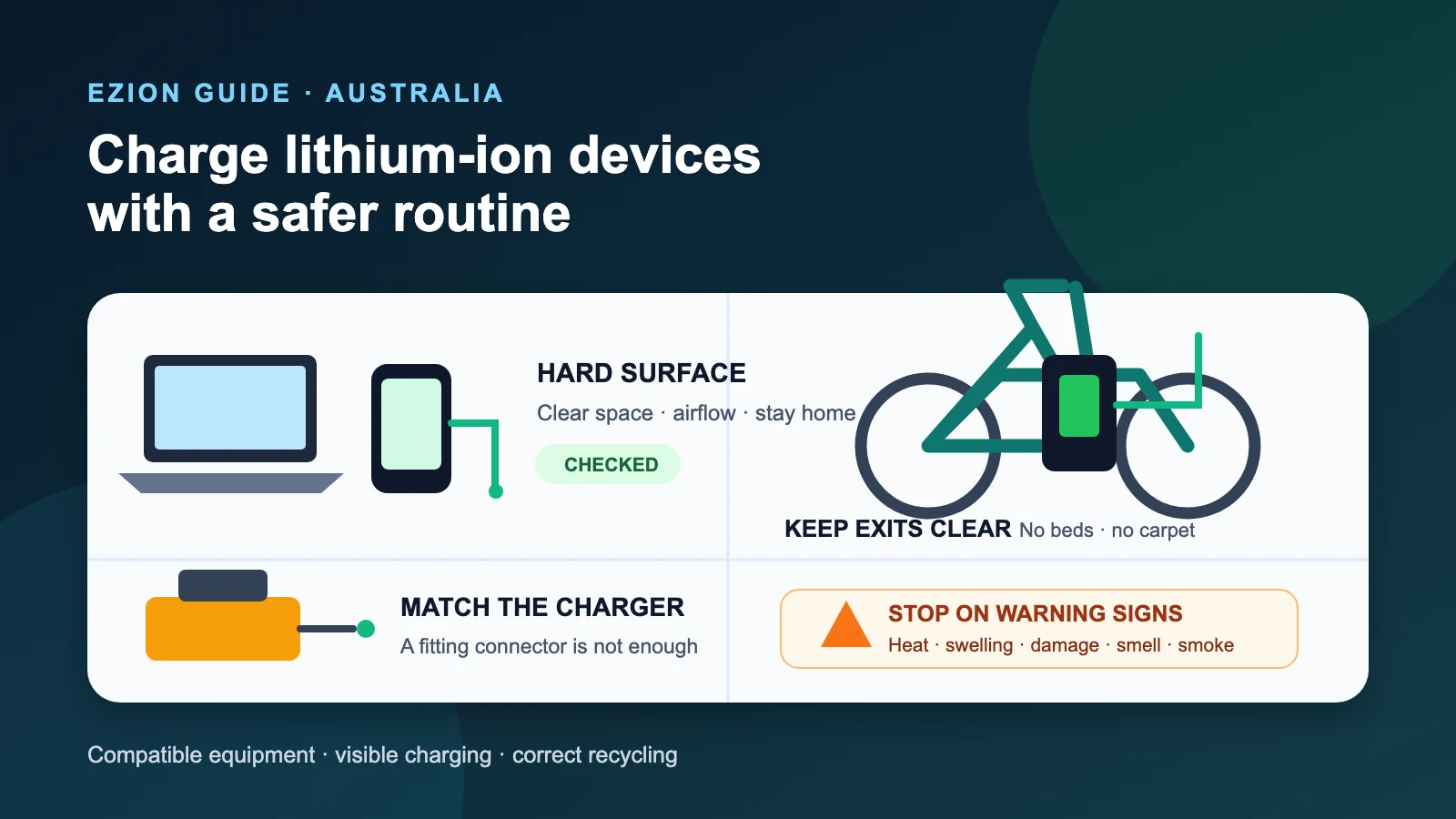
The short household rule
- Buy a traceable product from a reputable supplier and keep its model details, receipt and instructions.
- Use the supplied charger, or one the manufacturer explicitly identifies as compatible.
- Charge while you are home, on a hard non-flammable surface, where heat can escape and the device cannot block an exit.
- Stop using or charging anything that is swollen, leaking, unusually hot, damaged, hissing, popping, smoking or giving off an unusual smell.
- Never put a battery or battery-powered device in household rubbish, kerbside recycling or hard waste.
1. Buy for traceability and compatibility, not a bargain alone
Start with a reputable supplier that provides a recognisable manufacturer or importer, exact model identification, instructions and a way to obtain support. A very low price is not proof that a product is unsafe, and a familiar marketplace is not proof that every third-party listing is safe. What matters is whether you can identify who supplied the product, match it to safety information or a recall, and obtain the correct charger or replacement battery.
Australia’s national Product Safety guidance says there is no mandatory safety standard applying generally to lithium-ion batteries or products containing them. It recommends reputable suppliers, following the manufacturer’s instructions and checking labels such as “lithium ion”, “Li-ion”, “Li-po” or “lithium-polymer”. Read the national ACCC Product Safety lithium-ion batteries guide rather than treating one logo or marketing claim as a complete safety assessment.
Before first use, photograph the product label and record the brand, model, serial or batch number if shown. Keep the receipt and manual. Check the plug, cable, enclosure and battery for shipping damage. For chargers sold for connection to Australian mains power, check the product information and marking expected for the Australian market; if identity or compliance cannot be established, do not improvise a first charge to “see if it works”.
Replacement batteries deserve the same scrutiny as the original product. Buy from the original supplier or another reputable source where possible, and only use a battery designed for that exact product. A pack that slides into the tool or vacuum is not necessarily electrically or mechanically compatible. Do not modify a pack, bridge contacts, rebuild it with unknown cells, or use an adaptor to defeat the intended fit.
2. A connector that fits is not proof that a charger is compatible
Use the charger and cable supplied with the device. If they were not supplied, lost or damaged, follow the manufacturer’s specification for an approved replacement. The plug shape alone does not establish the required voltage, current, charging protocol, polarity, battery-management communication or temperature protection. This matters for USB-powered electronics as well as proprietary tool, vacuum, toy, e-bike and e-scooter packs.
Do not mix chargers between products merely because the connector fits. Never use a charger or cable with cracked insulation, bent or loose pins, exposed conductors, scorching or intermittent operation. Stop if the charger, plug, outlet, cable or battery becomes unusually hot. For power banks, the national ACCC Product Safety power banks guide specifically says to use the supplied equipment or check the manufacturer’s suitable-charger instructions, charge on a non-flammable surface, allow the unit to cool after use and keep it out of parked vehicles.
3. Make the charging place part of the safety system
Choose a stable, hard, non-flammable surface such as concrete, ceramic tile or steel. Keep the device away from bedding, sofas, carpet, curtains, paper, clothing, direct sunlight, heaters and hot vehicles. Do not cover a charging phone or laptop, bury a power bank in a bag, or charge a removable pack in a drawer. Ventilation and clear space help heat escape and make changes easier to notice.
Charge while someone is home and awake enough to notice a problem. Monitor the normal charge time, disconnect when charging is complete, and consider a reminder if you routinely forget. Allow a battery to cool after hard use before charging it. Make sure smoke alarms are installed and maintained as required for your home.
Keep charging away from the path people would use to leave the room or dwelling. This is especially important for larger e-bike and e-scooter batteries. Do not park or charge one in a hallway, doorway or stairwell where a battery failure could cut off the exit. Keep children and pets from chargers, loose cells and accessible battery contacts.
Fire and Rescue NSW describes lithium-ion batteries as a fast-growing fire risk in NSW and identifies overcharging, non-compliant charging equipment, heat, physical damage, short circuits, cell faults and manufacturing defects as possible failure pathways. Its battery and charging safety information is NSW agency guidance. Queensland Fire Department likewise advises Queensland households to charge on hard surfaces, use the correct charger, stay home while charging, disconnect when full and keep e-mobility devices out of living areas and escape paths; see its Queensland lithium-ion battery safety guidance. These state pages are useful operational guidance, but local disposal services and fire-safety requirements can differ elsewhere in Australia.
4. Inspect before charging and learn the stop signs
A ten-second inspection is more useful than trying to predict a battery’s age from appearance alone. Before charging, look at the case, seams, cable, connector and contacts. Ask whether the product has recently been dropped, crushed, punctured, soaked, exposed to extreme heat or repaired. For a removable pack, confirm that it seats normally without force.
- Shape: swelling, bulging, warping, splitting or a case that no longer closes.
- Temperature: unusual heat during use, rest or charging, especially heat that increases quickly.
- Surface and connections: dents, cracks, punctures, corrosion, melted plastic, discolouration or loose contacts.
- Leak or gas: liquid, residue, vapour or visible venting.
- Sound or smell: hissing, popping, crackling or a new unusual odour.
- Behaviour: repeated charging faults, abrupt shutdown, unexpectedly rapid loss of charge or other abnormal operation.
Any one of these is enough to stop. Disconnect power only if that can be done without touching a hot, smoking, leaking or visibly failing battery. Do not continue charging to diagnose it, press a swollen case flat, puncture it, dismantle it or leave it in a pile with other batteries. Keep people away and contact the manufacturer, supplier or local council for product-specific handling and disposal advice.
5. If there is smoke or fire, leave and call 000
If a lithium-ion battery or device is smoking or on fire, evacuate to a safe place and call Triple Zero (000). If you can close a door behind you without delaying escape or approaching the device, that may help slow the spread. Warn other occupants, stay out, and tell the operator that a rechargeable battery or battery-powered device is involved.
Do not pick up, carry or touch a smoking or burning device. Do not breathe the smoke or vapours. Do not re-enter because the flames appear to have stopped: lithium-ion battery fires can reignite. This guide deliberately does not instruct householders to fight a lithium-ion battery fire. Escape and an immediate 000 call take priority over protecting the product or property.
6. Store devices where heat, impact and metal cannot create the next problem
Store batteries and devices in a cool, dry place away from direct sunlight, heaters, moisture and combustible clutter. Do not leave them in a parked car. Protect them from being crushed, punctured or dropped, and do not stack heavy objects on battery packs. Use the manufacturer’s storage instructions for products kept unused for long periods.
Keep removed batteries separate so their terminals cannot touch each other, coins, keys, tools or other metal. Keep loose cells in an appropriate non-conductive holder rather than a drawer. A battery that has been exposed to water, especially saltwater, or involved in an impact needs cautious, product-specific advice even if it looks normal. Do not charge it as a test.
7. Treat a damaged battery as a handling problem, not a DIY repair
For a damaged battery with no smoke or fire, isolate the area from children, pets and combustible material without handling the battery unnecessarily. Do not put it in household bins, a normal store collection box or the post. Contact the supplier or your local council and describe the exact device, damage, heat, leakage and water exposure. Ask where it can be accepted and how it should be packaged and transported. A normal collection point may accept intact loose household batteries but refuse damaged, embedded or larger e-mobility batteries.
Some official state guidance gives detailed interventions for particular damaged-battery situations. Do not combine selected steps from different jurisdictions into a home experiment. The safest action depends on whether the battery is hot, leaking, venting, fire-damaged, embedded in a product, electrically energised or safe to move. Follow emergency services, the manufacturer, council or receiving facility rather than improvising.
8. Recycle by battery type and location—never through a household bin
Do not put lithium-ion batteries, power banks or battery-powered products in general waste, kerbside recycling or hard-waste collections. Batteries can be crushed during collection and processing, creating fires in bins, trucks and facilities. For an intact removable battery, cover exposed terminals with clear sticky tape and keep it separated from metal while arranging an appropriate drop-off. Confirm that the facility accepts that battery type, size and condition before travelling.
Routes vary. Small loose batteries, embedded batteries, mobile phones, laptops, power-tool packs, vacuum batteries and larger e-bike or e-scooter packs may go through different stewardship, e-waste or council services. NSW residents can use the NSW EPA Never Bin a Battery guidance to distinguish loose batteries, embedded products and larger batteries. That page describes NSW services; readers in other states and territories should check their own council or environmental authority rather than assuming the same collection rules apply nationally.
9. Make recall checks a normal household task
Check at purchase, when a product behaves abnormally, when you receive a supplier notice and during a periodic household review. Search by brand and model in the national ACCC Product Safety recalls database. A visual match is not enough: compare model, batch, serial and date details. If the product is recalled, stop or store it exactly as the recall notice directs and use the stated remedy. Do not keep using it while waiting for a convenient return date unless the notice expressly says that is safe.
If no recall appears, abnormal heat, swelling, damage, leakage, gas, sound or smell still requires action. A recall database cannot diagnose an individual battery, and absence from the search results is not a guarantee of safety. Keep purchase records so the supplier can identify the product and contact you if new information emerges.
A five-minute charging audit
- List the rechargeable products charged inside your home, garage or shed.
- Match each one to its supplied or manufacturer-approved charger.
- Move charging off beds, carpet and clutter and away from exits.
- Inspect cases, cables and connectors; quarantine normal use of anything abnormal.
- Record models and check recalls.
- Separate used batteries, tape exposed terminals and identify the correct local drop-off.
- Make sure everyone knows the emergency rule: smoke or fire means evacuate and call 000.
Disclosure: This is general safety information, not product testing, electrical advice or emergency-service training. Ezion Guide and Jay Jung have no affiliate relationship with and do not endorse any battery, charger, supplier, recycler or government body mentioned. No safety, performance, lifespan or other outcome is guaranteed. Follow the product manufacturer, recall notice, local authority and emergency services; requirements and collection options can vary by product, condition, location and date.