Ezion Guide · Home electrical safety
Power boards and extension leads: a room-by-room safety guide for Australian homes
Disclosure: This guide is independent and non-affiliate. It does not recommend particular products, and no link earns us a commission. It provides general practical information, not an electrical inspection, product endorsement, or guarantee of safety. Product instructions, ratings, recall notices, and advice from a licensed electrician take priority.
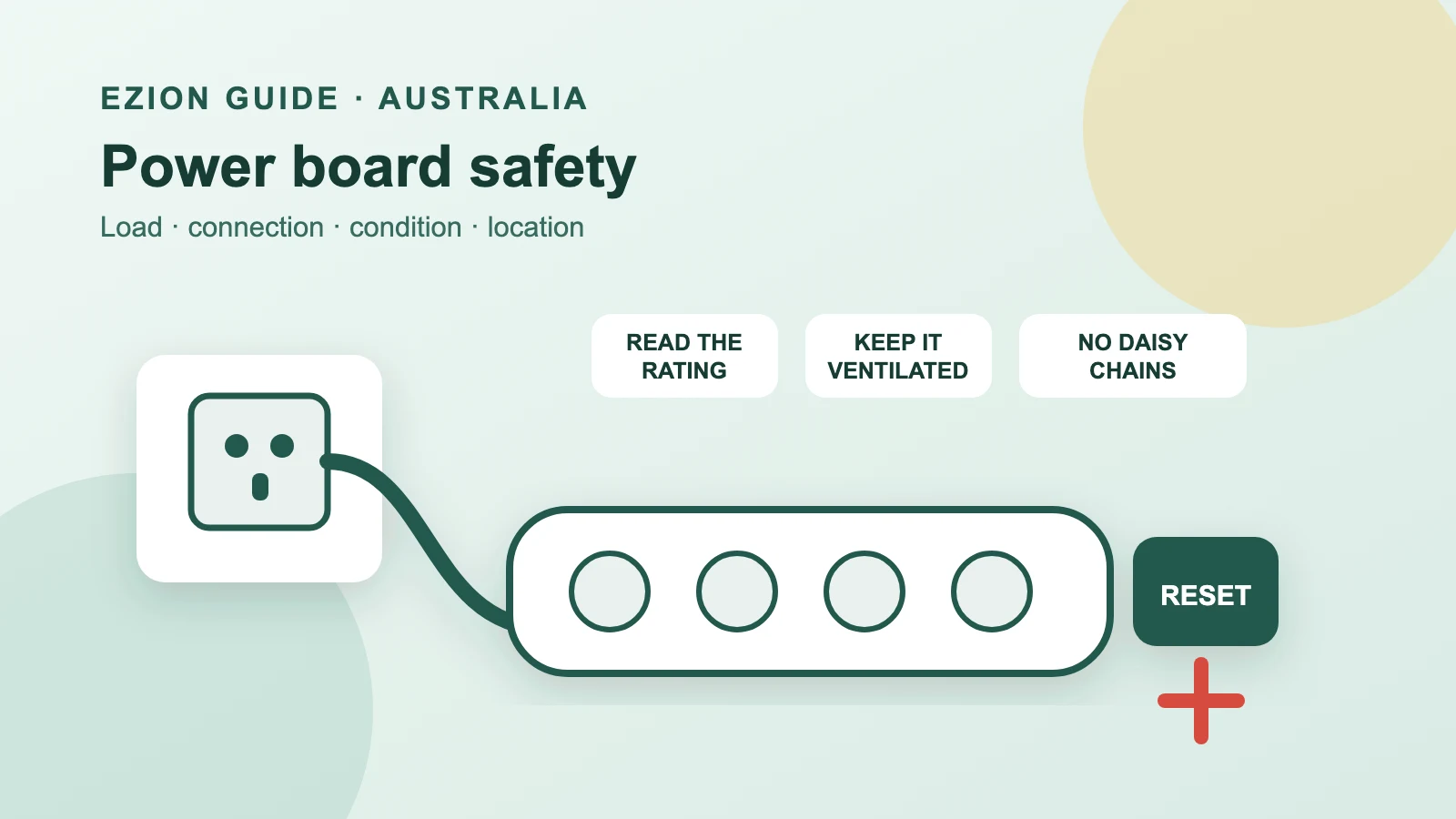
Power boards and extension leads are useful, but risk grows when temporary convenience becomes permanent wiring, several loads share one connection, or a board disappears behind furniture. A safe setup is not defined by occupied socket count. It depends on what runs at the same time, the rating and condition of every part, and the environment.
This guide focuses on whole-room outlet, board, and lead safety—not app setup, automation, or energy-monitoring instructions. The aim is a repeatable audit for any room without pretending one wattage limit fits every product.
First, know what each device does
- Power board
- A power board turns one wall outlet into several outlets. Use it only within its marked electrical rating. An overload cut-out is useful protection, not permission to connect any combination of appliances.
- Surge-protected power board
- This is a power board with components intended to limit certain voltage surges. Surge protection does not increase the board’s load capacity, prevent overheating caused by poor connections, or replace a safety switch. Its protective components can also be product-specific, so follow the manufacturer’s status indicators and replacement instructions.
- Safety switch (RCD)
- A safety switch monitors current imbalance and disconnects power when leakage is detected, reducing electric-shock risk. It does not make damaged cords safe, stop every shock, or necessarily protect against overload. Ask a licensed electrician if you are unsure what protects your circuits.
- Circuit breaker or overload cut-out
- This responds to excessive current in the circuit or device it protects. It serves a different purpose from an RCD. Neither feature makes piggybacking, damaged equipment, or an overloaded board acceptable.
- Extension lead
- An extension lead moves one outlet temporarily; it is not an extra circuit or permanent wiring. Its condition, rating, location, and whether it is coiled all matter.
A practical 15-minute room audit
- Stop and look before touching. If you see smoke, sparks, melted plastic, charring, exposed conductors, or water around electrical equipment, do not begin a normal audit. Keep people away and follow the emergency steps below.
- Map the chain. Trace every wall-outlet plug to its appliance. Note boards, leads, adaptors, coiled drums, and anything hidden. If one board feeds another, or a double adaptor creates a branch, disconnect and redesign the arrangement.
- Identify simultaneous loads. Write down what may run together, not merely what is plugged in. A television and console used together count together; an idle charger still occupies a connection but does not have the same load profile as a heater.
- Read the markings. Check each appliance nameplate and the marked rating on the power board and extension lead. Look for watts (W), amps (A), model details, indoor/outdoor restrictions, and manufacturer warnings. Do not use a guessed household-wide limit in place of the actual markings.
- Inspect condition. With power off and plugs removed only when safe, check for cracked casings, bent pins, frayed or crushed insulation, loose sockets, scorch marks, discolouration, or plugs that no longer seat firmly. Discard damaged boards and leads; tape is not a repair.
- Check placement. Move boards into open, dry, visible positions with room for ventilation. Clear dust. Keep plugs fully inserted and protect them from being kicked or pulled sideways. Remove leads from doorways, traffic paths, rugs, bedding, and places where furniture can crush them.
- Correct the setup. Put high-power appliances on suitable wall outlets, remove unnecessary adaptors, fully unwind leads in use, and choose equipment marked for the environment. If the room only works by chaining devices or stretching leads permanently, the lasting fix is usually more appropriately located outlets installed by a licensed electrician.
- Record and revisit. Photograph model labels, note replacements, and review after furniture moves, new purchases, or seasonal changes.
Reason about load in watts, not socket count
Four occupied sockets can be a modest load or a demanding one. The useful question is: what is the combined load while these appliances operate together? Find the input wattage on each appliance label or instructions and add the wattages of the items likely to run simultaneously. Compare that total with the marked rating of the power board and every extension lead in the path. The lowest-rated component governs the arrangement.
For example, do not assume that an eight-outlet board has more capacity than a four-outlet board. Outlet count describes connection points, not available circuit power. Likewise, splitting appliances across two boards does not create more capacity if both boards ultimately use the same wall outlet or circuit. Ratings may be stated in amps rather than watts, and appliance demand can vary during operation. If the labels are missing, unclear, or require interpretation, use the manufacturer’s information or ask a licensed electrician instead of inventing a conversion or safety margin.
Leave headroom rather than operating continuously at the edge of a marked rating. Recheck when adding an appliance; timers can make loads overlap. If an overload cut-out trips, reduce and reassess the load. Do not repeatedly reset it without finding the cause.
Give high-power appliances special treatment
Portable heaters, clothes dryers, washing machines, kettles, toasters, cooking appliances, portable air conditioners, and similar heating or motor-driven equipment can draw much more power than lamps, routers, or phone chargers. Do not treat that list as a universal ranking; read the appliance’s actual label and instructions. Queensland’s home electrical-safety guidance describes power boards as suitable for low-power items and warns against using them for appliances such as heaters, dryers, and washing machines.
The conservative arrangement is to connect a high-power appliance directly to a suitable wall outlet where its instructions permit, without a double adaptor, power board, or unnecessary extension lead. Do not run two demanding appliances together from one outlet arrangement merely because the plugs fit. If a required appliance cannot reach a suitable outlet, do not make a permanent workaround from temporary leads; have the location assessed by a licensed electrician.
Bulky plug packs can cover sockets, pull partly out, or cluster heat. Do not force them into a crowded board; support their weight, seat every plug fully, and allow air to circulate.
Connections, cords, heat, and housekeeping
No piggybacking. Never plug one power board into another. Avoid double adaptors, including using one to add branches before or after a board. Each extra connection adds another place for poor contact, movement, and heat, while making the real load harder to see. Use one correctly rated board connected directly to the wall outlet, or reduce the equipment and arrange proper outlets.
Keep plugs firm and boards ventilated. Position the board where cords cannot tug and people or furniture cannot knock plugs loose. Do not cover it with clothes, paper, bedding, or an unsuitable cable box. Keep it away from heat sources and do not let a transformer unbalance it.
Control dust. Switch off and disconnect equipment safely before cleaning around it. Dust and lint around sockets, vents, and plug packs should not be allowed to accumulate. If debris is inside a board, or liquid has entered it, replacement is safer than opening or attempting a home repair.
Retire damaged equipment. Replace a board or lead with cuts, exposed wires, crushed sections, loose pins or sockets, scorch marks, melted areas, or intermittent operation. Stop using an item that feels unusually hot, smells of hot plastic, crackles, buzzes, or sparks. A lead repaired with household tape is not restored to its original electrical and mechanical protection.
Unwind extension leads fully while in use. Coiled cable retains heat. Lay the full length where it cannot be pinched, driven over, trapped, or tripped over. Never hide it under carpet or bedding. Persistent extension-lead use means the outlet layout needs attention.
Wet areas, garages, and outdoors
Keep ordinary power boards and connections away from sinks, wet floors, condensation, rain, splashes, and other moisture. Do not handle plugs or switches with wet hands. A kitchen, laundry, bathroom, garage, balcony, or garden can add water, dirt, impact, and weather exposure that an indoor lead was not designed to withstand.
For outdoor use, every relevant component must be marked as suitable for that use: the extension lead, socket, plug, board or outlet device, and connected appliance. “Heavy duty” wording is not a substitute for checking the environmental rating and instructions. Keep connections elevated and protected as directed, and stop if conditions exceed the product’s stated use. Never assume a closed window or plastic bag makes indoor equipment weatherproof. For fixed outdoor supply or uncertainty about protection, use a licensed electrician.
What the RCM does—and does not—tell you
Look for the Regulatory Compliance Mark (RCM) when buying in-scope electrical equipment in Australia. It indicates that the supplier represents the product as meeting applicable regulatory requirements and participates in the relevant compliance framework. Buy from a seller that can identify the product and supplier, provide instructions, and respond if a safety issue emerges.
The RCM is not a promise that every individual item is defect-free, an independent award for quality, or a guarantee that a product is suitable for your particular load and environment. You still need to inspect the item, follow its ratings and instructions, and check recalls. Avoid equipment with missing compliance markings where they are required, dubious labelling, no traceable supplier, or a plug that does not suit Australian outlets.
Recalls are part of ownership
Safety checking does not end at purchase. Product defects, manufacturing variation, or later findings can trigger a recall. The ACCC has previously urged households to check power boards and double adaptors after unsafe products reached consumers, illustrating why an apparently normal product should not be assumed safe forever.
Keep a photo of the brand, model, batch or serial details, and receipt where practical. Search the Australian Product Safety recalls database when you buy second-hand equipment, inherit an unknown board, hear a safety notice, or perform your regular audit. If an item matches a recall, follow the recall instructions precisely. Stop using it when directed; do not improvise a repair or keep it in another room.
Warning signs and emergency action
- Heat, odour, buzzing, crackling, sparks, discolouration, or repeated tripping: stop using the equipment. Switch off power at the outlet only if it is safe to approach, and unplug only if doing so is safe. Keep it out of service until the cause is resolved or the item is replaced.
- Smoke or fire: warn others, get out, and call Triple Zero (000). Do not use water on electrical equipment. Do not re-enter or take risks to disconnect a board.
- Electric shock: do not touch a person who may still be in contact with live electricity. Disconnect power only if it can be done safely and call Triple Zero (000). Even when the person seems well, seek urgent medical advice because electrical injury may not be obvious.
- Damaged outlet, persistent fault, or uncertain household protection: stop using the affected setup and contact a licensed electrician. Power-board replacement cannot correct a fault in fixed wiring or an inadequate outlet arrangement.
A simple decision rule
Keep the setup only when you can answer yes to all of these questions: Is there one direct connection from the wall outlet to one undamaged, correctly marked board or lead? Are all plugs fully seated? Is the combined simultaneous load within every marked rating? Are high-power appliances connected as their instructions require? Is the equipment dry, ventilated, clean, fully unwound where applicable, and protected from impact? Is it suitable for the location? Is it unaffected by a recall?
If any answer is no or unknown, reduce the load and disconnect the questionable item. Replace damaged or unsuitable portable equipment. When the problem is too few outlets, poor outlet placement, repeated tripping, looseness at the wall, or uncertainty about circuit protection, use a licensed electrician rather than building a more elaborate chain of adaptors.