By Jay Jung · Reviewed 7 September 2026
A washing machine is bought once but used for years, so a small mismatch in capacity, cycle design or installation can become a repeated cost. The right machine is not automatically the one with the most stars, the biggest drum or the lowest sale price. Start with the loads your household actually washes, the laundry space and connections, then compare the energy and water figures for models of a similar size.
This guide explains capacity, front versus top loaders, Australia’s Energy Rating and Water Rating labels, cold and warm cycles, installation, daily use, fault signs and end-of-life decisions. Use our appliance running-cost guide to turn label kWh into a household estimate, our Energy Rating Label guide for the broader label rules, and our heat-pump clothes dryer guide when the full laundry system matters.
No universal saving or product recommendation: this article has no affiliate links and does not recommend a brand. Purchase prices, tariffs, water charges, detergents, textile care, household use and machine condition differ. It does not guarantee lower bills, cleaner clothes, a lifespan, a rebate or a safety outcome. Follow the exact model manual, garment care labels and current official advice.
1. Measure your real laundry before choosing capacity
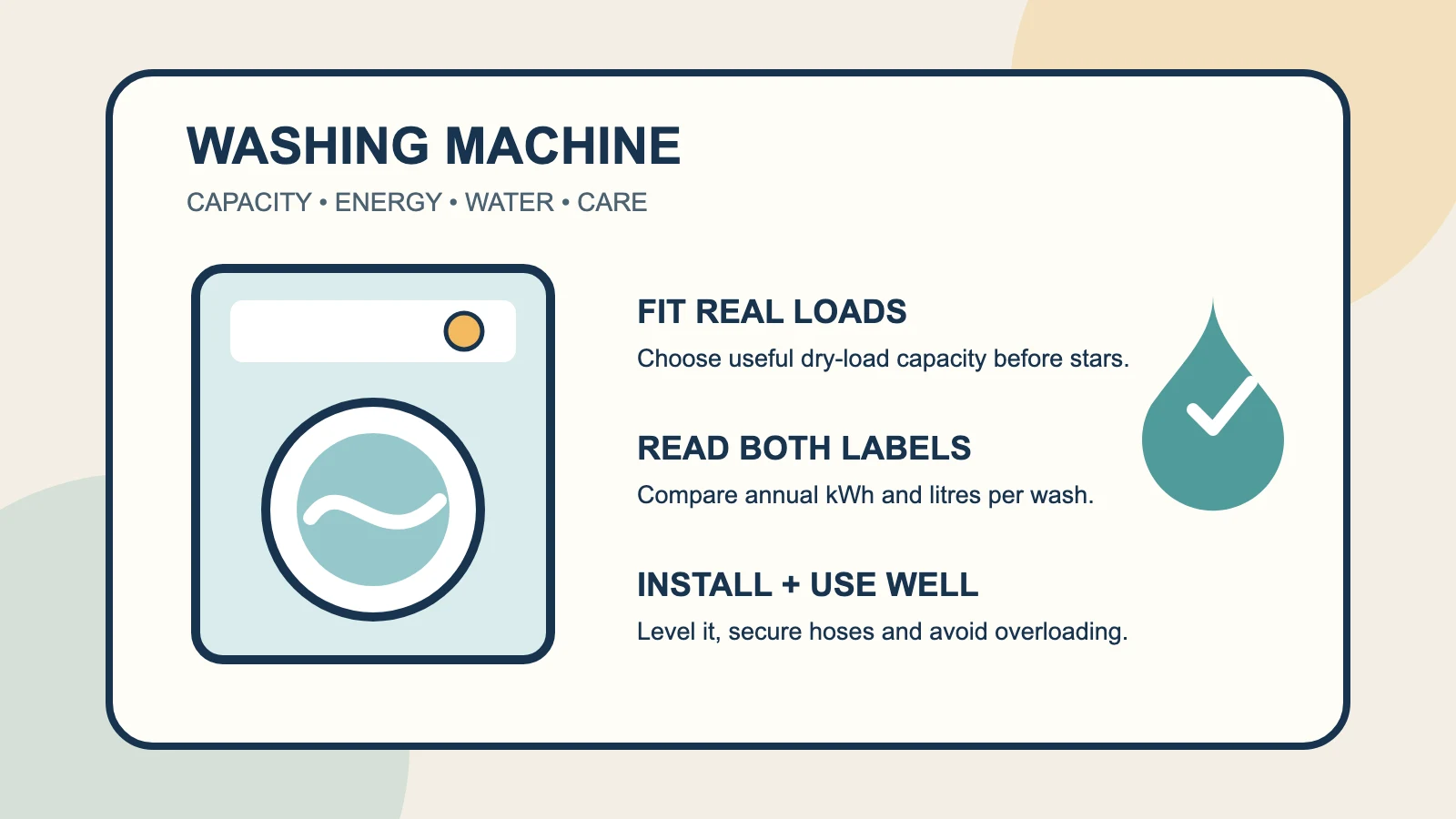
Rated capacity is the dry mass of clothing the machine is designed to wash on the nominated program. It is not a promise that every bulky load will fit or wash well. A kilogram of dense towels, a lightweight doona and a mixed everyday load occupy different volumes and move differently in the drum. Before shopping, record a normal week: how many loads you run, which loads are routinely half-full, and which bedding or workwear loads strain the current machine.
Choose enough capacity for frequent full loads without buying unused drum space. A larger model can be helpful for a large household or bulky linen, but it may cost more and occupy more space. An undersized machine encourages repeated cycles or overloading. If a bulky item barely fits dry, it may not have room to move once wet. Check the manual for bedding, waterproof items, shoes and other special loads rather than assuming the headline kilogram figure applies.
- Count load types, not just people. Babies, sport, uniforms, allergies, pets and shared housing can matter more than household size.
- Measure the room. Include hoses, taps, drain, plug, lid or door opening, detergent drawer and the clearance needed for service.
- Check access. Measure doorways, stairs and turns, and confirm the floor can support a level machine during spin.
- Compare similar capacity. Energy and water stars are most useful after size and required features are fixed.
2. Front loader, top loader or washer-dryer?
Energy.gov.au says front loaders tend to cost more upfront but generally use less water, energy and detergent, while top loaders are often cheaper to buy and have shorter cycles but can be less efficient and rougher on fabrics. These are broad tendencies, not a verdict on every model. Compare the two labels, program time, usable capacity, controls, door access and exact registered data for each shortlist.
A front loader needs bending access and room for the door. It may fit under a bench and can often support a compatible stacked dryer, but stacking requires the manufacturer-approved kit and a stable installation. A top loader needs clear space above the lid and cannot sit under a low fixed shelf. It can be easier to load from standing height. Test whether the shortest user can reach the bottom safely.
A combined washer-dryer saves floor space but has separate washing and drying ratings and may dry less than it can wash in one load. Check both capacities, both labels, cycle time, water use and what happens when the drying load must be split. Convenience can be worthwhile in a small home, but it should be an informed space trade-off rather than an assumption that one drum performs exactly like two dedicated appliances.
3. Read both Australian labels
Household clothes washers must meet minimum energy performance standards and display an Energy Rating Label. The label shows the model, rated capacity, star rating, estimated annual electricity use and the program used for the test. Current labels may show warm-wash information and, where tested and displayed, cold-wash information. Program time is also important: a high-efficiency test program may take longer than the cycle you normally choose.
The annual energy figure assumes seven loads each week on the labelled program. Your use can be higher or lower. Compare annual kWh among machines with similar capacity and features, then multiply by the usage rate on your bill for a rough annual electricity cost. Do not add the household’s daily supply charge when comparing two machines in the same home, because buying a different washer does not remove that fixed charge.
Washing machines must also carry Water Efficiency Labelling and Standards information. The Water Rating Label shows stars, litres per wash, load capacity and the program used for the water test. More stars mean greater water efficiency, but the litres-per-wash figure is the practical number to compare. Confirm the exact model in the WELS register, especially when buying online, and make sure the program and capacity behind the water result suit the way you will use the machine.
Never compare stars alone across very different sizes. First choose a useful capacity, then compare annual kWh, litres per wash, program time, purchase price, warranty, repair access and the cycles you need. A feature you never use can add cost without improving the household result.
4. Decide how you will use cold and warm washes
Heating water is a major part of washing energy use, so cold cycles can reduce electricity use. Energy.gov.au recommends cold water where suitable, while noting that some machines need both hot and cold connections. The garment label, detergent directions, machine manual and hygiene needs still apply. Cold is not automatically correct for every textile, stain or illness-related load, and “hotter” is not automatically better for fabrics or bills.
Check what the machine means by cold. Some models heat an incoming cold supply to a controlled temperature; others rely on the tap temperature. If a machine has separate hot and cold inlets, confirm the home’s water temperature and connection are within the manufacturer’s limits. Do not improvise a hot connection or assume solar-heated water is compatible without reading the manual.
Use the lowest suitable temperature and the shortest suitable cycle for the load. Heavily soiled workwear, nappies, bedding after illness and delicate garments have different needs. Follow current health advice for contaminated laundry rather than relying on a generic energy tip. Keep detergent dosing aligned with load size, soil and local water conditions: too much detergent can leave residue and trigger extra rinsing, while too little may not clean properly.
5. Install it so it can spin, drain and be serviced
Remove transit bolts exactly as instructed before the first cycle and keep them for a future move. A front loader operated with transit bolts installed can vibrate or be damaged. Place the machine on a firm, level surface and adjust the feet according to the manual. Do not steady a rocking appliance with loose packing material.
Connect inlet hoses to the correct taps, fit washers as specified and check for leaks under pressure. Route the drain hose at the required height and secure it so it cannot jump out or siphon. Avoid kinks and crushing behind the cabinet. Keep taps and the wall outlet accessible. If plumbing or a fixed electrical outlet needs alteration, use an appropriately licensed trade.
Do not use an overloaded power board or an extension lead as the permanent supply. Leave the clearances required for ventilation, hoses, door movement and service access. If stacking a dryer, use only the supported configuration and kit. After installation, run the manufacturer’s commissioning or empty-clean cycle, watch the fill, drain and spin, and recheck hose connections.
6. Build a low-waste washing routine
Wait for a suitably full load unless the machine has an effective load-sensing or half-load option, but do not pack the drum so tightly that items cannot move. Sort by colour, textile, soil and care instructions. Empty pockets, close fasteners where directed, and use laundry bags for small or delicate items. A balanced load reduces violent movement during spin.
Select the labelled efficient program when it suits the clothes and available time; its longer duration can be part of how it reduces energy or water. Quick cycles are useful for some small, lightly soiled loads but are not automatically the most efficient choice per kilogram. Eco, cotton, mixed, delicate and hygiene names are not standard promises across every brand, so use the model manual.
A higher final spin speed can leave less water for a dryer to remove, but it may not suit delicate fabrics and can increase creasing. If line drying is practical, it avoids dryer energy entirely. When using a dryer, match its load to the washer’s output rather than assuming capacities are identical. Clean the washer’s detergent drawer, door seal, filters and accessible areas on the schedule and by the method in the manual.
Leave the door or lid and dispenser in the manufacturer-recommended position between cycles so moisture can escape safely. Keep children and pets away from the drum, detergents and controls. Do not mix cleaning chemicals. Use only washer-cleaning products and procedures approved for the model.
7. Respond to vibration, leaks and faults early
Excessive movement is not normal just because the machine spins quickly. Stop and check for an unbalanced load, transit bolts, an unlevel floor, loose feet or contact with cabinetry. Repeated walking, banging or a burning smell needs diagnosis. Do not restrain the machine with improvised brackets or stand on it during spin.
For a leak, stop the cycle if safe, isolate water and electricity as appropriate, and protect the area from further damage. Check only user-serviceable filters, hose fittings and obstructions described in the manual. A damaged power lead, hot plug, sparks, smoke, repeated circuit trips or water near live electrical parts requires immediate isolation and qualified help.
Record the exact model and serial number and check the ACCC Product Safety recall database. A recall applies to specified models or serial ranges, not every appliance from a brand. Follow the supplier and regulator instructions for an affected unit; a successful recent cycle is not proof that a recalled hazard is absent.
8. Repair, replace and dispose without guessing
A noisy or inefficient cycle does not by itself prove that replacement is cheaper. First rule out installation, load balance, blocked filters, wrong program and dosing problems. For a genuine fault, ask for the diagnosis, repair price, parts availability, warranty on the work and expected remaining service. Compare that with the delivered and installed price of a suitable replacement and its verified energy and water data.
Age alone is not a compulsory replacement date, and a new machine does not guarantee a whole-of-life saving. Consider the frequency and cost of failures, corrosion, leaks, drum or bearing condition, availability of parts and how well the capacity still fits the household. Keep invoices, model details and repair records.
For disposal, ask the retailer about take-back, check council whitegoods collection or use a recycler that accepts washing machines. Drain residual water, secure hoses and the drum as directed, and use suitable help to move the appliance. Do not leave a heavy machine where children can enter or tip it, and do not resell a recalled or known unsafe unit.
A practical shortlist
- Record a normal week of loads, including bulky items and half-loads.
- Choose a useful dry-load capacity before comparing stars.
- Measure the laundry, door path, connections, lid or door swing and service clearance.
- Compare exact-model annual kWh, litres per wash, program time and tested program.
- Estimate electricity cost with your own usage rate and assess water charges separately.
- Check cold and warm capability, spin speed, cycle controls, noise and accessibility.
- Confirm warranty, repair access, stacking requirements and recall status.
- Install level, remove transit bolts, secure hoses and run a supervised commissioning cycle.
- Use full but not overloaded loads and the lowest suitable temperature and cycle.
- Maintain the seal, drawer and filters, and respond early to leaks, movement or electrical signs.
A good washing machine decision is deliberately ordinary: a drum that fits real loads, labels checked against the exact model, connections that are safe and serviceable, and cycles chosen for the clothes rather than habit. Savings come from the combination of suitable capacity, verified energy and water data, correct installation and consistent use—not from one star number or a universal “best” machine.