By Jay Jung · Reviewed 5 September 2026
A fridge or freezer is unusual among household appliances: it runs every hour of every day, protects food, and must keep working through Australian summer heat. The best choice is not automatically the model with the most stars, the largest capacity or the lowest ticket price. Start with the food your household stores, the space and ventilation available, then compare annual electricity use among genuinely similar models.
This guide covers capacity, Energy Rating Labels, running-cost estimates, installation, safe temperatures, daily use, faults and end-of-life recycling. Use our appliance running-cost guide for the bill calculation, our Energy Rating Label guide for label fundamentals, and our standby-power guide before switching other appliances off at the wall. A working fridge or freezer is not a standby load to disconnect.
No universal saving or product recommendation: this article has no affiliate links and does not recommend a brand. Purchase prices, tariffs, room temperatures, household use and appliance condition differ. It does not guarantee a bill reduction, lifespan, food-safety outcome or rebate. Follow the exact model manual, food packaging directions and current official advice.
1. Size the appliance from real storage
Extra refrigerated volume has to be kept cold whether or not it is useful. The Australian Government’s household appliance guide gives broad fridge capacity starting points of 250–380 litres for one or two people, 350–530 litres for three or four people, and 440 litres or more for larger households. Treat those figures as prompts, not entitlements or guarantees. Shopping patterns, bulk cooking, medical needs, garden produce and the split between fresh and frozen food matter more than a head count alone.
For one or two weeks, note what occupies the current fridge and freezer. Record the shelves that remain empty, the items that never fit, and seasonal peaks such as holiday food. If a second garage fridge is used only a few times a year, compare the cost and space of a better-sized main appliance with the cost of keeping two compressors running.
- Choose the compartment mix first. A household that freezes batch meals may need more freezer volume; one buying fresh food frequently may value adjustable fridge shelves instead.
- Compare like with like. Star ratings account for size and features, so first narrow the list to similar capacities and configurations.
- Check usable layout. Door bins, drawers, ice makers and thick insulation can change how much advertised volume works for your containers.
- Avoid both extremes. A needlessly large cabinet wastes energy, while an undersized fridge packed so tightly that air cannot circulate may cool unevenly.
Freezer-on-top two-door designs often perform efficiently, according to energy.gov.au, but configuration is only one factor. Compare the exact annual kilowatt-hour figure, required features and usable volume. A simpler efficient model that fits the household can be a better decision than a fashionable layout with features that consume space or need maintenance.
2. Read the label after fixing the size
Australian household fridges and freezers must meet minimum energy performance requirements and carry an Energy Rating Label. The stars compare efficiency; the annual energy-consumption figure estimates kilowatt-hours used under standard test conditions. More stars generally mean lower energy use among comparable products, but two models with the same stars can have different annual consumption when their size or features differ.
Use the exact model number. Retail families often contain several widths, door layouts or ice-maker options with different registrations. In a shop, photograph the full label and model plate. Online, confirm the model in the official Energy Rating Calculator or product database rather than relying on a marketing badge alone.
Estimate annual running cost by multiplying the label’s annual kWh by the usage rate on your electricity bill. For example, keep the calculation symbolic: annual kWh × your dollars per kWh. Add any daily supply charge only when comparing complete electricity plans, not when comparing two appliances in the same home, because replacing a fridge does not remove the household supply charge.
The label remains a comparison tool, not a promise. Kitchen temperature, door openings, temperature setting, ventilation, ice making, maintenance and ageing can change real consumption. If two suitable models differ only slightly in estimated annual cost, also compare purchase price, warranty exclusions, repair access, shelf durability, noise and expected use. Do not invent a payback period from a star count.
3. Measure the cavity, delivery path and ventilation
Measure the narrowest doorway, stairs, lift, hallway turns and the final cavity before ordering. At the destination, allow for hinges, handles, door swing, drawers that must pull out, skirting boards, power plug and water connection if fitted. Check whether doors can open far enough to remove shelves and whether an adjacent wall prevents a drawer from clearing.
Ventilation is part of the installation, not spare space to reclaim. The national household guide suggests allowing an extra 5 cm at each side and 10 cm at the top and back, but the selected manufacturer’s instructions take priority because modern designs differ. Blocking required gaps traps heat around the condenser and can increase run time. Keep the cabinet away from direct sun and, where practical, from ovens, heaters and dishwashers.
Use a sound, accessible wall outlet that matches the manual. Do not make an overloaded power board or extension lead the permanent installation. If a fixed electrical outlet, plumbing connection or cabinetry change is needed, use appropriately licensed trades. For plumbed ice or water, confirm pressure, filter and leak-protection requirements before delivery.
After transport, follow the manufacturer’s standing-time and start-up directions before connecting power or loading food. Refrigeration systems can be damaged or perform poorly if a model is energised too soon after being laid down or tilted. Keep perishable food safely chilled elsewhere until the new cabinet reaches a verified safe temperature.
4. Set temperatures for food safety and efficiency
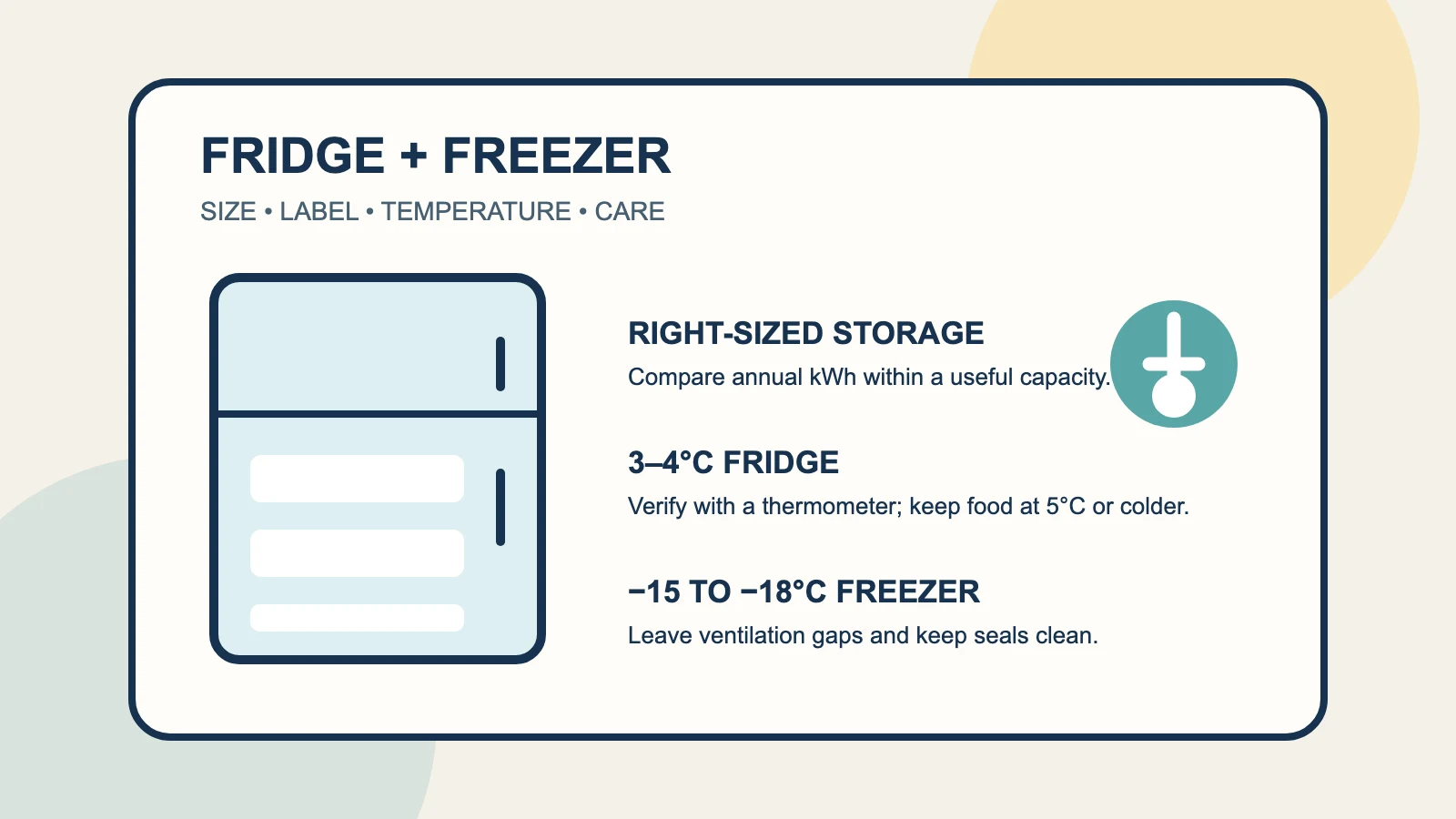
Food Standards Australia New Zealand advises keeping perishable food refrigerated at 5°C or colder. Healthdirect likewise says to refrigerate food at or below 5°C and store frozen food at −15°C or colder. For normal appliance operation, energy.gov.au recommends a fridge setting between 3°C and 4°C and a freezer between −15°C and −18°C. Those ranges work together: the lower fridge setting gives a practical margin below the 5°C food-safety ceiling without making the cabinet unnecessarily cold.
Do not rely only on the control dial, which may show a level rather than the actual food-zone temperature. Place a suitable appliance thermometer in the main compartment, allow time to stabilise, and check more than one location if food is freezing near an outlet or warming in the door. Recheck after a heatwave, a large grocery load, a power interruption or a setting change.
- Store raw meat, poultry and seafood sealed and below ready-to-eat foods so leaks cannot drip onto them.
- Follow package storage and use-by directions; correct fridge temperature does not extend a use-by date.
- Cool and refrigerate food according to current food-safety guidance rather than leaving it in the 5–60°C danger zone.
- Defrost frozen food in the fridge or by another officially recommended method, not unattended at room temperature.
If the cabinet cannot hold safe temperatures, protect food first. Minimise door opening, check the thermometer and follow official advice for affected food. A reset, colder dial or temporary ice pack is not proof that a failing refrigerator is safe.
5. Use it efficiently without compromising safety
Organise frequently used items so the door stays open for less time. Let air move around vents and shelves; do not press food against internal air outlets. Cover or contain food as recommended to limit moisture and cross-contamination. A full but not jammed fridge usually has useful thermal mass, while a tightly packed cabinet can block circulation. In a lightly used freezer, safe containers of frozen water can fill some empty space, but leave the clearances required by the manual and do not obstruct fans.
Check door seals with clean hands. Remove crumbs and residue using the method in the manual, then inspect for tears, distortion or a section that does not contact the cabinet. A worn seal lets warm moist air enter, increases frost and extends compressor operation. Replace it with the correct part rather than forcing the door shut with an improvised latch.
Clean accessible condenser coils or ventilation grilles only as the manual instructs and disconnect power when required. Do not remove covers or touch refrigerant components. Vacuum dust from accessible vents, keep the top clear if it is a ventilation path, and remove freezer frost according to the model instructions. Never chip ice with a sharp tool.
Use fast-cool or fast-freeze modes for the situation described by the manufacturer, then confirm that the appliance exits the mode. These settings can help after a grocery load but may use more energy if left active. Door alarms are useful only when enabled and audible. Smart connectivity can report a door or temperature warning, but it does not replace a thermometer, physical inspection or a response plan during an outage.
6. Decide whether repair or replacement is sensible
A high electricity bill alone does not prove the fridge is faulty. Compare bills across similar periods, inspect the meter data if available and check other large loads. If the fridge appears to run continuously, verify room temperature, door closure, settings, ventilation and dust before assuming compressor failure. Do not attach a cheap plug timer or routinely turn the appliance off to save power; unsafe food temperatures can cost more than the electricity avoided.
Seek qualified service for repeated temperature failure, damaged wiring, water leaks, unusual electrical smells, persistent loud mechanical noise or a hot plug or outlet. Stop using equipment that presents an electrical hazard. Refrigerant work is not a household repair. Ask for diagnosis, repair cost, warranty on the work, part availability and expected remaining life.
For a replacement decision, compare the repair quote with the new model’s total delivered and installed cost, measured energy use or label estimate, warranty and disposal. Age alone is not an automatic reason to discard a reliable unit, and a new appliance is not automatically cheaper over its whole life. The NSW Government page suggests considering replacement when a unit has broken down, needs expensive repair or is over ten years old; treat that as a prompt for assessment, not a mandatory rule.
7. Handle outages and food loss conservatively
During a power outage, keep doors closed and monitor official emergency and food-safety advice. How long food remains safe depends on starting temperature, cabinet type, load, room heat and how often the door opens. Do not publish or rely on one universal number for every outage. Use a thermometer where possible and discard food when official guidance says it may be unsafe; smell and appearance cannot reliably identify every hazard.
If electricity returns but the appliance does not restart, check only safe user-accessible items described in the manual, such as the outlet or circuit breaker. Repeated tripping, a damaged lead, sparks, smoke or a burning smell requires urgent isolation and qualified help. Do not repeatedly reset a protective device to force a faulty appliance to run.
Households that store temperature-sensitive medicines should follow the medicine label, pharmacist or health professional rather than a general food guide. Plan a separate backup arrangement before an outage; a kitchen fridge alarm alone is not a medical cold-chain plan.
8. Recycle the old appliance correctly
Fridges and freezers contain refrigerant and other materials that need controlled handling. Recycling Near You warns that old units must be disposed of correctly so they can be degassed. Do not cut refrigerant lines, strip the compressor or leave an appliance where children can enter it.
Ask the retailer about take-back when arranging delivery, check the local council’s whitegoods service, or use a recycler that accepts refrigerators and manages refrigerant. Fees, pickup areas and accepted conditions vary. If an appliance still works, reuse or refurbishment can extend its life, but disclose known faults and confirm safe transport.
Before removal, empty and clean the appliance, protect shelves and doors for transport, and follow the carrier’s instructions. If doors must be removed for safety, do it without disturbing the sealed refrigeration circuit and only when you can handle the weight safely. Large appliances are awkward; use suitable equipment and help rather than risking an injury.
A practical buying and use checklist
- Record the fresh and frozen storage your household actually uses.
- Measure the cavity, delivery path, door swing and manufacturer ventilation gaps.
- Shortlist comparable capacities and configurations.
- Verify exact model numbers, annual kWh and stars in the official database.
- Estimate running cost with your own usage rate; do not promise a payback.
- Check shelf layout, noise, seals, service access, warranty and water requirements.
- Install to the manual, allow any required standing time and verify temperature with a thermometer.
- Keep the fridge at 5°C or colder, normally targeting 3–4°C; keep the freezer around −15 to −18°C.
- Clean seals and accessible ventilation, respond to alarms and repair faults safely.
- Arrange proper refrigerant-aware recycling when the appliance reaches end of life.
A good refrigerator decision is a measured one: enough usable space, no unnecessary volume, verified label data, correct clearances and safe temperatures. The quiet savings come from choosing a suitable cabinet once, installing it properly and keeping doors, seals and airflow working—not from extreme temperature settings or risky switching.
Official and primary sources
- energy.gov.au: Appliances
- Energy Rating: Fridges and freezers
- Energy Rating: Understand the Energy Rating Label
- Energy Rating Calculator: Fridges and freezers
- Food Standards Australia New Zealand: Food safety basics
- Healthdirect: Food safety
- NSW Climate and Energy Action: Energy-efficient fridges and freezers
- Recycling Near You: Whitegoods