Reviewed: 5 August 2026
The Energy Rating Label is one of the few things on a showroom floor that is designed to be compared. It is a regulated label applied to specific appliance categories sold in Australia, and it exists so that two products of the same type can be assessed against the same measured test. Used carelessly, it becomes a star-counting contest that ignores the part of the label which actually describes how much electricity an appliance is expected to use.
This guide explains how to read the label, what the stars and the kilowatt-hour figure each mean, and how to keep a comparison honest by matching size and features before comparing efficiency. It does not rank brands or recommend a model. To turn a label figure into an estimated cost for your household, see our appliance running-cost guide. If you are also reviewing what you pay for electricity itself, our electricity plan comparison guide covers that separately.
What the label is actually telling you
The Energy Rating Label carries two different pieces of information, and they answer two different questions. The star rating answers a comparative question: how efficient is this model relative to other models of similar size and type. The number in the box below the stars answers an absolute question: how much electricity, in kilowatt-hours per year, the model used under the standard test.
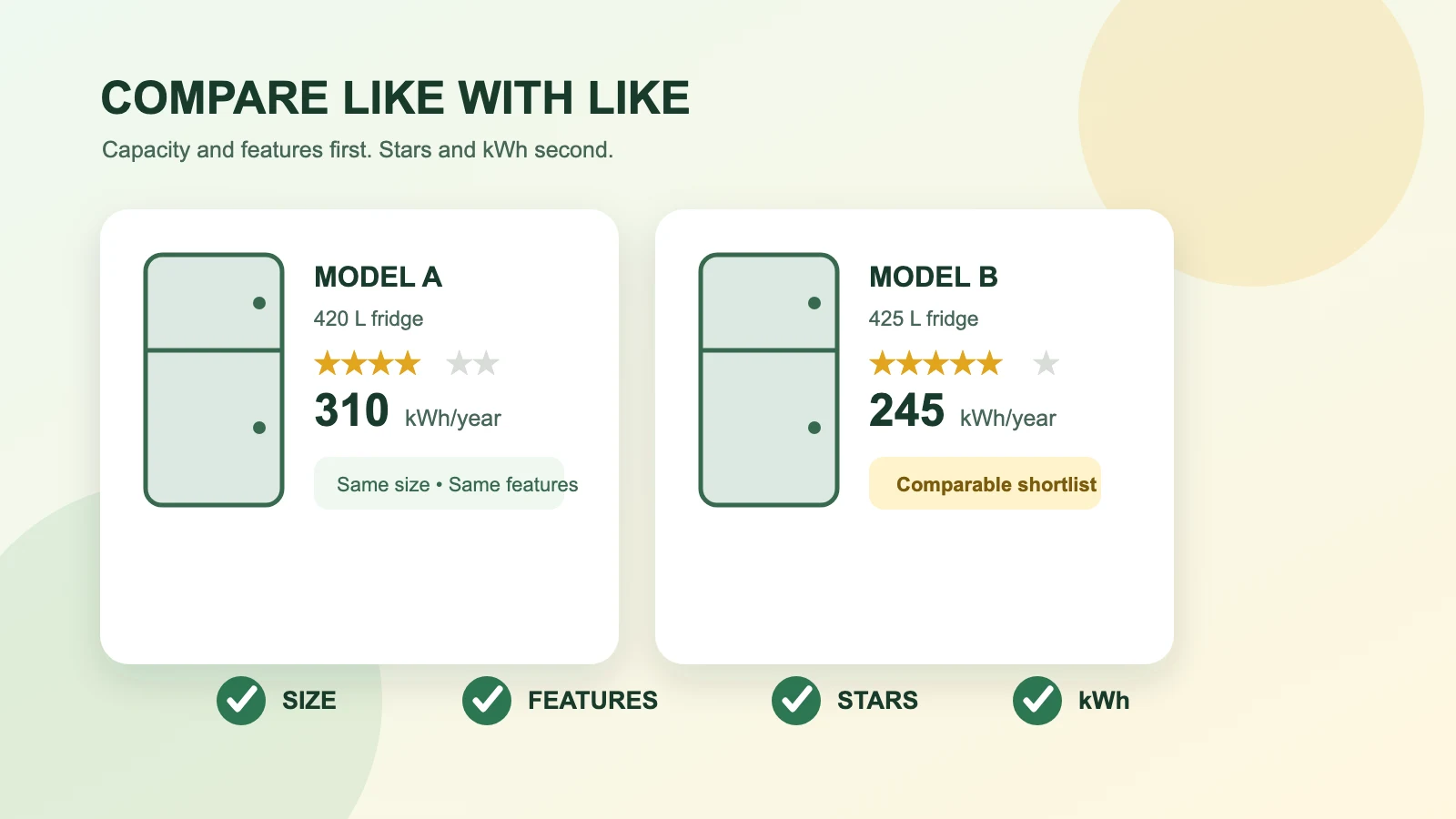
Both matter, but they are not interchangeable. Stars are a relative measure. A large appliance and a small appliance can carry the same star rating while consuming very different amounts of electricity, because each is rated against comparable products rather than against everything on the floor. If you compare only stars across different sizes, you can convince yourself that a bigger machine is the more economical choice simply because its efficiency is good for its class.
The annual energy consumption figure is the one to carry into a cost estimate. It is expressed in kilowatt-hours per year and is the closest thing on the label to a directly comparable running figure. Two models you are genuinely choosing between should be compared on that number first, with the stars used as a quick sanity check that the design is efficient for its class.
Compare like for like: capacity and features first
Efficiency comparison only means something once the products are genuinely comparable. Before you look at a single star, settle the practical questions.
- Capacity. Decide the size the household actually needs, in litres for refrigeration or kilograms for laundry, and compare within that band rather than across it.
- Configuration. A top-mount, bottom-mount, side-by-side or French-door fridge are different products even at the same total volume, and their consumption figures reflect that.
- Features that draw power. Through-the-door ice and water, internal cameras, permanently connected displays and always-on network features all have some effect on how a product behaves in a home.
- Fit and installation. A model that does not fit the cavity, the doorway or the plumbing is not a candidate regardless of its rating.
- The way you will really use it. A machine that suits your actual load sizes and cycle habits beats a nominally more efficient one that you end up running twice as often.
Once the shortlist contains products that could genuinely replace one another, the label comparison becomes meaningful.
Category notes
Refrigerators and freezers
Refrigeration runs continuously, so the annual consumption figure carries real weight over the life of the appliance. Compare within the same capacity band and the same broad configuration. Be wary of moving up a size class on the strength of a good star rating, because the larger cabinet may still use more electricity per year than the smaller model you were originally considering. Where the label shows a figure for a specific climate or test condition, note it rather than assuming it is universal.
Washing machines and dishwashers
These are tested on a defined cycle, not on every cycle the machine offers. The comparative energy figure and, on the separate water label, the water figure both relate to that tested program. If your household normally uses a hotter, longer or heavier program, your real-world consumption can differ from the label. Compare washing machines at the same rated capacity, and compare dishwashers at the same place setting count, then look at whether the tested cycle resembles anything you would actually run.
Televisions
Screen size drives consumption, so comparing a large television with a small one on stars alone tells you almost nothing useful. Choose the screen size first, then compare the annual energy figures within that size. Picture mode, brightness and connected features all affect what a television draws in a real living room, so treat the label figure as a standardised comparison point.
The figures come from a standard test, not from your home
Every number on the label is produced under defined test conditions. That is precisely what makes the label useful: it holds the conditions steady so the products, rather than the circumstances, are what differ. It is also the reason the label cannot promise a result in your house.
Your actual consumption depends on ambient temperature, how full the appliance is, how often the door is opened, which programs you choose, water temperature, how well the appliance is installed and ventilated, and how it is maintained over the years. None of these are captured by a laboratory test. Treat the annual figure as a fair basis for ranking comparable models, and treat any dollar figure you derive from it as an estimate that will move with how you live.
A practical five-step shortlist
- Fix the size and type first. Write down the capacity, configuration and installation constraints before you look at any ratings.
- Collect the annual kilowatt-hour figure for each candidate. Take it from the label or from the government product database, and record it next to the exact model number.
- Use the stars as a class check. Within your chosen size, a higher star rating suggests a more efficient design. Across sizes, it does not.
- Check water where a water label applies. For washing machines and dishwashers, compare the water rating and the litres per cycle alongside the energy figure.
- Confirm the model, then estimate the cost. Verify that the model number matches the one you are buying, then convert the annual kilowatt-hours into an estimated cost using your own electricity rate.
Heating and cooling: the Zoned Energy Rating Label
Air conditioners use a different label. The Zoned Energy Rating Label recognises that a machine which performs well in a mild climate may behave quite differently in a very hot or very cold one, so it presents performance across three climate zones: hot, average and cold.
Two things follow from this. First, read the zone that matches where you live rather than the most flattering figure on the label. A rating that looks strong in the average zone does not tell you how the unit will cope with a run of extreme days in your region. Second, the label shows heating and cooling separately. A reverse-cycle unit can rate differently for each, and the one you care about most depends on whether your household spends more of the year heating or cooling.
Compare units of similar capacity for the space you intend to condition. An undersized unit running constantly at full output is not a good outcome, and neither is an oversized one that cycles inefficiently. Capacity, zone and the heating-versus-cooling distinction all come before the star count.
Water use: the WELS label
Washing machines and dishwashers carry a separate water rating under the Water Efficiency Labelling and Standards scheme. The WELS label has its own star rating for water efficiency and a water-consumption figure in litres per wash. It also identifies capacity and, for these products, the model and cycle used for testing.
Like the energy figure, the water figure comes from the tested cycle rather than from every program on the dial. More WELS stars indicate greater water efficiency, but the litres-per-wash figure and tested cycle provide the detail needed for a like-for-like comparison. Check whether that cycle is one the household is likely to use.
Read the energy and water labels together without combining their stars: one measures energy efficiency and the other water efficiency. The WELS product register can also be used to confirm the exact model and its registered water-rating details.
Labels in store versus listings online
In a physical store, appliances in the regulated categories are required to display the Energy Rating Label, so you can read the stars and the annual figure directly from the product in front of you. Online, what you see is whatever the retailer has chosen to publish. Some listings reproduce the label accurately, some show an image of a label for a related model, some quote a star rating without the kilowatt-hour figure, and some carry nothing at all.
Treat a retailer listing as a starting point, not as the record. Where a listing shows only stars, find the annual energy figure before comparing. Where a listing shows a label image, check that the model number on the image matches the model number of the item you are about to buy.
The government’s energy rating calculator and product database let you look up registered models directly and compare them side by side. That is the more reliable route when the retail information is thin, inconsistent or out of date.
Verify the exact model number
Manufacturers frequently sell close variants of the same appliance: a different colour, a different door configuration, a retailer-specific version, or a revision released in a later year. These variants can carry different registered figures despite looking almost identical on a shelf.
Before you buy, match the full model number, including any suffix, against the label or the database entry you used for your comparison. If the number on the box does not match the number you compared, you have not yet checked the appliance you are actually buying.
Final takeaway
Choose the size and type your household needs, then compare the annual kilowatt-hour figures of products that could genuinely substitute for one another, using the stars as a check on how efficient each design is for its class. Read the zoned label by your own climate zone and by the function you use most. Read the water label alongside the energy label for laundry and dishwashing. Verify the exact model, and remember that every figure comes from a standard test rather than from your home.
Disclosure: Ezion Guide has no affiliate relationship with the government programs, schemes or regulators listed in this article. This is general information. It does not provide financial advice, rank brands or products, promise savings, or guarantee that a particular appliance will perform or cost a particular amount in your household. Ratings, registered figures, product availability and program details can change. Verify current details on the label and through the official sources below before making a decision.